 Manufacturer · Fashion & Home Accessories











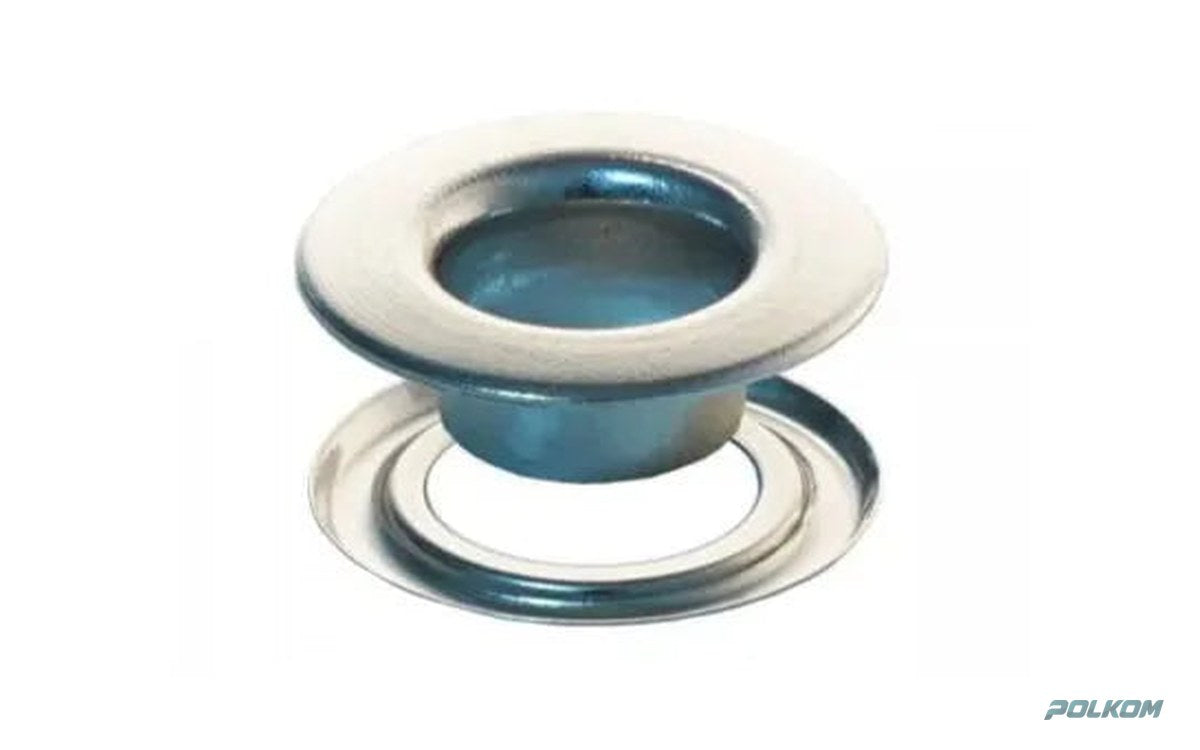
Eyelets for leather are chosen according to the thickness of the leather, the purpose of the hole and the style of the product. Belts and bags use metal eyelets with a washer and a taller shank that takes in the full thickness of the leather, while thin fashion leather calls for lower eyelets with a narrow flange. Brass eyelets are the most reliable, because they do not rust and do not leave marks on the leather.
Where eyelets for leather are used
Leather is a strong material, but holes in it stretch and wear with constant friction. Eyelets for leather are set in:
- belts – for the holes that take the buckle prong, or as a decorative row;
- bags and backpacks – for cords, handles and straps;
- shoes and boots – for the laces;
- watch straps, dog collars and pet accessories;
- leather jackets and waistcoats – as a decorative detail or for cords.
How to choose an eyelet for leather
Leather thickness and shank height
This is the most important parameter. Belt leather is often 3–4 mm, bag leather is thinner, and on lined products the total thickness increases. Measure the whole stack – leather, bonding and lining – and choose an eyelet with a slightly longer shank. If the shank is too short, the eyelet does not grip and falls out. If it is too long, the roll-over is uneven and can cut the leather.
Inner diameter
This is determined by what passes through the hole. For a belt buckle prong, the hole should be slightly wider than the prong. For cords and laces, measure with the aglet.
Flange and washer
Eyelets with a wide flange spread the load and suit handles and heavy bags. A washer on the reverse prevents the leather from tearing and makes the hole more stable. With leather, eyelets with a washer are almost always the better choice.
Eyelet materials for leather
| Material | Advantages | Suitable for |
|---|---|---|
| Brass | does not rust, takes finishes well, does not stain leather | belts, bags, high-end products |
| Coated steel | strength, lower cost | work products, shoes |
| Aluminium | lightness, easy to colour | light fashion products |
Be careful with steel eyelets on vegetable-tanned leather – once the finish wears, the metal can react with the tannins and leave dark stains around the hole.
Saddlery eyelets and decorative eyelets
In saddlery and in handmade belts and harnesses, sturdy eyelets with a tall shank and a wide flange are used, sometimes in vintage finishes such as antique brass or bronze. In fashion, eyelets for leather are often decorative – oval, square or embossed. It is important that their finish matches the product's metal accessories – the metal buckles, rings and rivets.
How to set eyelets in leather
- Marking. Mark the centres of the holes with an awl or marker using a template. On belts the spacing between holes is usually the same along the whole length.
- Punching. Use a round punch with a diameter equal to the outer diameter of the shank. Punch on a hard base with one firm blow so that the edge is clean.
- Inserting. Insert the eyelet from the face side and the washer from the reverse.
- Rolling over. Use a tool or press with a die that matches the size. The blow or pressure must be even so the eyelet does not distort.
- Checking. The eyelet must not turn, and the edge on the reverse must be smooth.
Common problems with eyelets in leather
- The eyelet falls out. The hole is too large or the shank is too short.
- The leather splits around the hole. The eyelet is too close to the edge or there is no washer.
- The eyelet is crushed. The hole is too small or the pressure is too high.
- Stains on the leather. The finish is worn or not resistant enough.
The distance from the edge of the leather should be at least equal to the flange diameter, so that there is enough material around the hole.
Eyelets for belts
On belts, eyelets in the prong holes are more a matter of style. They make the holes uniform and protect the leather on thin, soft belts, but with thick tanned leather they are often unnecessary. On textile belts, however, eyelets are essential, because without them the fabric frays. Choose the eyelet together with the buckle so that colour and finish match.
Eyelets for leather bags and backpacks
On bags, eyelets work under different loads. Eyelets for the drawcord of a pouch or backpack face constant friction and must have a smooth inner edge so they do not wear the cord. Eyelets that take handles or straps carry the weight of the contents – choose a larger diameter, a wide flange and a washer for them, and reinforce the leather around the hole with an extra layer or interfacing. Decorative eyelets on the flap or sides of the bag can be smaller, but their finish must match the zip, rings and buckles. If the bag is made of soft lambskin, add a fusible interfacing under each hole, otherwise the leather will wrinkle around the eyelet as soon as it is set.
Eyelets for leather from Polkom
Polkom is a Bulgarian manufacturer of accessories for fashion, furniture, footwear, bags and leather goods, based in Sofia, with over 30 years of experience. We offer eyelets in various sizes and finishes, custom logo eyelets and matching metal accessories from the shoes and leather category. Send us the leather thickness and the type of product via our contact page to receive samples and a quote.




