 Manufacturer · Fashion Accessories

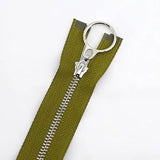


Button, Zip and Ribbon Sizes and Order Quantities
A reference guide from the manufacturer to button sizes in ligne and millimetres, zip gauges, elastic and ribbon widths, and how order quantities are set.
When you order garment accessories, the exact size is just as important as the colour and material. On this page we have collected the units of measure most used in the industry: button sizes in ligne and millimetres, zip gauges, elastic and ribbon widths, and general guidance on packaging and quantities. Use it as a reference when preparing an enquiry to Polkom as your manufacturer and wholesale supplier.
Button sizes in ligne (L) and millimetres
In the garment industry, button diameter is traditionally measured in ligne (abbreviated L). One ligne equals 0.635 mm, so 40 ligne correspond to one inch (25.4 mm). To convert a size to millimetres, multiply the number of ligne by 0.635. The widest diameter of the button is measured.
| Size (ligne) | Diameter (mm) | Typical use |
|---|---|---|
| 14L | 8.9 | shirts, blouses, lingerie |
| 16L | 10.2 | shirts, blouses, childrenswear |
| 18L | 11.4 | shirts, dresses, cuffs |
| 20L | 12.7 | dresses, cardigans, knitwear |
| 24L | 15.2 | blazers, trousers, waistcoats |
| 28L | 17.8 | blazers, jackets, skirts |
| 32L | 20.3 | jackets, trench coats |
| 36L | 22.9 | coats, jackets |
| 40L | 25.4 | coats, outerwear |
| 44L | 27.9 | coats, decorative accents |
The uses listed are indicative – the final choice depends on the fabric thickness, the buttonhole size and the design. Browse models in different sizes in the buttons category.
How to choose the right size
- If you have a sample, measure its diameter with a calliper and compare it with the table.
- The buttonhole length is usually about the button diameter plus its thickness.
- Cuffs and collars use smaller sizes than the front placket.
- For shank buttons, also consider the shank height relative to the fabric thickness.
Zip sizes: gauges and lengths
The zip gauge (number) indicates the approximate width of the teeth when closed, in millimetres. The higher the number, the stronger and heavier the zip. The gauge applies to metal, nylon coil and moulded plastic zips, including original YKK zips.
| Gauge | Characteristics | Typical use |
|---|---|---|
| No. 3 | light and fine | dresses, skirts, trousers, pockets, invisible zips |
| No. 5 | all-round | jeans, jackets, sweatshirts, bags |
| No. 8 | strong | outerwear, coats, backpacks, luggage |
| No. 10 | heavy-duty | winter jackets, workwear, holdalls, tents |
Zip length is given in centimetres and measured from the top stop to the bottom stop, excluding the tape beyond them. Closed-end (non-separating) zips are used for trousers, skirts and pockets, and open-end (separating) zips for jackets and cardigans. See all types in the zips category.
Elastic and ribbon widths
Elastics and ribbons are specified by width in millimetres. The most commonly used values are:
- elastics 5–10 mm – for lingerie, sleeve cuffs and childrenswear;
- elastics 15–25 mm – for skirt waistbands, bottoms and sportswear;
- elastics 30–50 mm and above – for trouser waistbands, wide-band lingerie and technical applications;
- satin and grosgrain ribbons 3–10 mm – for decorative details and hanger loops;
- ribbons 15–25 mm – for trims, edge facings and bias binding;
- ribbons 38–50 mm – for decorative belts, handles and packaging.
You will find the full range of elastics, ribbons and cords in the haberdashery category.
Packaging and units of measure
Different groups of articles are counted and packed differently:
- buttons and metal trims are counted by the piece, often by the gross (144 pcs) or by the thousand;
- zips are supplied in finished lengths or as continuous chain by the metre with separate sliders;
- elastics, ribbons and cords are wound on rolls whose length depends on the article;
- threads come on spools and cones of various lengths;
- labels are supplied on rolls or cut, depending on the type and how they are attached.
Minimum order quantities
Minimum quantities are available on enquiry and depend on the article – for stock models they differ from those for custom production, dyeing to a sample or logo work. Send us an enquiry with the model, size, colour and quantity you need, and we will reply with a specific quote. If you are not sure which size you need, see our services – we will be happy to advise you.
Frequently asked questions
How many millimetres is a 24L button?
What zip gauge should I choose for jeans?
Can I order zips in a non-standard length?
What are the minimum quantities?
Looking for a specific model, colour or size?
Send us an inquiry with a description or photo – you will receive an offer, samples and a production lead time.