Manufacturer · Fashion Accessories

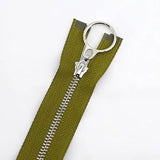


There are four main ways to attach a zip puller to a slider: with a metal ring, with a built-in hook, with a cord loop, or directly as a detachable pull that replaces the factory one. The choice depends on whether the slider has a movable lug or a fixed pull, on the size of the lug and on the weight of the puller. The right attachment is a precondition for the puller not getting lost and not interfering with locking.
How the top of a slider is built
On the body of the slider there is a small bridge – a lug. On most sliders for clothing the factory pull is hooked into this lug. It is important to know which of the two main types you have:
- Slider with a movable (detachable) pull – the lug is open or the pull is attached in a way that allows it to be removed. This makes it possible to fit your own puller.
- Slider with a fixed pull – the pull is an integral part of the slider. A puller can only be attached to it as an extension.
On auto-lock sliders the pull is part of the mechanism: when it is lowered, a pin locks the slider. So the puller must not prevent the pull from dropping freely.
Attaching a zip puller to the slider: the four methods
1. Metal ring
A round or oval ring connects the hole in the puller with the lug of the slider. A universal solution for metal and rubber pullers. The diameter and wire thickness matter: the ring must pass through the lug and the hole in the puller but be thick enough not to open. A split ring is more secure than an open ring, but slower to fit. Suitable rings are selected in the same finish as the puller.
2. Built-in hook
The metal puller has an open hook at its top end, which is passed through the lug and closed with pliers or a press. It looks clean, with no extra component, and is the standard for branded metal pullers. Drawback: if it is not closed properly, the hook can open under load.
3. Cord loop
A cord or tape is passed through the lug and tightened with a lark's head knot – the loop wraps around the lug. It is used for cord pullers and rubber ends. It needs no tools and allows easy replacement.
4. Puller as a detachable pull
On some sliders the factory pull can be removed and replaced by a branded puller that itself acts as the pull. This solution looks the cleanest, but it requires the shape of the puller's eye to match the slider design exactly. It is suitable for series production in which the pullers are fitted before or together with the sliders.
Compatibility with zip types
| Zip type | Slider features | Recommended attachment |
|---|---|---|
| Nylon coil | Light slider, often a small lug | Cord loop, thin ring, light puller |
| Moulded (plastic) | Larger slider, sturdy lug | Ring, hook, loop |
| Metal | Strong metal slider | Ring or hook in the same finish |
| Invisible | Small teardrop pull, rarely detachable | Pullers are usually not fitted |
The zip size (No. 3, 5, 8, 10) also determines the size of the slider and its lug. A puller designed for a No. 8 slider may not pass through the lug of a No. 3. So when designing a logo puller, always state the type and size of the zip.
What to check on a sample
- Passing through the lug – the ring or hook goes in without effort and without scratching the finish.
- Free drop – the puller drops down under its own weight and does not sit at an angle.
- Locking – with an auto-lock slider the zip locks when the puller is lowered.
- Strength – repeated hard pulling without the ring or hook opening.
- Noise and friction – the puller does not knock noisily against the slider or scratch the fabric.
- Washing – after several washes the attachment is intact.
Fitting in series production
For large runs the attachment must be quick and repeatable. Practice shows:
- A built-in hook closed with a hand press gives the most consistent result.
- Cord loops are quick to fit but must be tightened evenly.
- Open rings need care – each one must be closed fully.
- If the pullers are delivered already attached to the sliders, fitting in the workshop is saved altogether.
Attachment on leather, denim and outdoor products
On leather jackets and bags the metal puller is often attached with a hook, because it looks the cleanest and adds no extra colour. On denim and workwear thicker rings are preferred that withstand rough use and industrial washing. On outdoor gear a cord loop is almost always used – it does not freeze, does not rattle and the user can replace it in the field if the puller breaks.
Common problems and solutions
- The puller gets lost – the ring is too thin or not closed. Solution: a thicker ring or a split ring.
- The zip does not lock – the puller is heavy or rests against the slider body. Solution: a longer ring or a lighter puller.
- The puller hangs crooked – the puller's eye is too narrow for the ring.
- Scratches on the slider – the metal of the ring is harder than the finish. Solution: careful fitting and matching finishes.
You will find standard models with different attachment methods in the zip pullers category.
Zip pullers and attachment from Polkom
Polkom offers zip pullers, rings, zips and sliders that can be selected as a compatible set. When you order logo pullers, we match the attachment method to your slider and prepare a sample. Send a photo of the slider or the zip type via our contact page.