Manufacturer · Fashion Accessories



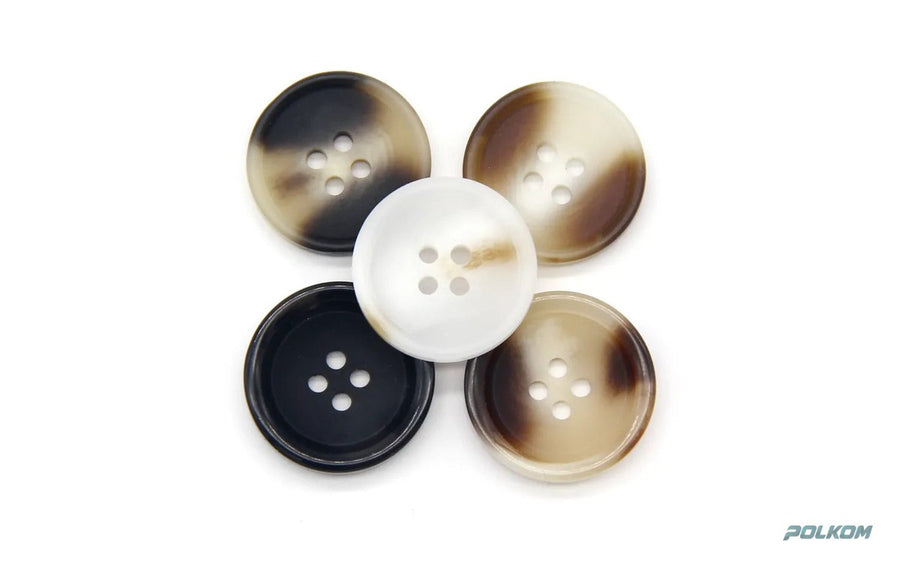
Custom urea buttons are made in a colour matched to a swatch of your fabric or to a Pantone reference, and they can carry a logo – laser-engraved or pressed in relief. Because urea is coloured throughout its mass, the colour is even through the whole button and does not rub off with washing, ironing or dry cleaning. The process involves colour matching, trial buttons and approval before the series batch.
Why urea is suitable for colour-matched orders
With urea, the pigment is mixed into the powder compound before pressing. The result is a button coloured throughout its volume, not just on the surface. This brings several advantages:
- a scratch does not reveal a different colour underneath;
- the colour does not fade from friction during wear;
- there is no coating that could peel off during dry cleaning;
- the matt or satin look is the same from all sides.
By comparison, with many fashion buttons the colour comes from dyeing or a lacquer coating, which wears off at the edges over time.
Custom urea buttons – how the colour is matched
Fabric swatch
The most accurate method. Send a piece of the actual fabric at least the size of a palm, preferably from the same batch that will be sewn. Fabric colour varies between batches and under different lighting, so the swatch must be representative.
Pantone reference
Convenient when the fabric is not yet available or when the colour is a corporate one. State the code and the system (for example Pantone TCX for textiles). Bear in mind that a hard, dense material such as urea looks slightly different from fabric in the same code – which is why a trial button is essential.
Sample button
If you have a button you want to reproduce in colour and shape, send it physically. A photo is not enough – screens display colours differently.
Metamerism: why the colour "changes" under different light
The button and the fabric can look identical in daylight and different under a fluorescent lamp in the shop. This phenomenon is called metamerism and is caused by different pigments and materials. To reduce it:
- compare the trial buttons with the fabric under several types of lighting;
- state in your inquiry under which light the colour will be assessed;
- for dark colours (navy, black, burgundy), choose a shade that is slightly darker rather than lighter than the fabric.
Logo on urea buttons
| Method | What it looks like | When it is suitable |
|---|---|---|
| Laser engraving | Recessed logo with a slight tone-on-tone contrast | Small and medium series, complex logos, lettering |
| Relief from a mould | Raised or recessed logo pressed with the button | Large and recurring series |
| Engraving with colour fill | Logo in a contrasting colour in the recess | When the logo must be visible from a distance |
More examples of personalised designs can be found in the engraved buttons category.
How to prepare the logo
- send a vector file (AI, EPS, PDF or SVG);
- simplify the logo – thin lines under about half a millimetre and small text get lost;
- think about the position – centred or around the edge, between the holes, or across the whole surface on a shank button;
- state the size of all the buttons that will carry the logo – the mark scales differently at 18L and at 32L.
Order stages
- Inquiry – model or sketch, size in ligne, number of holes, colour, logo, finish, quantity and the garment's use.
- Quote – once the details have been clarified.
- Trial buttons – we make samples in the colour and with the logo for approval.
- Approval – you check the samples against the fabric; if necessary we make a correction.
- Series production and delivery – according to the approved sample.
Minimum quantities depend on the article – send an inquiry. The price is determined by size, model, complexity of the colour, logo method and quantity.
One colour, several sizes
A garment usually uses buttons in two or three sizes – for example 18L for cuffs and 28L for the front of a jacket. Order all sizes in one colour at the same time and approve them together. The reason is practical: a larger button is thicker and lets less light through, so with the same recipe it can look slightly darker than the small one. When you see the samples side by side on the fabric, you can judge whether a fine correction is needed.
Corporate colours
For uniforms and corporate clothing, the button colour often has to match the logo rather than the fabric. State clearly which is the reference – the fabric or the corporate palette – so there is no ambiguity at approval.
Finishes for urea buttons
- Matt – the most typical, classic look;
- satin – a soft sheen, more elegant for jackets and shirts;
- polished rim with a matt centre – emphasises the shape;
- marble, stone and horn effects – for coats and classic menswear.
For classic men's collections, also see our selection of men's buttons, and the full range of materials in the urea buttons category.
Common mistakes when ordering in colour
- approving a colour from a photo instead of a physical sample;
- a fabric swatch from a different batch;
- a logo that is too complex for a small diameter;
- ordering different sizes at different times, which leads to a difference in shade;
- no reference sample kept for future top-up orders.
Custom urea buttons from Polkom
Polkom is a Bulgarian manufacturer and wholesaler of garment accessories based in Sofia, with over 30 years of experience. We make urea buttons colour-matched to your sample and with logo, produce trial buttons quickly and deliver across the EU. Send a fabric swatch and your logo via our contact page.