Manufacturer · Fashion Accessories



Designer buttons are the detail by which an experienced eye recognises a carefully made garment. When the cut and fabric are flawless, the button completes the look – or spoils it. For boutique brands, ateliers and niche collections, choosing a button is a design decision, not a technical detail. In this article we look at what distinguishes a designer button from a standard one, which materials and finishes are used, how a logo is incorporated and how to plan an order for a small run.
What we call designer buttons
The term has no strict technical definition, but in practice designer buttons are models created specifically for a particular collection or brand. They are usually distinguished by three things:
- An original shape or profile – a non-standard silhouette, relief, recesses, asymmetry.
- Selected materials – metal with a quality finish, natural materials, combinations of several materials.
- A brand element – an engraved logo, monogram, symbol or enamelled appliqué.
Such buttons are produced in limited quantities and are often associated with just one line or season. This gives them exclusivity and turns each button into a small signature of the brand.
Materials for designer buttons
The material determines the weight, the feel, the way it ages and the price of the final product. The most commonly used options are:
Metal
Metal models allow the greatest freedom of shape and detail: relief, engraving, cut-out outlines, combination with enamel. Finishes range from classic gold and nickel to gunmetal, black nickel and aged effects. See the main range in our metal buttons category.
Natural materials
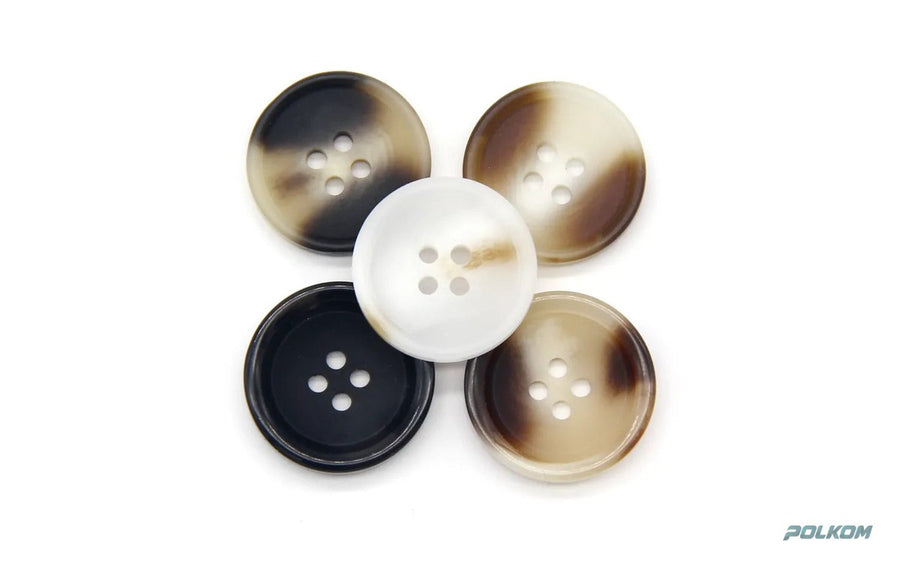
Corozo (vegetable ivory), horn and mother-of-pearl give a warm, "living" look in which every button is slightly different. They suit classic suits, coats and shirts where the brand wants to emphasise a natural and sustainable character. You will find more about them in corozo buttons and horn buttons.
Combined solutions
A metal rim with an insert of natural material, a pearl or crystal accent on a metal base, an enamelled centre – combinations widen the possibilities and let the brand create something truly its own.
Finishing techniques and platings
The surface of a button is as important as its shape. The most commonly used techniques include:
- polishing to a high gloss or satin-finishing to matt;
- electroplated finishes – gold, light gold, nickel, black nickel, gunmetal, rose gold;
- patination and antiquing for a vintage effect;
- coloured enamel to fill a logo, letters or ornaments;
- laser or mechanical engraving;
- relief and three-dimensional elements.
The right finish should match the rest of the garment's hardware – zips, eyelets, buckles and metal logo plates. When all the metal details are in one tone, the product looks complete and well thought out.
Where designer buttons are used
Their presence is strongest on garments where the button is visible and carries visual weight:
- women's and men's coats;
- jackets, blazers and suits;
- dresses and designer shirts;
- high-end knitwear and cardigans;
- bags, belts and accessories.
On shirts and blouses the accent is usually more delicate – a fine relief or monogram. On coats and jackets the button can be the leading decorative element, so larger sizes and more expressive shapes are chosen there.
Personalisation with a logo and your own design
The greatest value of a designer button is that it can carry the brand's identity. Polkom manufactures custom buttons to the client's design and logo. The options include:
- engraving a logo or monogram on the face or the rim;
- a relief logo, raised or recessed;
- coloured enamel in one or several colours;
- a completely new shape from a technical drawing or sketch;
- colour matching to the fabric or a Pantone reference.
For the best result it helps to prepare the logo in vector format and state the desired size in lignes (L) or millimetres. As a guide: 1 ligne is 0.635 mm, so a 24L button is about 15 mm and a 32L about 20 mm.
How to choose the right size
The size depends on the type of garment and the button's role in the design. Approximate values used in the industry:
- shirts and blouses – 14L–20L (about 9–13 mm);
- jackets and cardigans – 24L–32L (about 15–20 mm);
- coats and outerwear – 36L–54L (about 23–34 mm);
- decorative accents – according to the designer's concept.
With designer models the rule is often deliberately broken – a large button on a clean-lined dress can be the main accent of the silhouette. It is only important that the size suits the buttonhole and the weight of the fabric.
Small runs and exclusivity
Boutique brands rarely need huge quantities. Usually the goal is a short, limited run that will not be found in mass-market shops. Minimum quantities depend on the article, the material and the production technique – send an inquiry and you will receive specific information for your model.
The advantage of working with a manufacturer is that the model remains yours. For a repeat order the buttons are made to the same specification, so the next season or an additional batch looks identical.
How ordering designer buttons works
- Inquiry – you send a sketch, logo, desired sizes, material and finish.
- Consultation – we discuss technically feasible solutions and propose options.
- Sample – we make a fast sample so you can see the shape and finish in person.
- Production – after approval we launch the series.
- Delivery – Polkom delivers across Europe, including to ateliers and production facilities in the EU.
If needed, we also offer a service for attaching buttons and accessories, so the product reaches you finished.
Why work with Polkom
Polkom is a Bulgarian company based in Sofia with over 30 years of experience in the manufacture and wholesale of garment accessories. The range numbers more than 10,000 articles, and large stock allows you to combine designer buttons with standard models and matching hardware. We make samples fast, engrave logos and advise on choosing material and size.
If you are preparing a new collection and are looking for a button to set it apart, get in touch – write to info@polkom.com or call +359 876 76 60 50 (also WhatsApp and Viber).