Manufacturer · Fashion Accessories



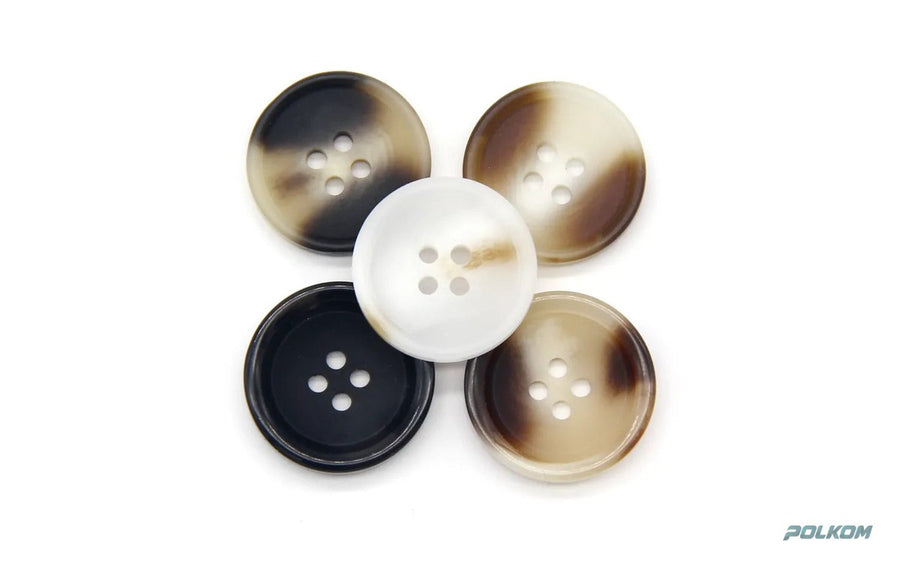
Laser engraving buttons is a method in which a focused laser beam vaporises or scorches a thin layer of the surface and leaves a permanent logo, lettering or ornament. It requires no mould, allows fine detail and quick design changes, which is why it is the most flexible way to brand buttons made of polyester, corozo, wood, bone and other materials.
Laser engraving buttons: how it works
The vector file with the logo is loaded into the machine software, where the size, position and parameters are set – power, speed and number of passes. The buttons are arranged in a jig that holds them still and centred. The laser follows the outline and fills the areas of the logo line by line.
The result depends on the material:
- on natural materials (wood, corozo, coconut) it produces darkening – a warm, slightly smoky tone;
- on polyester the top layer is removed, revealing a lighter or matt sublayer;
- on coated metal the laser removes the coating and shows the base metal;
- on bone and horn the outline is light brown to dark, depending on the settings.
Materials suitable for laser engraving
| Material | Look of the engraving | Notes |
|---|---|---|
| Corozo | dark brown, clear | very good contrast, especially with light tones |
| Wood | smoky, warm | depends on density and grain direction |
| Coconut shell | dark on a dark background | works better with larger, simple logos |
| Polyester | light or matt | suitable for filling with paint |
| Bone | brown, classic | often with coloured grooves |
| Coated metal | contrast between coating and base | for a raised logo, embossing is more suitable |
If you are looking for a natural look, corozo buttons and wooden buttons give the most expressive engraving without additional colouring.
How fine the detail can be
The laser itself is very precise, but the limitation comes from the size of the button and the material. Practical guidelines:
- lines thinner than about 0.2–0.3 mm can "merge" on porous materials such as wood and coconut;
- text below 1.5–2 mm in height is hard to read with the naked eye;
- on shirt buttons (16L–18L, about 10–11.5 mm) it is better to use a mark or monogram instead of the full name;
- on coats and jackets (28L–40L) there is room for a logo with lettering.
Advantages and limitations
Advantages
- no mould cost – suitable for smaller runs too;
- the design changes easily between two collections;
- it can also be engraved on existing models from stock;
- the engraving is part of the material and does not wash off.
Limitations
- the engraving is recessed, without relief – for a raised logo, embossing is chosen;
- on dark materials the contrast is weaker and colouring is sometimes needed;
- curved and strongly convex surfaces limit the engraving area.
How to prepare the logo for laser engraving
- Send a vector file with clear outlines and no gradients.
- Convert fonts to curves so that they are not substituted.
- State the desired size of the logo in millimetres or as a percentage of the diameter.
- Specify whether the logo is centred or has a particular orientation relative to the holes.
- If the logo has many details, also prepare a simplified version for small buttons.
Orientation relative to the holes and shank
A four-hole button has no "top" and "bottom", but the logo does. If the lettering must sit horizontally when the garment is buttoned, the sewer must sew every button in the same position – this requires care with hand sewing and adjustment with machine sewing. That is why round or symmetrical marks that look the same from every angle are often chosen for buttons with holes. With shank buttons orientation is easier to fix, because the shank sets the direction. When the logo is placed around the holes, check on the sample that the thread does not cover part of it.
Engraving on garments already sewn
Brands sometimes ask whether they can engrave buttons that are already sewn on. Technically it is possible with some models, but the risk of damaging the fabric and inaccurate positioning is high. It is much safer to engrave the buttons before sewing and to check the batch in advance.
Quality control
In series engraving, buttons from each batch are checked at random: the depth and evenness of the engraving, centring, no burning at the edges and clean grooves. With natural materials, small differences in tone are normal and part of their character – what matters more is that the logo is equally legible on every piece.
It is also a good idea for the brand to set its own acceptance criterion: for example a permitted deviation in logo position or in the tone of the fill. This way both the supplier and your quality department assess the batch by the same rules, and disputed cases are resolved quickly.
Durability in washing and wear
As the laser changes the material itself rather than applying a layer on top, the engraving does not peel. On polyester and corozo it withstands machine washing without problems. If the grooves are filled with paint, the quality of the fill determines how long the colour stays saturated – so this option is always checked on a sample.
Laser engraving from Polkom
Polkom is a Sofia-based manufacturer of garment accessories with over 30 years of experience. We engrave logos on custom buttons in various materials, make fast samples and deliver throughout the EU. Send your logo and the model you like via the inquiry form – we will suggest a suitable material and a sample for approval.