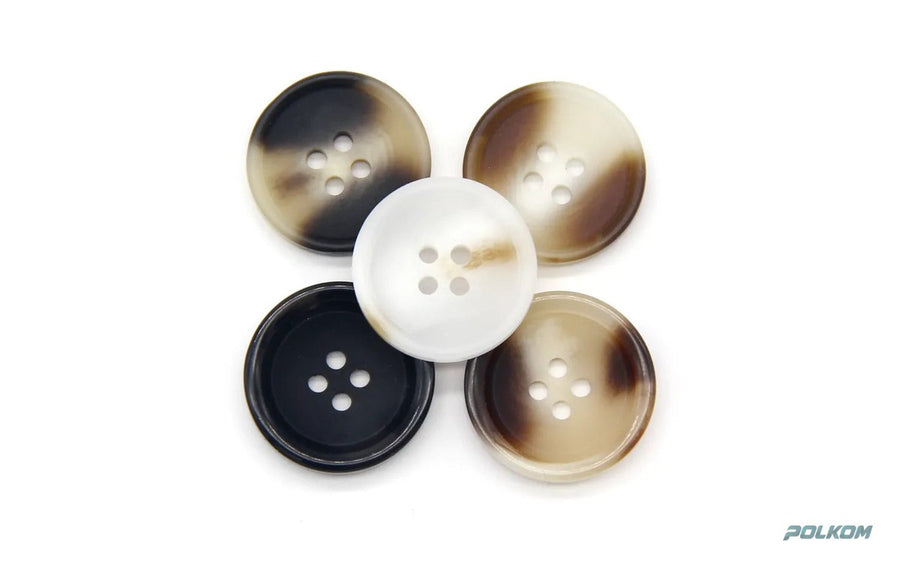
Manufacturer · Fashion Accessories



Bone button sizes are given in ligne (L), where 1L = 0.635 mm. The most common are 16L–20L (about 10–13 mm) for shirts and cuffs, 24L (about 15 mm) for jacket sleeves and waistcoats, 30L–32L (about 19–20 mm) for jacket fronts and 32L–40L (about 20–25 mm) for coats. The choice depends on the garment, the fabric and the proportions of the style.
How a button is measured
The size of a button is its diameter, measured at the widest point. The thickness and the height of the shank are not part of the size, but they matter when making the buttonhole. Use a calliper for measuring – a ruler gives too large an error with small sizes. If you measure in millimetres and want to convert to ligne, divide by 0.635: a button with a diameter of 20 mm is approximately 31.5L, i.e. between 30L and 32L.
Chart: bone button sizes
| Ligne (L) | Diameter, mm | Typical use |
|---|---|---|
| 14L | 8.9 | button-down collar buttons, babywear |
| 16L | 10.2 | shirt collar and cuffs |
| 18L | 11.4 | shirt fronts, blouses |
| 20L | 12.7 | heavier shirts, work shirts, trousers |
| 22L | 14.0 | dresses, children's knitwear, suit waistcoats |
| 24L | 15.2 | jacket sleeves, waistcoats, pocket flaps |
| 26L | 16.5 | suit waistcoats, cardigans |
| 28L | 17.8 | women's jackets, knitted cardigans |
| 30L | 19.0 | front of a men's jacket |
| 32L | 20.3 | jackets, light coats, trench coats |
| 36L | 22.9 | coats, outer jackets |
| 40L | 25.4 | men's coats, voluminous styles |
| 44L–48L | 27.9–30.5 | oversized coats, decorative accents |
The values are rounded to a tenth of a millimetre. With natural bone the real diameter can deviate minimally because of the hand finishing.
Bone button sizes by garment type
Shirts
A shirt uses two sizes: a smaller one for the collar and cuffs and a slightly larger one for the front. The classic combination is 16L + 18L. Work shirts, denim shirts and heavier cotton use 18L + 20L.
Jackets and suits
The standard for a men's jacket is 30L–32L on the front and 24L on the sleeves. The suit waistcoat usually has 24L–26L. With women's jackets the choice is freer – from 24L to 36L depending on the design.
Coats
Women's coats most often have 28L–36L and men's 32L–40L. Sleeve buttons are 24L–28L, and the backing buttons on the inside 16L–20L.
Knitwear
A knitted buttonhole is elastic and stretches, so the buttons are larger than on woven garments with the same purpose: 24L–32L for adults and 18L–22L for children.
Trousers, dungarees and workwear
The inner waistband buttons of trousers and brace buttons are usually 20L–24L. On dungarees and retro-style workwear, larger and thicker bone buttons of 24L–28L are used, which are easy to grip and withstand load.
Size and the proportions of the garment
Charts give a standard, but the final decision is visual. The button should be in proportion to the width of the lapel, the placket and the silhouette. With narrow lapels and fitted cuts a smaller button looks more elegant; with wide lapels and voluminous coats a standard button can get lost. Good practice is to place two samples in neighbouring sizes on the finished prototype and look at them from a distance of two or three metres. A difference of two lignes, which looks insignificant in the chart, is clearly visible on the garment. Do not forget the spacing between buttons either – a larger button usually needs a slightly larger interval.
Thickness and profile
Two buttons with the same diameter can require a different buttonhole if one is flat and the other convex. Bone buttons are made in different profiles:
- flat – thin, for shirts and light garments;
- rimmed – medium thickness, classic for jackets;
- convex – thicker, for coats;
- shank – the overall height includes the loop that sits beneath the fabric.
Buttonhole relative to size
The practical rule is: buttonhole length = diameter + button thickness + a small allowance. The allowance is about 1–2 mm for thin fabrics and more for thick ones. Bone is not elastic, so with a buttonhole that is too tight the button tears its ends. Make a test buttonhole on the real fabric with the real sample before programming the machine.
Size sets
When ordering for one garment, two or three sizes are usually combined. An example set for a double-breasted coat:
- 6 buttons 36L for the front;
- 1 inner button 24L;
- 8 buttons 24L for the sleeves (4 per sleeve);
- 18L backing buttons for the functional buttons;
- spare buttons of each size.
Each size is a separate line in the order, but it is best that they all come from one batch so that the tone of the natural bone is the same.
Common mistakes
- mixing ligne and millimetres in the specification;
- measuring with a ruler instead of a calliper;
- ignoring the thickness when making the buttonhole;
- ordering the sizes from different batches.
See the available sizes in the bone buttons category, and for other natural materials the buttons section.
Samples by size from Polkom
Polkom is a Bulgarian manufacturer and wholesaler of garment accessories from Sofia with more than 10,000 articles. If you are hesitating between two sizes, we will send you samples to try on the real fabric and buttonhole. Send an inquiry with the style and sizes via the contact form.