Manufacturer · Fashion Accessories

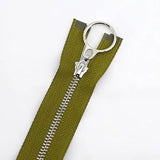


For a sweatshirt zip, an open-end nylon coil zip is used, most often No. 5, with an auto-lock or semi-auto-lock slider. The length is determined by the front opening from the bottom edge to the top of the collar or hood. For long sweatshirts and cardigans a two-way open-end zip is chosen, and for sports styles with a minimalist look a reverse coil zip.
Why the coil zip is the standard for sweatshirts
Jersey is soft and stretchy, and a heavy zip distorts it. A coil zip is light, flexible and follows the movements of the body without creating "waves" along the front edge. It withstands repeated washing and drying, and the tape and coil are dyed together, so the zip can be completely in tone with the fabric or deliberately contrasting.
- Lightness – it does not drag the jersey down.
- Flexibility – comfortable for movement, sport and sitting.
- Colours – a large choice, easy to match with the collection.
- Comfort – the smooth coil does not irritate the skin around the neck.
Which sweatshirt zip: open-end, two-way or reverse
| Style | Zip type | Size | Slider |
|---|---|---|---|
| Classic hooded sweatshirt | Open-end | No. 5 | Auto-lock |
| Light sweatshirt or tracksuit top | Open-end | No. 3 or No. 5 | Semi-auto-lock |
| Long cardigan, longline sweatshirt | Two-way open-end | No. 5 | Two sliders |
| Half-zip at the neck | Closed-end | No. 3 or No. 5 | Auto-lock |
| Sports top with a technical look | Reverse open-end | No. 5 | Auto-lock |
| Pockets | Closed-end | No. 3 or No. 5 | Non-locking or locking |
Open-end zip
An open-end zip separates completely – at the bottom end there is a pin on one side and a box on the other. It is essential for any garment that is taken off like a jacket. An open-end zip cannot be made from continuous zip by the metre in an ordinary workshop, so it is ordered in a finished length.
Two-way open-end zip
On long styles a two-way zip lets the bottom part be undone without separating the whole zip – convenient when sitting and cycling. There are two sliders here, and the lower one stops in the box.
Reverse coil zip
The reversed coil stays on the inside and the front looks flat and clean. It suits sports and technical collections, but requires a slider for a reverse coil.
How to determine the zip length
- Measure the finished front opening from the bottom edge (or rib) to the highest point where the zip ends – the top edge of the collar or up to the hood.
- Measure the length of the chain itself, from the box to the top stop, without the tape above and below it.
- Measure each size in the size chart separately – with sweatshirts the length changes between sizes.
- Test on a prototype – jersey can shrink or stretch slightly after sewing.
The exact length is especially important with open-end zips, because they cannot easily be shortened from the bottom end.
Sliders and pulls for sportswear
- Auto-lock – the zip does not slide down by itself during movement.
- Rubberised or cord pulls – quieter and softer than metal ones, comfortable for sport.
- Logo pull – the most visible place for the brand on a sweatshirt.
- Slider finish – in tone with the eyelets, cord ends and other metal details.
For decorative and branded pullers take a look at zip pullers, and for hood cords at cords and suitable cord ends.
Colour and coordination within the collection
On sweatshirts the zip is a visible detail along the whole front, so its colour is a design decision. There are three usual approaches. The first is a zip in tone with the fabric – calm and versatile, suitable for basic styles. The second is a contrasting zip – for example a white coil on a navy sweatshirt or a neon zip in sports collections. The third is a combination: tape in the fabric colour and a coil in a contrasting colour that shows only as a thin line. If the collection has several colours, plan the zip together with the hood cords and labels – this way the range looks finished. Approve the colour from a physical sample, because jersey and polyester tape reflect light differently.
Sewing a zip into a sweatshirt
- Stabilise the front edge of the jersey with a narrow fusible tape so that it does not stretch during sewing.
- Sew with the zipper foot and even feeding, without stretching the fabric.
- Check that the two halves are at the same height – especially with stripes and waist seams.
- Provide an inner tape or flap at the top end so that the zip does not irritate the chin.
- With a hood, the zip often ends below the hood seam – clarify this when measuring.
Care and washing
Close the zip before washing – this way the coil and slider do not snag or distort the fabric. With reverse and coated zips, wash at a moderate temperature and do not iron directly on the tape. Open zips in the washing machine are a common cause of damaged sliders.
Common mistakes
- A closed-end zip on a garment that needs to open fully.
- A slider without a lock – the sweatshirt unzips by itself.
- The same length for all sizes.
- Too large a size on light jersey – the zip "sticks out" and distorts the front.
Zips for sweatshirts and sportswear from Polkom
Polkom is a Sofia-based manufacturer and wholesaler of garment accessories with over 30 years of experience. We supply open-end, two-way and reverse nylon coil zips in the lengths you need, logo sliders and pulls, as well as complementary accessories for sports collections. We send samples before the run. Send a request for a quote with the lengths by size, the colour and the type of slider.