Manufacturer · Fashion Accessories



The right colour of imitation horn buttons is chosen according to the fabric: light honey and caramel shades suit beige, camel and olive, medium browns suit tweed and brown fabrics, while dark and black horn suit grey, navy and black. The safest option is a button one or two shades darker or lighter than the fabric, and on patterned fabrics a button that repeats one of the colours in the pattern.
Main shades of imitation horn
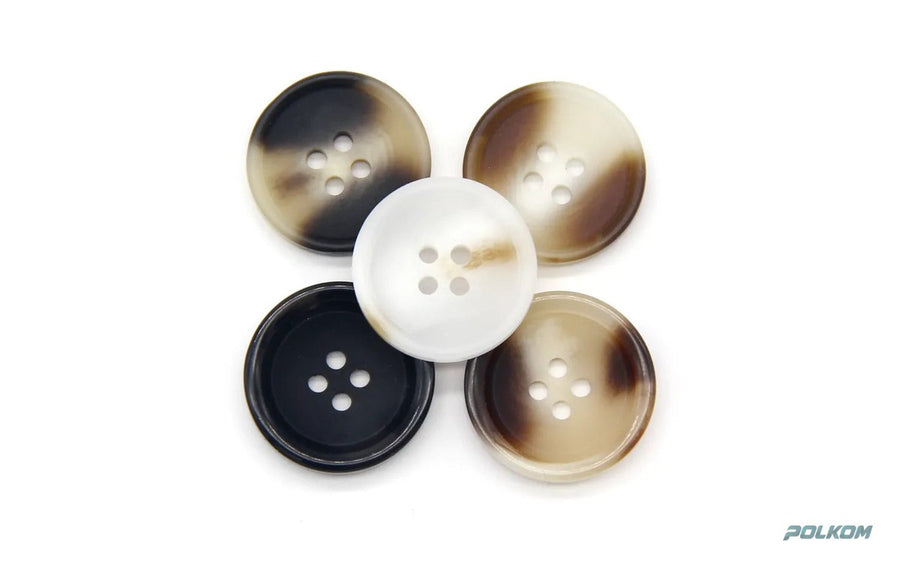
Imitation horn recreates the natural range of horn and extends it with fashion colours. These are the main groups:
| Shade | Description | Character |
|---|---|---|
| Light honey, cream | light base with beige and golden veins | summery, soft, casual |
| Caramel, amber | warm mid-tone with translucent areas | classic, warm |
| Medium brown | brown with dark and light veins | versatile |
| Dark brown, chocolate | dark base with coppery highlights | business-like, elegant |
| Grey-black | dark grey base with black veins | cool, modern |
| Black horn | almost black with fine light veins | formal, strict |
| Fashion colours | olive, burgundy, navy, grey with a horn effect | seasonal accent |
How to choose imitation horn button colours for the fabric
Warm fabric colours
Camel, beige, sand, brown, rust, mustard and olive green combine best with warm horn shades – honey, caramel, medium brown. The button is in the same colour family, but with depth and veining that emphasise the natural character of the fabric.
Cool fabric colours
Navy, grey, anthracite and black combine with dark brown, grey-black and black horn. Dark brown on navy is a classic in menswear, while grey-black on grey fabric is a modern, monochrome choice.
Light and white fabrics
White, cream and light grey allow for contrast. Light honey gives a soft, summery effect, while medium brown horn creates a stronger accent. Black horn on white fabric is a strong contrast that is used less often and looks graphic.
Patterned fabrics
For checks, herringbone, tweed and mélange, choose a shade that appears in the pattern. If the fabric has brown and green yarns, a medium brown horn will look natural. If it has grey and blue ones – dark or grey-black horn. Avoid a button whose colour does not appear anywhere in the fabric.
Combination table
| Fabric colour | Recommended shade | Alternative |
|---|---|---|
| Camel | caramel | dark brown for contrast |
| Beige | light honey | medium brown |
| Navy | dark brown | black horn |
| Grey | grey-black | dark brown |
| Black | black horn | grey-black |
| Olive | medium brown | caramel |
| Burgundy | dark brown | black horn |
| White, cream | light honey | medium brown |
| Denim | medium brown | dark brown |
Tone on tone or contrast
Tone on tone – the button is in the colour of the fabric, slightly darker or lighter. It looks calm and elegant and is the safe choice for business wear and classic coats.
Contrast – the button is visibly darker or lighter than the fabric. It emphasises the fastening line and the cut, but any inaccuracy in placement becomes more visible. It suits fashion collections and casual wear.
Gloss, semi-matt or matt
The surface changes how the colour is perceived. Gloss makes the shade more saturated and the veins more visible – it suits smooth woollen fabrics and formal wear. Matt softens the colour and brings it closer to natural unpolished horn – it looks good on linen, cotton, tweed and knitwear. Semi-matt is the compromise that works on almost everything.
How light changes the colour
Horn and its imitation are translucent materials, and light strongly affects their appearance. Under warm artificial lighting the buttons look browner and warmer, while in daylight they look cooler and lighter. So always compare samples in daylight and, if possible, under the lighting of the shop in which the garments will be sold.
Colour matched to a sample
If the standard shades do not match the collection, imitation horn can be made in a colour matched to a sample – a piece of fabric, a Pantone reference or an existing button. Since the effect is achieved by mixing several pigments, the colour is agreed with an approval sample. Keep in mind that each batch has its own pattern, so order the whole quantity for the collection at once. You will find more about solid colours in our polyester buttons category, and about the natural material in horn buttons.
Colour across the collection
If the same garment is sewn in several colours, not all variants need to have the same button shade. Often a better result comes from two or three horn shades for the whole collection – light for the light fabrics, dark for the dark ones. This increases the number of articles, but every garment looks finished.
Colour and thread
The thread used to sew on the button is also part of the colour scheme. It is usually chosen in the colour of the button or the fabric. A contrasting thread – for example light on a dark button – is a modern detail, but it also highlights every irregularity. On buttons with a recessed centre the thread is less visible.
Common mistakes
- choosing a shade from a photo on screen, without a physical sample;
- comparing only under artificial light;
- a button whose colour does not appear in the patterned fabric;
- ordering in parts, which leads to different shades in one collection;
- the same shade for all colours of the collection, without checking how it looks on each fabric.
Colour samples from Polkom
Polkom is a manufacturer and wholesale supplier of garment accessories based in Sofia with over 30 years of experience. We offer imitation horn buttons in a wide range of shades, as well as colours matched to your sample. Send an inquiry with samples of your fabrics and we will suggest suitable options.