Manufacturer · Fashion Accessories

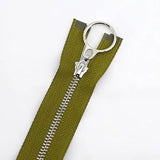


For a YKK backpack zip the basic rule is: the main compartment gets a large, strong zip – moulded Vislon or a No. 8 to No. 10 coil zip with two-way closed-end sliders – while the outer pockets and flaps get smaller No. 5 zips, often coil, because they go round corners more easily. The pullers must be easy to grip and, on travel backpacks, allow locking with a padlock.
On backpacks and holdalls the zip works in the toughest conditions: the contents push on it from the inside, the tape bends at the corners and the slider is yanked hard, often with one hand. It is no coincidence that the zip is the most common reason for a backpack being returned.
How to choose a YKK backpack zip
1. Main compartment
This is where the load is greatest. Choose No. 8 for city and school backpacks and No. 10 for hiking and travel backpacks and holdalls. Moulded Vislon is a good choice when the opening runs in a straight line or with a large curve radius. If the zip runs round sharp corners, a coil zip of the same size bends more easily.
2. Outer pockets and flaps
No. 5, coil or moulded. Small pockets with curved lines are almost always coil.
3. Inner pockets and laptop compartments
No. 3 to No. 5, usually coil – light and discreet.
4. Expanders and volume compartments
The zip that increases the volume of a backpack or holdall carries load when fully packed – No. 8 makes sense here.
Moulded or coil zip for a backpack
| Criterion | Moulded (Vislon) | Coil |
|---|---|---|
| Straight line, heavy load | excellent | very good in a large size |
| Sharp corners and curves | difficult | excellent |
| Abrasion (rubbing on ground, rocks) | very good resistance | medium |
| Sand and dust | easy to clean | can retain particles |
| Look | sporty, chunky | clean |
Two-way sliders – the standard on backpacks
Backpacks and holdalls almost always use a closed-end zip with two sliders that meet in the middle or at the top. The advantages are clear:
- the compartment opens from either side;
- only part of the opening can be opened without the contents falling out;
- the two pullers can be locked together with a small padlock;
- wear is spread between two sliders.
Pullers for backpacks
The puller is the part the user grips every day. On backpacks the following are used:
- metal pullers – strong, with the option of branding by engraving or embossing depending on the article;
- rubberised pullers – pleasant to the touch, comfortable in the cold;
- textile loops and cords – light, quiet, easy to grip, often with a logo via a woven label or cord end;
- pullers with a padlock hole – on travel backpacks and luggage.
If you want the puller to carry your logo, the options depend on the article and the quantity and are clarified on inquiry. For your own branding with textile loops and cord ends, see also the accessories in our general range.
How the zip affects the construction of the backpack
- Corner radius – the smaller the radius, the more flexible the zip must be.
- Storm flap – on outdoor backpacks the zip is often hidden under a flap against rain.
- Zip garages – small pockets at the ends into which the sliders are tucked.
- Reinforcement at the ends – the stops and tape ends are sewn with reinforcement, because the load is greatest there.
Testing the sample
Before the run, do a few simple checks on the backpack sample:
- Fill the main compartment to the maximum and open and close the zip twenty times.
- Pull the slider with one hand at an angle, as a user does on the move.
- Check the corners – whether the slider passes without jamming and whether the tape puckers.
- Leave the backpack full for a day and night and check whether the zip has split anywhere.
- Check the pullers with a glove on if the backpack is for hiking or winter sports.
If a test shows a problem, it is almost always solved with a larger size, a different chain type or a change of the corner radius in the pattern – much cheaper at the sample stage than after the backpacks are in the shop.
Common mistakes with backpack zips
- No. 5 for the main compartment of a hiking backpack – it splits when fully packed.
- A moulded zip round a sharp corner – it jams and wears the tape.
- Only one slider on a large compartment – inconvenient access.
- Small pullers without a loop – hard to grip.
- No reinforcement at the ends – the tape tears at the stop.
Putting together the hardware for backpacks
Besides zips, a backpack needs plastic or metal buckles, adjusters, rings, cord stoppers, cords and labels. When all the hardware is coordinated in colour and finish, the product looks coherent and sourcing is simpler. Polkom can put such an order together in one.
Planning and ordering
When ordering backpack zips, state for each zip: its position on the product, the line (moulded or coil), the size, the type (closed-end, two-way), the length, the colour of the tape and teeth, and the type of slider and puller. You will find the moulded models among YKK moulded zips, the coil ones among YKK nylon coil zips, and the full overview in YKK zips.
Zips and hardware for backpacks from Polkom
Polkom is a Bulgarian manufacturer and wholesaler of accessories for clothing and bags. YKK is a third-party brand – we supply original YKK zips in Bulgaria and the EU and advise on size and construction. Send an inquiry with a drawing or photo of the backpack and the quantity – we will suggest zips and coordinated hardware.