Manufacturer · Fashion & Home Accessories




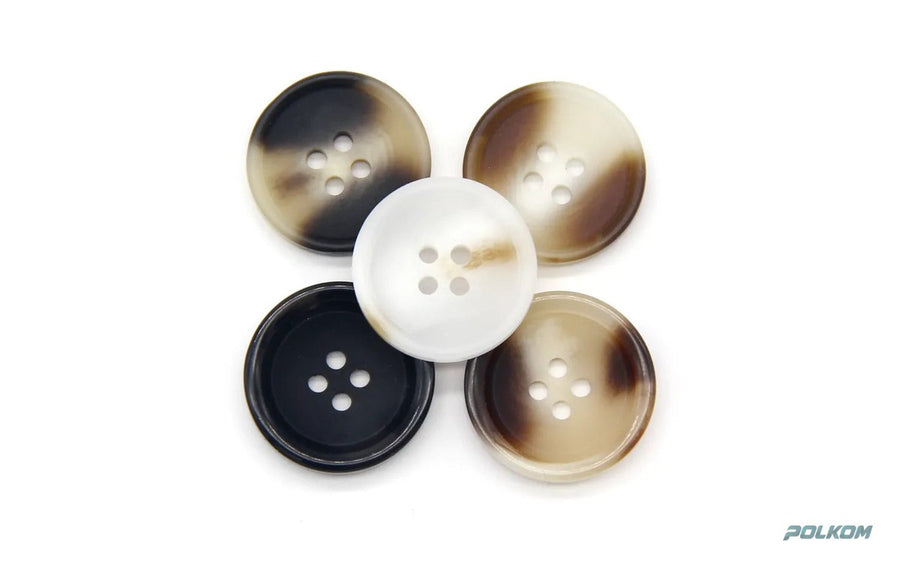
Imitation horn jacket buttons are most often used in two sizes: about 28L–32L (17.8–20.3 mm) for the front and 20L–24L (12.7–15.2 mm) for the sleeves. A single-breasted jacket usually has two or three buttons at the front and three or four on each sleeve, and the tone is chosen one or two shades darker or lighter than the cloth. Imitation horn is the classic choice for casual and business jackets, because it gives the look of horn while coping with wear and cleaning without problems.
Why imitation horn buttons for a jacket
A horn button is the traditional choice for a jacket in British and Italian style. It has a warm, natural look that works well on wool, tweed, linen and cotton. Imitation horn recreates this look while adding the advantages of polyester: uniform sizes, a predictable tone across the whole batch, resistance to dry cleaning and a more affordable price. For manufacturers of jackets in series, it is the most common choice.
Sizes of imitation horn jacket buttons
| Position | Size (L) | Approx. mm | Note |
|---|---|---|---|
| Front, single-breasted jacket | 28L–32L | 17.8–20.3 | 32L is the more classic choice for a men's jacket |
| Front, double-breasted jacket | 28L–32L | 17.8–20.3 | plus an inner button, often without a visible tone |
| Sleeves | 20L–24L | 12.7–15.2 | 24L for wider sleeves and coat-style jackets |
| Flap pockets (if any) | 20L–24L | 12.7–15.2 | the same size as the sleeves |
| Women's jacket | 24L–30L | 15.2–19 | depends on the cut and fashion |
The mm values are based on 1L = 0.635 mm and are approximate. The surest option is to send a sample of the jacket or the pattern.
How many buttons are needed for one jacket
- Single-breasted two-button jacket – 2 large at the front and 6–8 small on the sleeves (3–4 per sleeve).
- Single-breasted three-button jacket – 3 large and 6–8 small.
- Double-breasted 6×2 jacket – 6 large at the front, 1 inner and 6–8 small.
- Sports jacket with flap pockets – add 2–3 small for the pockets.
Add a reserve for rejects to the net quantity and, if your practice requires it, one spare large and one spare small button for each jacket.
Profile and number of holes
The classic jacket button has four holes, a flat or slightly dished centre and a pronounced rim. The rim adds depth and makes the button look "expensive". Two holes are more casual and are found on sports jackets and outer jackets. Shank buttons are rarely used on the classic jacket, but are common on blazers with metal buttons.
Thickness
The front button should be substantial enough to grip well, but not so thick that it does not pass easily through the buttonhole. Sleeve buttons are thinner, especially if the sleeve has working buttonholes where the buttons are undone.
How to choose the colour
Imitation horn comes in tones from light honey to almost black. A few proven combinations:
| Jacket colour | Button tone |
|---|---|
| Navy | dark brown horn, almost black or dark grey horn |
| Grey (medium and dark) | dark horn, grey-black veining |
| Light grey | medium brown or grey horn |
| Brown, tweed | medium to light brown horn |
| Beige, camel, sand | light honey or caramel |
| Olive, green | medium brown horn |
| Black | black horn with fine grey veining |
The basic rule: the button should not "disappear" on the cloth, but it should not clash with it either. One or two shades of difference in tone is the safest choice. If the cloth has a pattern – check, herringbone, tweed – choose a tone that picks up one of its colours.
Gloss or matt
Glossy buttons are more formal and look good on smooth wool cloths for business jackets. Semi-matt and matt ones are more casual and suit tweed, linen, cotton and textured cloths. On summer jackets in linen and cotton a matt surface looks more natural.
The jacket and the set
If the jacket is part of a suit, use the same buttons on the waistcoat (in a smaller size, usually 20L–24L) and, if the trousers have a visible button, match it to them. For a unified look, order all sizes from one batch so that the tone and pattern match. Take a look at men's buttons too for other suit models.
Imitation or natural horn for a jacket
For hand-tailored made-to-measure jackets in the premium segment, natural horn is the traditional choice – see horn buttons. For series-made jackets, for women's styles in fashion tones and for jackets that will be worn intensively, imitation horn gives a similar look with greater predictability in sewing.
Sewing on jacket buttons
The front buttons are sewn on with a thread shank – a small gap between the button and the cloth that lets the thickness of the buttonhole edge pass under the button when fastened. Sleeve buttons are sewn tight and often slightly overlapping (kissing) – a detail that reveals good workmanship. Use a strong thread in the tone of the button or the cloth.
In series production the buttons are sewn on with a button-sewing machine, which requires a consistent diameter and hole spacing. This is exactly where imitation horn shows its advantage over the natural material – the machine runs without stops, and the button position is the same on all jackets.
Jacket buttons from Polkom
Polkom is a Sofia-based manufacturer and wholesale supplier of garment accessories with over 30 years of experience. We offer imitation horn buttons in the sizes for fronts and sleeves, in various tones and profiles, with the option of a logo. Send an inquiry with a sample of the cloth and the quantity per size.