Manufacturer · Fashion & Home Accessories


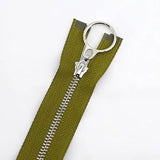


A zip consists of the tape (two textile tapes), a chain of teeth or a coil, a slider with a puller, and stops – top and bottom. An open-end (separating) zip also has a separating mechanism: an insertion pin and a retainer box. Knowing the parts of a zip helps you describe exactly what you need when ordering or repairing.
Parts of a zip – overview
| Part | Also known as | Function |
|---|---|---|
| Tape | Zip tape | The textile base that is sewn to the product |
| Chain (teeth, coil) | Elements | The closing part – the two rows interlock |
| Slider | Zip head, runner | Opens and closes the chain |
| Puller | Pull tab, zip pull | The part you grip to move the slider |
| Top stops | Top end stops | Stop the slider at the top end |
| Bottom stop | Bottom end stop | Joins the two tapes on a closed-end zip |
| Insertion pin and retainer box | Pin and box, separating mechanism | Separating mechanism on an open-end zip |
| Reinforcement film | Tape reinforcement | Strengthens the ends of an open-end zip |
Tape
The tape is the woven or knitted base, most often polyester. It determines how the zip lies in the seam, how flexible it is and how it takes dye. Cotton tapes are found on jeans, and polyurethane-coated tapes for water resistance on technical garments. The tape width increases with the zip gauge – this matters if the seam will be visible from the outside. The tape colour is matched to a fabric sample or a Pantone reference.
Chain
The chain is the heart of the zip. Its type gives the zip its name:
- Metal chain – individual teeth of brass, aluminium or alloy, clamped onto the edge of the tape;
- Coil chain – a continuous nylon or polyester coil, sewn or woven in;
- Moulded chain – individual plastic teeth moulded directly onto the reinforced edge of the tape;
- Invisible chain – a coil turned to the reverse side so it cannot be seen from outside.
The width of the closed chain in millimetres gives the zip gauge – No. 3, No. 5, No. 8, No. 10.
Slider
The slider is the metal or plastic body that runs along the chain. Inside it has a Y-shaped channel: moving up, it brings the two rows of teeth together and interlocks them; moving down, its wedge separates them. Sliders differ in:
- Locking: auto-lock (locks itself with a pin when the puller is down), non-lock, or manual lock.
- Number of pullers: single puller or double-sided (pullers on both sides) – for reversible jackets and tents.
- Material: zinc alloy, brass, plastic.
- Finish: nickel, antique brass, black, rubberised, painted in colour.
The slider is always chosen for the specific chain type and gauge.
Puller
The puller is the most visible part and therefore the most often customised. It can be metal, plastic, rubberised, cord or tape. Brands often use pullers with a logo – engraved, stamped or cast. On sportswear and backpacks, long cord pullers with a cord stopper or cord end are used, as they are easy to grip with gloves.
Stops
Top stops
Small metal clips or plastic elements above the last tooth. They prevent the slider from coming off the chain. On coil zips they are sometimes replaced by a bartack.
Bottom stop
Exists only on closed-end zips. It joins the two tapes at the bottom and determines how far the zip opens.
Separating mechanism: insertion pin and retainer box
On an open-end zip, the bottom of one tape has an insertion pin and the other a retainer box with its own pin. The pin is inserted into the box and the slider begins to close the chain. Both ends are reinforced with plastic film or a strong tape, because this is where the load concentrates. On a two-way open-end zip the mechanism is designed so that the lower slider takes over the role of the box.
Which parts of a zip can be customised
- tape colour – to a sample or Pantone;
- teeth colour – on moulded zips it can be a contrast colour;
- finish of the metal teeth and the slider;
- puller – shape, material, logo;
- length and type of stops.
That is why, when ordering zips, it is best to describe each part separately. If you work with branded zips, see also our YKK zips.
Which part fails most often
In atelier practice the most common failure is a worn slider – its plates spread apart and the zip starts to split open behind it. Second are missing top stops, after which the slider comes off the chain. On open-end zips the retainer box is vulnerable, especially on heavy winter jackets, and on moulded zips individual teeth, if they are knocked or bent hard. Metal teeth rarely break but can oxidise and make movement stiff. The tape wears out last, unless it has been scorched by an iron or abraded against the edge of a bag.
Why it is important to know the parts of a zip
When you speak the same language as your supplier, the sample comes out right first time. "A 60 cm zip" is not enough – you need the gauge, chain type, open-end or closed-end, tape colour, slider type and puller. Knowing the parts also helps with repairs: often you do not need a new zip, just a new slider or stop.
Polkom – zips, sliders and logo pullers
Polkom is a Bulgarian manufacturer and supplier of garment accessories from Sofia with over 30 years of experience. We offer zips, sliders and pullers to the client's design, with a logo and in a colour matched to a sample, with delivery throughout the EU. Send an inquiry – we will help you write the exact specification.