Manufacturer · Fashion & Home Accessories


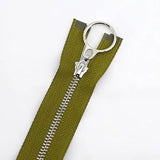


An open-end zip separates completely into two halves – which is why it is used on jackets, hoodies and gilets. A closed-end zip is joined at the bottom and does not separate – for trousers, skirts, pockets and bags. A two-way zip has two sliders and can be opened from both ends.
Open-end and closed-end zips – the key difference
The difference lies at the bottom of the chain. On a closed-end zip the bottom stop joins the two tapes and the slider only goes as far as it. On an open-end zip the bottom has a two-part mechanism: an insertion pin on one tape and a retainer box with a pin on the other. The pin is inserted into the box, the slider moves up and engages the teeth. The type of teeth – metal, coil or moulded – does not determine whether a zip is open-end. All three types are made in both versions.
Closed-end zip
This is the most common type in clothing by number of pieces. It is used wherever the opening is in a seam or on the edge but the product must not separate into two parts.
- the fly of trousers and jeans (with an auto-lock slider);
- skirts and dresses – including as an invisible zip;
- pockets, sleeves, trouser legs;
- bags, pouches, covers, cushions.
The advantage is simplicity: there is no insertion mechanism, the zip is cheaper and can be shortened from the top or bottom. The disadvantage is that the garment has to be put on "over the head" or "over the legs".
Open-end zip
An open-end zip is essential when the product must open fully at the front – jackets, coats, hoodies, gilets, cardigans. It is also used for detachable parts: hoods, linings, sleeves of convertible jackets, zip-off trouser legs.
How the mechanism works
One tape has a box and the other a pin. The box holds the pin in place until the slider starts to engage the teeth. Both ends are usually reinforced with plastic or textile tape for extra strength, because this is where the load is greatest.
Important limitations
- An open-end zip cannot be shortened from the bottom – that is where the mechanism is. It is shortened only from the top, and carefully.
- It requires an exact length according to the pattern, often different for each size.
- The gauge must be large enough – the weak point is the bottom part, which is strained when sitting.
Two-way zip
A two-way zip has two sliders on one chain. There are two main versions.
Two-way open-end zip
Used on long jackets, parkas, coats and skiwear. The bottom slider lets the jacket open at the bottom without unzipping the top – for freedom when sitting, driving or walking. To separate the zip completely, both sliders are brought down to the box, and when zipping up the pin is inserted through the bottom slider.
Two-way closed-end zip
Both ends are closed, and the two sliders meet at any point. This is the typical zip on suitcases, holdalls, tents, sleeping bags and covers. The zip can be opened from the middle, the left or the right, and the two sliders can be locked together with a padlock.
Comparison
| Type | Bottom end | Sliders | Shortening | Typical product |
|---|---|---|---|---|
| Closed-end | Bottom stop | 1 | From top or bottom | Trousers, skirt, pocket, bag |
| Open-end | Pin and box | 1 | From the top only | Jacket, hoodie, gilet |
| Two-way open-end | Pin and box | 2 | From the top only, limited | Parka, long coat, ski jacket |
| Two-way closed-end | Stops at both ends | 2 | Limited | Holdall, suitcase, tent |
How to choose the right type
- Must the product separate into two? If yes – open-end. If not – closed-end.
- Is the product long and will the wearer sit in it? For jackets below the hip, consider a two-way zip.
- Is access from both sides needed? For luggage and tents – two-way closed-end.
- What load will it carry? Choose the gauge and tooth type – for jackets and outdoor wear moulded plastic zips are often used, for lighter products nylon coil zips.
Common mistakes
- Ordering a closed-end zip for a cardigan or hoodie that must open fully.
- A two-way zip without enough room at the bottom – the lower slider hits the hem.
- An open-end zip with an insufficiently reinforced bottom end on a heavy fabric.
- Shortening an open-end zip from the bottom – the mechanism is destroyed.
What to state in your inquiry
To get an accurate quote and sample, describe the zip with a few parameters. This avoids discrepancies between the sample and the series delivery.
- type: closed-end, open-end, two-way open-end or two-way closed-end;
- tooth type and gauge – for example moulded No. 8 or coil No. 5;
- lengths per size, in centimetres;
- tape and teeth colour – to a fabric sample or Pantone;
- slider type: auto-lock, non-lock, double-sided puller or with a logo;
- approximate quantity and desired timing for the sample.
For jackets with a detachable hood or lining, list the small open-end zips separately as well – they often have a smaller gauge and a different length from the centre front zip.
You will find all options – closed-end, open-end and two-way, in different gauges and colours – in our zips category.
Zips from Polkom for series production
Polkom is a manufacturer and supplier of garment accessories from Sofia with over 30 years of experience. We offer open-end, closed-end and two-way zips in standard and non-standard lengths, in colours matched to a sample and with logo sliders, with delivery throughout the EU. Send an inquiry with a description of the style – we will suggest the right type and a sample.