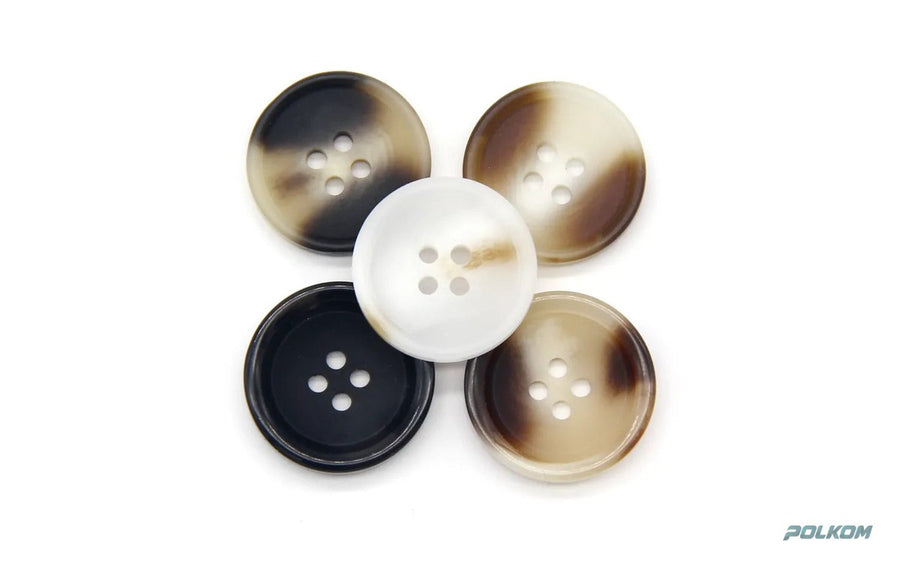
Manufacturer · Fashion & Home Accessories




Imitation horn button sizes are given in lignes (L), where 1L = 0.635 mm, so 24L is about 15.2 mm, 32L about 20.3 mm and 40L about 25.4 mm. Shirts use 16L–20L, waistcoats 20L–24L, jacket sleeves 20L–24L, jacket fronts 28L–32L and coats 32L–44L and above.
What a ligne (L) is and why it is used
The ligne is a traditional unit of measurement in button manufacturing, inherited from old European measures. Although we work in millimetres today, button manufacturers and suppliers continue to use lignes, because that is how catalogues and orders are established. The size in lignes always refers to the diameter of the button, not its thickness.
Imitation horn button sizes: chart
| Lignes (L) | Diameter (mm) | Typical application |
|---|---|---|
| 14L | 8.9 | fine blouses, babywear |
| 16L | 10.2 | shirt – collar and cuff |
| 18L | 11.4 | shirt – front |
| 20L | 12.7 | shirt, waistcoat, jacket sleeve |
| 22L | 14.0 | waistcoat, knitted waistcoat |
| 24L | 15.2 | jacket sleeve, waistcoat, trousers |
| 26L | 16.5 | jacket, overshirt |
| 28L | 17.8 | women's jacket, cardigan |
| 30L | 19.1 | jacket |
| 32L | 20.3 | men's jacket front, coat |
| 36L | 22.9 | coat, trench coat |
| 40L | 25.4 | coat, greatcoat |
| 44L | 27.9 | large coat, duffle coat |
| 54L | 34.3 | oversized, decorative button |
The values are rounded to a tenth of a millimetre. The applications are approximate – fashion and cut can shift them by a few lignes up or down.
Sizes by garment type
Shirts
Shirts use 16L–20L. Thin imitation horn is popular for linen, Oxford and flannel shirts, where it gives a warm, natural look. The collar button is usually one or two lignes smaller than the front buttons.
Waistcoats and knitwear
Suit waistcoats use 20L–24L, while knitted waistcoats and cardigans use 22L–30L, depending on the thickness of the knit. With chunky knits, a larger button looks more proportionate.
Jackets
The classic combination is 32L on the front and 24L on the sleeves for a men's jacket, and around 28L–30L on the front for a women's jacket. Double-breasted jackets use the same size on the front as single-breasted ones, but with more buttons.
Coats
Coats start at 32L and go up to 44L, and oversized styles up to 54L. Sleeve tabs and belts use 24L–28L.
Trousers
The waistband button and brace buttons are usually 24L–26L. Inner brace buttons are often a simpler version, but imitation horn is used on classic trousers where the buttons are visible.
How to measure a button
- Use a calliper or a ruler with millimetre markings.
- Measure the diameter through the centre, from edge to edge.
- Divide the result by 0.635 to get the lignes, and round to the nearest standard size.
- For a shank button, measure only the face, without the shank.
- Also measure the thickness – it affects the buttonhole length.
Example: a button with a diameter of 20 mm ÷ 0.635 = 31.5, i.e. 32L.
Size and buttonhole
The buttonhole must be slightly longer than the button diameter. The practical rule is: buttonhole length = diameter + button thickness, plus a small allowance depending on the fabric. If you replace the buttons on a garment with larger ones, the buttonholes will not let them through; if you replace them with smaller ones, the buttons will come undone. So when replacing buttons, measure the buttonholes too.
Thickness and profile
Two button models of the same ligne size can look quite different because of their thickness and profile. A button with a wide rim looks bigger and heavier, while a flat one looks lighter and smaller. When replacing buttons, compare these parameters too, not just the diameter. You will find more options among our polyester buttons and men's buttons.
Sizes for children's clothing
For children's clothing, sizes are smaller than for adults, but not too small – the button must be easy for small fingers to handle. Children's coats and cardigans usually use 20L–28L. Choose buttons with smooth edges and sew them on securely. For the youngest children, observe the applicable safety requirements for children's clothing regarding small parts.
How to state sizes in your inquiry
The clearest way is to send a table: position on the garment, size in lignes or mm, profile (holes or shank) and quantity. For example: front – 32L, 4 holes, 3 per garment; sleeve – 24L, 4 holes, 8 per garment. If you have a sample button, send it – it gives the size, profile and thickness. If you are working from someone else's pattern, check whether the sizes there are in lignes or millimetres – confusing the two is a common cause of wrong orders.
Common mistakes when choosing a size
- stating a size "by eye" without measuring;
- confusing diameter with radius or thickness;
- measuring a shank button together with the shank;
- forgetting that the buttonhole determines which size can be used;
- ordering the sleeve buttons in the size of the front buttons.
Custom sizes from Polkom
Polkom is a manufacturer and wholesale supplier of garment accessories based in Sofia with over 30 years of experience. We offer imitation horn buttons in a wide range of sizes, and more specific sizes and profiles are made to order. Send an inquiry with the sizes in lignes or mm, or send us a sample button.