Manufacturer · Fashion & Home Accessories




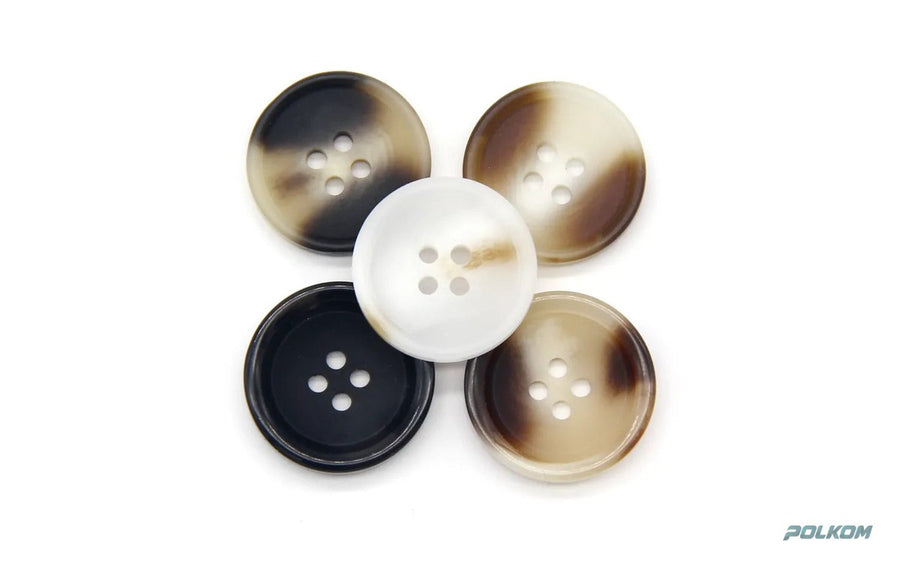
Imitation horn coat buttons are usually chosen in sizes between 32L and 44L (about 20–28 mm), and larger for oversized coats and greatcoats. For classic wool coats, four-hole buttons with a pronounced rim are most often chosen, and for double-breasted and military models, shank buttons. The tone is matched to the fabric: honey and caramel shades for camel and beige, dark horn for grey, navy and black.
Why imitation horn for a coat
A coat is a garment that is worn for a long time and buttoned many times a day. The buttons are the most visible detail on the front and take a lot of strain. Imitation horn combines the classic look that suits wool, cashmere and tweed with the durability of polyester. It does not split in the cold, does not dry out and withstands dry cleaning, which is the standard care for coats.
Sizes of imitation horn coat buttons
| Type of coat | Size (L) | Approx. mm |
|---|---|---|
| Classic single-breasted men's | 32L–36L | 20.3–22.9 |
| Double-breasted coat, greatcoat | 32L–40L | 20.3–25.4 |
| Women's fitted coat | 28L–36L | 17.8–22.9 |
| Oversized, cocoon | 40L–54L | 25.4–34.3 |
| Duffle coat, car coat | 36L–44L | 22.9–27.9 |
| Sleeve and belt | 24L–28L | 15.2–17.8 |
The diameters are calculated using 1L = 0.635 mm. Proportion matters more than the exact figure: the button should be in proportion to the width of the lapel and the spacing between buttons.
With holes or with a shank
Hole buttons
Four holes are the classic on a men's Chesterfield coat and on most women's coats. The button sits closer to the fabric, and the thread allows a shank of the required height to be formed. Choose a model with a recessed centre – this protects the thread from friction so it lasts longer.
Shank buttons
The shank is a small loop on the back of the button. The face remains smooth and its entire area shows the horn pattern, so such buttons look more substantial and luxurious. They suit double-breasted coats, greatcoats, military-style designs and thick fabrics that need more space between the button and the fabric.
How many buttons a coat needs
- Single-breasted coat – 3–4 visible buttons, sometimes also a concealed collar button.
- Double-breasted coat – 6 or 8 visible, plus 1 inside button for fastening the underlap.
- Coat with epaulettes, belt and sleeve tabs – add 2–6 smaller buttons.
- Coat with a hood or high collar – 1–2 small buttons for the collar.
Add a reserve and one spare button of each size if you supply spares with the coat.
Button profile
- wide rim – classic, emphasises the pattern;
- domed – soft, suitable for knitted coats and cashmere;
- flat – minimalist, for modern cuts;
- thick, "chunky" – an accent on oversized coats.
On heavy wool fabrics the button must be thick enough to look proportionate. A thin button on a thick coat looks like a cost-cutting choice.
How to choose the tone
| Coat colour | Button tone |
|---|---|
| Camel | caramel, honey brown |
| Beige, cream | light honey, sand horn |
| Navy | dark brown or black horn |
| Grey | dark horn with grey veining |
| Black | black horn or very dark brown |
| Burgundy, green | medium to dark brown horn |
| Check, herringbone | a tone from the fabric pattern |
It is best to place the samples directly on the fabric and look at them in daylight. Under artificial lighting, horn tones look warmer.
Sewing on coat buttons
With thick fabrics, it is important for the button to have a sufficiently high thread shank – otherwise the coat puckers around the button when fastened. A small backing button is usually also used on the inside, which takes the strain and protects the fabric from tearing. The thread must be strong – polyester or polyester-core.
Button placement
Besides size, the spacing between buttons is important. On a single-breasted coat it is usually between 10 and 14 cm, depending on the length of the coat and the height of the lapel. The top button determines how high the buttoning line will be, and the bottom one how the coat moves when walking. On a double-breasted coat, the top buttons are often placed slightly wider apart than the lower ones, creating the classic V-shaped silhouette. These parameters are determined by the pattern, but it is useful to know them when assessing the number and size of buttons.
Coat buttons with logo
A coat is the ideal garment for a branded button, because the size allows a clear logo. Imitation horn can be laser-engraved, and on new models the logo can be cast in relief. Engraving on light horn is more contrasting, on dark horn more discreet. If you want a logo, plan for it when choosing the model, because buttons with a wide rim have less free area.
Care
Coats are mainly dry-cleaned. Imitation horn withstands dry cleaning without changes to shape or colour. When steam ironing, do not press the iron directly on the buttons. If the coat is lined and the buttons have a shank, check the thread's strength periodically – this is the point of greatest strain.
Imitation or natural horn for a coat
For a premium-segment cashmere coat, natural horn is the traditional choice – see our horn buttons. A natural alternative without animal origin is corozo, which is also available in large sizes. For series-produced coats, imitation gives a more predictable batch, a wider choice of sizes and easier care.
Coat buttons from Polkom
Polkom is a Sofia-based manufacturer and wholesale supplier of garment accessories with over 30 years of experience. We offer imitation horn buttons for coats – with holes and with shank, in various sizes, tones and profiles, with the option of logo engraving. Send an inquiry with a fabric swatch, the coat model and the quantities by size.