Manufacturer · Fashion & Home Accessories




Men's T-shirts with buttons come in two main types: the polo, with a collar and a placket with two or three buttons, and the henley, collarless with three to five buttons at the neckline. They use small buttons of 14L–18L (about 9–11.5 mm), most often with two or four holes, in polyester, urea or mother-of-pearl. Because jersey stretches, the placket is reinforced with interfacing and the buttons are sewn on so that they do not pull the knit.
Men's T-shirts with buttons: polo and henley
| Model | Number of buttons | Size | Features |
|---|---|---|---|
| Classic polo | 2–3 | 16L–18L | Placket with collar, matching or contrasting buttons |
| Polo with button-down collar | 2–3 + 2 on the collar | 14L–18L | More formal look, close to a shirt |
| Short-sleeve henley | 3–4 | 14L–16L | No collar, longer placket |
| Long-sleeve henley / top | 3–5 | 16L–18L | Sometimes also buttons on the cuff |
| Long-sleeve polo | 2–3 + cuffs | 16L–18L | Rib-knit cuffs without buttons or with a button |
The size is given in ligne, where 1L = 0.635 mm. On polo shirts, the buttons are usually slightly larger than on henleys, where the placket is narrower.
Materials
Polyester
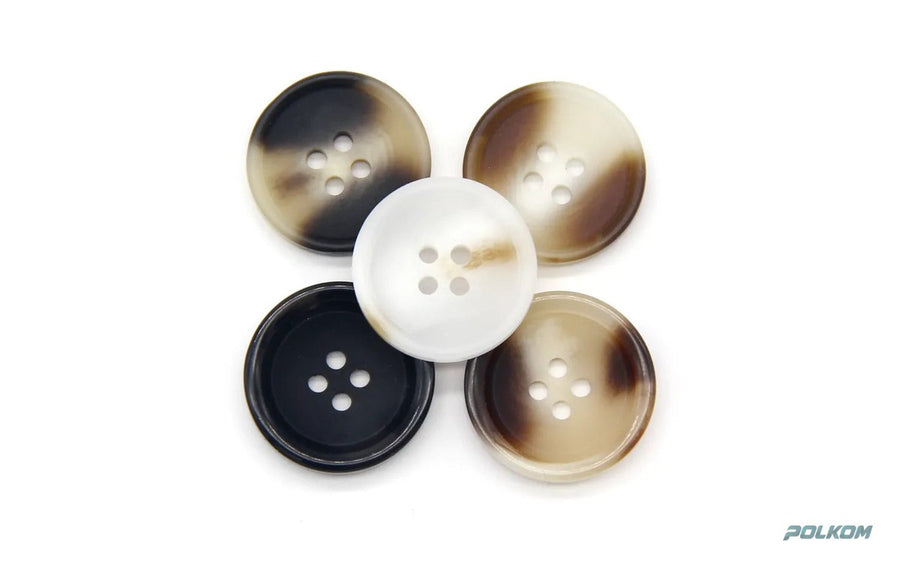
The most common choice for polo and henley shirts. Polyester buttons are made in the colour of the jersey, with a pearl effect or in a contrasting colour. They withstand regular washing and offer good value for money. Browse our polyester buttons.
Urea
A suitable material for corporate, sports and uniform polo shirts that are washed often at higher temperatures. Urea is hard and does not deform when ironed. See our urea buttons.
Mother-of-pearl
The classic choice for premium polo shirts in piqué or mercerised cotton. Mother-of-pearl adds a noble lustre and is a visible sign of quality.
Corozo and wood
For henley shirts and tops in natural tones and a rustic style, especially in linen jersey or heavy cotton.
Metal and snap buttons
Found on workwear henleys and on casual designs in a workwear style.
Piqué, jersey or linen knit
The type of knit also influences the choice. The classic piqué of polo shirts is dense and structured and copes well with four-hole buttons and a slightly more pronounced rim. The thin jersey of henley shirts is softer and stretchier, so lighter, flatter two-hole buttons that do not weigh it down are preferred there. Mercerised cotton has a slight sheen and looks best with pearl or mother-of-pearl buttons. Linen and linen–cotton knits have a natural character that is complemented by corozo or wood. If a collection includes polo shirts in different fabrics, it is best to use one button model in several colours rather than different models – this makes the line look coherent and the order easier to plan.
Colour and style
- Tone-on-tone – the buttons match the colour of the jersey. The most versatile and understated option.
- Pearl white – a classic for white and pastel polo shirts.
- Contrasting – for example navy buttons on a white polo, matching the collar or sleeve trim.
- Natural – corozo or wood on henleys in earthy colours.
Sewing buttons on jersey
Jersey stretches, so buttons and buttonholes need special attention:
- Reinforce the placket with knit interfacing so it does not deform around the buttonholes.
- Use a thread suited to knitwear, matching the button or fabric.
- Sew with a small shank so the placket can lie under the button without puckering.
- Orient the buttonholes correctly – on polo shirts they are usually vertical.
- Avoid heavy buttons that pull the placket down.
Polo shirts for companies and uniforms
Corporate polo shirts are one of the most widespread types of workwear – for shops, restaurants, events, sports clubs and companies. Here the buttons are a small but visible detail that can carry the brand:
- buttons with an engraved or moulded logo;
- buttons in the corporate colour, matched to a sample;
- durable materials that withstand frequent washing.
Because uniform polo shirts are ordered in large runs, it is important that all buttons come from one batch and that spare buttons are available for replacement.
Washing and care
Polo and henley shirts are washed often, usually at 30–40 °C. Button up the buttons and turn the shirt inside out before washing – this keeps the placket from twisting and the buttons from getting scratched. When ironing, do not press the iron on the buttons. If the shirts are corporate and washed at higher temperatures, choose urea or a sturdy polyester.
Men's tops with buttons
The same principles apply to men's long-sleeve tops with buttons – waffle-knit henleys, knitted tops with a placket and jumpers with buttons on the shoulder or neckline. On heavier knits the buttons can be slightly larger, 18L–22L, with a smooth rim so they do not catch the stitches.
Common mistakes
- no interfacing in the placket – the buttonholes stretch after a few washes;
- buttons too large for a narrow henley placket;
- buttons that cannot withstand the ironing temperature on uniform polo shirts;
- colour mismatch between batches in large corporate orders;
- forgetting spare buttons.
Buttons for polo and henley shirts from Polkom
Polkom is a Bulgarian manufacturer and wholesaler of garment accessories based in Sofia, with more than 10,000 articles. In the men's buttons section you will find small buttons for polo and henley shirts, and to order we make buttons in a corporate colour and with logo. Send an inquiry via our contact page.