Manufacturer · Fashion & Home Accessories




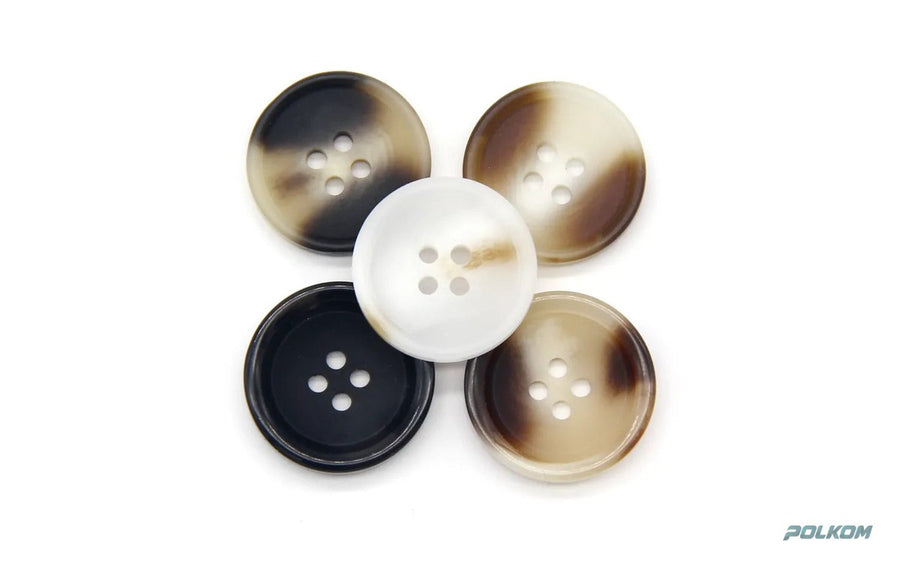
Horn buttons for shirts are used on heavier, casual and seasonal shirts – flannel, Oxford, corduroy, denim, linen and wool overshirts. Standard sizes are 16L–18L (about 10–11.5 mm) for the front and cuffs and 14L for a button-down collar. Horn gives a warm, natural look but requires more careful ironing, so it is not the typical choice for white business shirts, where mother-of-pearl remains the classic.
When horn buttons for shirts are worth it
A shirt is a garment with many buttons – usually between 10 and 14 – and each of them is visible close up. That is why their material strongly influences the perception of quality. Natural horn is suitable when you want the shirt to look like a garment with character rather than part of a suit:
- Flannel and checked shirts – dark and marbled horn emphasise their autumn–winter character.
- Oxford and corduroy – matt horn sits naturally on the heavier texture.
- Linen shirts – light or marbled horn is an elegant alternative to mother-of-pearl.
- Overshirts and shirt jackets – larger buttons, 20L–24L, can also be used here.
- Denim and chambray shirts – horn is a more refined option than metal and plastic buttons.
When to choose a different material
For white and light formal shirts that are ironed often and at high temperatures, the classic choice is mother-of-pearl buttons or their polyester imitations. Dark horn on a white business shirt looks heavy, and frequent press ironing requires more heat-resistant materials.
Sizes and distribution
| Position | Size | Approx. diameter |
|---|---|---|
| Front | 16L–18L | 10–11.5 mm |
| Cuff | 16L–18L | 10–11.5 mm |
| Button-down collar | 14L | 9 mm |
| Sleeve placket | 14L | 9 mm |
| Flap pocket | 16L–18L | 10–11.5 mm |
| Overshirt / shirt jacket | 20L–24L | 12.7–15 mm |
When ordering for a series of shirts, calculate the number by size: for example 7 on the front, 2–4 for the cuffs, 2–3 for the collar and plackets, plus 1–2 spares.
Thickness and profile
A horn shirt button should be thin, with a flat or slightly concave profile. A thick button is hard to push through a shirt's small buttonhole and stands out under a jacket. The edge can be fine or slightly bevelled. Most models have four holes – they allow secure sewing and a stable position of the button. On more casual shirts, two-hole buttons are also used, especially on overshirts.
Colour and surface
- Dark horn – for dark, saturated and checked fabrics.
- Marbled horn – for beige, olive, blue and mélange tones.
- Light horn – rarer and therefore more valuable; for linen and light summer shirts.
- Matt or semi-matt – best suited to shirts, as a high gloss looks too formal.
Because every horn button is different, with shirts it is especially important that the buttons for one garment are selected close in tone – in a row of seven buttons, every deviation is noticeable.
Sewing on
Shirt buttons are sewn on with a small thread shank, just enough for the button to lie over the buttonhole without puckering the fabric. Industrial production uses automatic button-sewing machines; before the series it is a good idea to check that the horn buttons feed smoothly and that their holes match the machine setting. With horn, thickness and hole spacing can vary slightly more than with plastic.
Washing and ironing
Horn buttons can be machine washed at a moderate temperature. They do not like prolonged soaking in hot water, so a programme of up to 40 °C is recommended for shirts with horn buttons. When ironing, do not press the iron directly on the buttons – iron around them or from the reverse, on a soft pad. Industrial press ironing at high temperature is not suitable for natural horn.
Horn or imitation for shirts?
If the collection is large and complete uniformity or intensive washing is required, the practical solution is a polyester imitation horn. Natural horn remains the choice for upper-segment shirts, where the customer values the genuine material and the difference to the touch. Also browse the men's buttons category for other options.
Common mistakes
- Buttons that are too thick and hard to pass through the buttonhole.
- Polished buttons on a casual shirt.
- A set with visibly different-toned buttons on the front.
- Press ironing without protecting the buttons.
- Dark horn on a white business shirt.
The detail the customer notices
With upper-segment shirts, the buyer often looks at the buttons in particular to judge the quality. The cool, dense feel of natural horn and its lively pattern immediately set the garment apart from mass-market ready-to-wear. Combined with an engraved logo on the cuffs or collar, it is a discreet but effective way for a brand to show attention to detail.
How to test the sample
Before approving the series, sew a few horn buttons onto a piece of the shirt fabric, make a buttonhole and button it repeatedly. Then wash the sample on the programme you will state on the label and iron it in the usual way. Compare the shine and colour with an unwashed button. This way you can be sure the chosen model will withstand real use.
Horn buttons for shirts from Polkom
Polkom supplies thin buttons made from natural buffalo horn for shirts and overshirts – in dark, marbled and light tones, with selection of harmonious sets and the option of logo engraving. Browse the horn buttons and send an inquiry with the sizes and a fabric swatch; minimum quantities depend on the article.