 Manufacturer · Fashion & Home Accessories


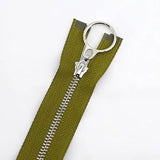


YKK Zip Sliders and Pullers – Locking Types
Types of YKK zip sliders – auto-lock and semi-auto lock, non-lock, reversible and double-pull – and how to choose the right one for apparel, bags and footwear.
YKK Sliders and Pullers – examples from our production
A small selection of the models we produce and supply. Send an inquiry for samples and the full catalogue.
What the slider of a YKK zip does
The slider is the part that joins and separates the teeth as it moves up and down. It consists of a body, through whose openings the chain runs, and a puller (pull tab) you hold. The type of slider determines whether the zip stays in place during wear, whether it can be operated from both sides and how easy it is to handle with gloves. Polkom supplies original YKK zips with sliders to YKK specification; YKK sliders are ordered as part of the zip, according to the model and size.
Main types of YKK sliders
| Type | How it works | Typical use |
|---|---|---|
| Non-lock | No locking mechanism, moves freely | bags, cases, pockets, furniture |
| Auto-lock | Locks by itself as soon as you release the puller; releases when pulled | jackets, trousers, sweatshirts |
| Semi-auto lock | Locks when the puller is folded down | garments where the zip must stay in place |
| Denim slider | Semi-automatic lock developed for jeans | jeans and trousers |
| Pin-lock | Pins on the puller enter between the teeth and block the slider | garments and bags |
| Reversible | The puller rotates on a rail and the zip can be operated from both sides | reversible jackets |
| Double-pull | A puller on both sides of the body | products that open from inside and outside |
The function code in the YKK specification
The code of every YKK zip contains a digit that describes the slider lock. Knowing it helps when checking an old specification or sample:
| Digit | Function |
|---|---|
| 0 | cam-lock |
| 1 | non-lock |
| 2 | pin-lock |
| 3 | notch-lock |
| 4 | double-pull with notch-lock |
| 5 | double-pull, non-lock |
| 6 | auto-lock |
| 7 | double-pull with auto-lock |
| 8 | reversible, auto-lock or non-lock |
| 9 | semi-auto lock |
One or two sliders
| Configuration | How they move | Where it is used |
|---|---|---|
| Closed-end, one slider | opens from top to bottom | trousers, skirts, pockets |
| Closed-end, two sliders “head to head” | meet in the middle | bags, suitcases, cases |
| Closed-end, two sliders “bottom to bottom” | move apart towards the ends | special openings |
| Two-way open-end | the top and bottom sliders open from both ends | long jackets, parkas |
For open-end and two-way zips, YKK also distinguishes between a version with the pin on the right or on the left – specify it if your brand has an established standard for men's and women's styles.
A simple rule helps when choosing: if the zip must stay in place under load – for example on trousers or on a jacket worn half-open – choose a locking slider. If the zip is opened and closed often and is not under tension – as with bags and cases – a non-lock slider is more convenient.
Pullers and special versions
The puller is the visible part the buyer handles every day. YKK offers pullers that match the teeth finish on metal zips, plastic and rubberised pullers for outdoor products, a puller that stays tucked away on invisible zips, a replaceable TPU puller, powder-coated sliders and a protective cap against snagging. There is also a solution where a damaged slider can be replaced without changing the whole zip.
How YKK tests sliders
Besides the chain itself, YKK also tests the slider. Standard tests include slider lock strength – the locked slider is placed in the middle of the chain and both sides are pulled apart – the holding strength of the puller to the body at angles of 90° and 45°, and twisting the puller by 180°. Requirements increase with the zip class – from ultra-light to extra-heavy – and differ for metal and plastic sliders.
Slider finishes
The slider can have the same finish as the metal teeth – brass, nickel, antique gold, antique silver, etc. – be painted to the tape colour or powder-coated. With moulded zips, a slider in the colour of the teeth or in contrast is often chosen. Also specify the desired puller type in your enquiry – metal, plastic, rubberised or textile.
How to choose and maintain the slider
- match the slider size and type to the chain – the slider is ordered for the specific model and size;
- for contact with the skin, ask for the nickel-free N-ANTI version;
- YKK notes that slider paint may chip during dry cleaning or washing – test if needed;
- do not force a stiff slider – paraffin or wax on the teeth restores smooth running;
- with an open-end zip, lower the slider fully, insert the pin completely and only then pull upwards.
Send us a description of the product and the desired function and we will suggest a combination of zip and slider – see also YKK VISLON® moulded zips. If your brand does not require YKK, Polkom makes logo sliders for its own zips. All lines are in the YKK zips section.
Frequently asked questions
What is the difference between auto-lock and semi-auto lock?
Which slider should I choose for a bag?
What is a reversible slider?
Can I order YKK sliders separately?
Why does the zip slider not run smoothly?


Looking for a specific model, colour or size?
Send us an inquiry with a description or photo – you will receive an offer, samples and a production lead time.