Manufacturer · Fashion & Home Accessories




The main types of buttons for clothing are divided by three criteria: by construction (with holes, shank, press-on, toggles), by material (synthetic, metal, natural) and by purpose (functional or decorative). The right choice depends on the garment, the load and the care. Below you will find a systematic overview that helps narrow the choice quickly.
Types of buttons for clothing by construction
The construction determines how the button is attached to the fabric and how it behaves when fastened. This is the first question to answer before thinking about colour and material.
Buttons with holes
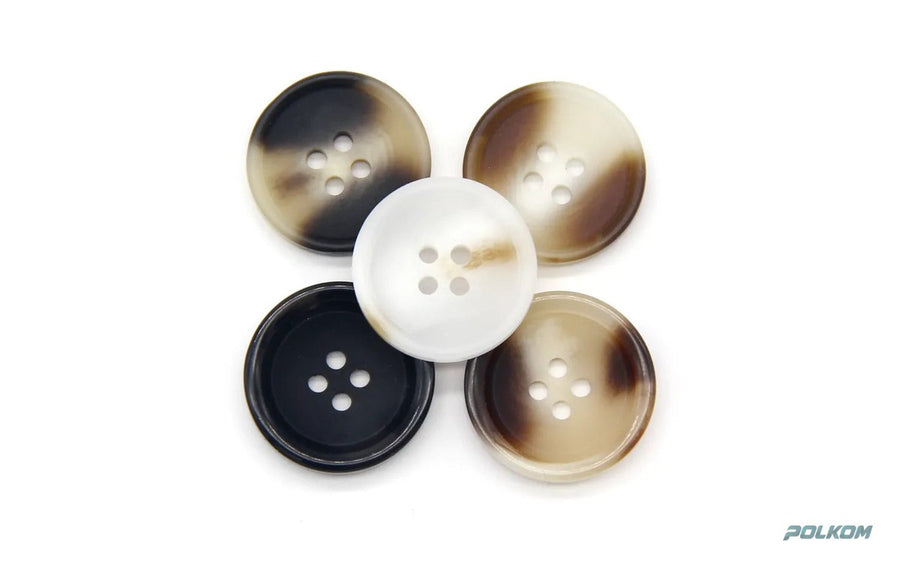
The most common type. They have two or four holes and are sewn on with thread through them. Flat two-hole buttons are typical of shirts, blouses and children's clothing, while four-hole ones are used for jackets, coats, trousers and uniforms. They are convenient for machine sewing and are made in practically every material.
Shank buttons
Underneath they have a loop (shank) through which the thread passes, and the face is smooth with no holes. This keeps the design, logo or engraving intact. The shank creates a natural distance from the fabric, so these buttons suit thick materials, knitwear and blazers.
Press-on buttons
They are not sewn but attached with a hand or automatic press. This group includes jeans buttons, snap buttons and eyelets. They withstand heavy load and frequent washing, which is why they are standard on denim, workwear and children's clothing. Searches for "no-sew buttons" usually refer to exactly these.
Toggles
Elongated buttons that fasten into a loop of cord or leather. They are associated with duffle coats but are also found on cardigans and bags.
Fabric-covered buttons
A metal or plastic base covered with fabric, leather or faux leather. They are used when the button must be in exactly the same colour and material as the garment – on dresses, bridal styles and jackets.
Magnetic and concealed fastenings
Magnetic buttons fasten without a buttonhole and are convenient for bags, adaptive clothing and garments for people with limited mobility. Concealed buttons are sewn into a separate placket and are not visible from the front.
Types of buttons by material
| Group | Materials | Strengths |
|---|---|---|
| Synthetic | polyester, urea, acrylic, nylon | price, a huge choice of colours, consistent quality across the run |
| Metal | brass, zinc alloy, aluminium, steel | strength, raised logo, various finishes |
| Natural | corozo, mother-of-pearl, horn, bone, wood, coconut | unique texture, prestige, a more sustainable profile |
| Combined | metal with enamel, polyester with a metal rim, fabric-covered | decorative effect, combining materials |
Synthetic buttons take the largest share in mass-market garment production because they allow exact colour matching to a sample and stable repeat orders. Natural materials are chosen by brands looking for a premium feel or focusing on sustainability, and metal ones for denim, outerwear and uniforms.
Functional and decorative buttons
A functional button holds the garment closed and must withstand strain and washing. A decorative button has a purely aesthetic role – on a sleeve, pocket, epaulette or belt. Decorative buttons for clothing can be heavier, with crystals, pearls or stones, with enamel and unusual shapes, because they do not pass through a buttonhole. Even so, they must be securely sewn and withstand the care stated on the label.
Types of buttons by garment
- Shirts and blouses – small flat buttons with 2 or 4 holes, polyester or mother-of-pearl.
- Jackets and suits – four-hole or shank buttons, corozo, horn, imitation horn, metal on blazers.
- Coats – large four-hole or shank buttons, toggles, fabric-covered models.
- Trousers and skirts – four-hole buttons for the waistband or a press-on jeans button.
- Denim and workwear – press-on metal buttons and eyelets.
- Children's and baby clothes – snap buttons, flat buttons without sharp edges.
- Knitwear – shank buttons, wood, leather, horn.
How to choose the right type
Start with the construction: if the garment is denim or will be washed often at high temperatures, prefer press-on buttons or strong synthetic models. Then choose the material according to the price positioning and the style of the collection. Finally, determine the size in ligne and the colour. For mass production, the advice is to test the sample on the real fabric and with the real wash programme before releasing the run.
The widest choice in the mass-market segment is offered by polyester buttons, and when the colour and material of the button must match the garment completely, take a look at fabric-covered buttons.
Surfaces and finishes
The same type of button can look completely different depending on the finishing. The most common finishes are gloss, matt, satin, marble or horn effect, pearlescent sheen, laser engraving and, on metal models, plating – nickel, gold, antique, gunmetal. The choice of finish is as important as the material, because it determines whether the button blends with the fabric or becomes an accent.
All types of buttons from one manufacturer
Polkom is a Bulgarian manufacturer and wholesaler based in Sofia, with more than 10,000 articles in the catalogue. In the buttons category you will find synthetic, metal and natural models, as well as production to your design and with your logo. Send an inquiry with a description of the garment – we will suggest suitable types and samples.