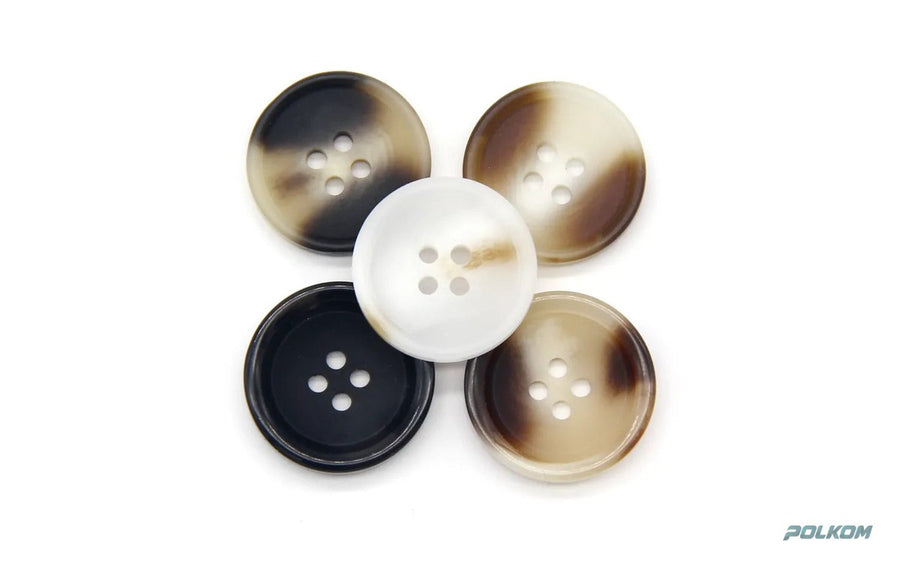
Manufacturer · Fashion & Home Accessories




Corozo button sizes are given in ligne (L), where 1L = 0.635 mm. The most commonly used sizes are 16L–18L (about 10–11.5 mm) for shirts, 24L (about 15 mm) for jacket sleeves, 30L–32L (about 19–20 mm) for jacket fronts and 36L–44L (about 23–28 mm) for coats. Because corozo is cut from the nut of the tagua palm, the largest diameters and thicknesses are limited by the size of the nut itself.
What a ligne (L) means
The ligne is a traditional unit of measurement in button manufacturing. It comes from old French and German practice and is still used today by manufacturers and tailors all over the world. The formula is simple: diameter in millimetres = number of lignes × 0.635. Conversely: number of lignes = diameter in mm ÷ 0.635. For example, a 32L button is 32 × 0.635 = 20.32 mm.
Corozo button size chart
| Ligne (L) | Diameter (mm) | Typical use |
|---|---|---|
| 14L | 8.9 | Button-down collar, small details |
| 16L | 10.2 | Shirts, blouses, cuffs |
| 18L | 11.4 | Shirts, skirts, light knitwear |
| 20L | 12.7 | Blouses, pockets, children's clothing |
| 22L | 14.0 | Knitwear, trousers |
| 24L | 15.2 | Jacket sleeves, waistcoats, cardigans |
| 26L | 16.5 | Waistcoats, knitwear |
| 28L | 17.8 | Light jackets, cardigans |
| 30L | 19.1 | Jacket front |
| 32L | 20.3 | Jacket and blazer front |
| 36L | 22.9 | Trench coats, light coats |
| 40L | 25.4 | Coats |
| 44L | 27.9 | Heavy coats and outerwear |
The chart is a guide. The final size depends on the pattern, the fabric thickness, the buttonhole length and the brand's style.
Why corozo has a size limit
The tagua nut is roughly the size of a hen's egg and has a hollow inside. Buttons are cut from the dense zone, so the thickness and diameter of the blank are limited. Small and medium sizes are produced without any problem, while in the largest sizes for coats the choice of models and thicknesses is narrower. If you need a very large or very thick button, discuss it in your inquiry – sometimes the solution is a different profile or a combination with horn buttons.
How to measure a button correctly
- Use a calliper, not a ruler – a difference of half a millimetre is already a different size.
- Measure the widest part of the button, including the rim.
- For shank buttons, measure only the diameter of the face, without the shank.
- Also measure the thickness – it matters for the buttonhole and the look of the button.
- Convert the millimetres to lignes and round to the nearest standard size.
Buttonhole size
The buttonhole must be slightly longer than the button's diameter so that the button passes through freely. A practical rule is buttonhole length = diameter + button thickness. For thick corozo buttons with a domed profile, add a little more, otherwise buttoning will be difficult and the buttonhole will fray faster. Always make a test buttonhole on the actual fabric.
Recommended sizes by garment type
Shirts
Front and cuffs 16L–18L, button-down collar 14L. Corozo for shirts is thinner, with four holes and a slight rim.
Jackets and suits
Front 30L–32L, sleeves 24L. Double-breasted jackets often have 32L on the front and an inside button of 24L or smaller. You will find more details in our men's buttons section.
Waistcoats
24L–26L, denser, usually with four holes.
Coats
36L–44L depending on volume and style. Inside buttons are added for double-breasted coats.
Knitwear and cardigans
22L–28L, often with a more pronounced profile that sits well on the knit.
Thickness and profile
Two buttons with the same diameter can look completely different because of thickness and profile. A flat, thin button is discreet, while a thick one with a rim or domed centre is more noticeable. Corozo allows different profiles – flat, rimmed, concave, domed. When ordering, state the desired profile in addition to the ligne size, or send a sample.
How to specify the size in the technical sheet
Button size mistakes most often come from an incomplete specification. In the model's technical sheet, record for each button:
- the size in ligne and in millimetres, for example 32L / 20.3 mm;
- the type – two or four holes, or a shank;
- the profile and thickness;
- the colour and finish – natural, dyed, matt, polished;
- the position on the garment – front, sleeve, pocket, inside button;
- the number of buttons of this size per garment, including spares.
Such a sheet lets the button manufacturer and the garment factory work from the same information and reduces the risk of sizes being mixed up during sewing. It is a good idea to attach a photo or sketch of the garment with the positions marked.
A set of sizes for one garment
A garment usually uses two or three sizes of the same model: for example 32L for the front and 24L for the jacket sleeves, plus a spare button. All sizes should ideally come from one model and one dye lot so they look like a set. State in your inquiry the number of buttons of each size per garment and the total number of garments.
Ordering from a manufacturer
Polkom is a Bulgarian manufacturer and wholesaler of garment accessories based in Sofia. We offer corozo buttons in the standard ligne sizes, natural and dyed, with the option of a logo. We send samples so you can check the size on your fabric and buttonhole. Minimum quantities depend on the article – write to us via our contact page.