Manufacturer · Fashion & Home Accessories




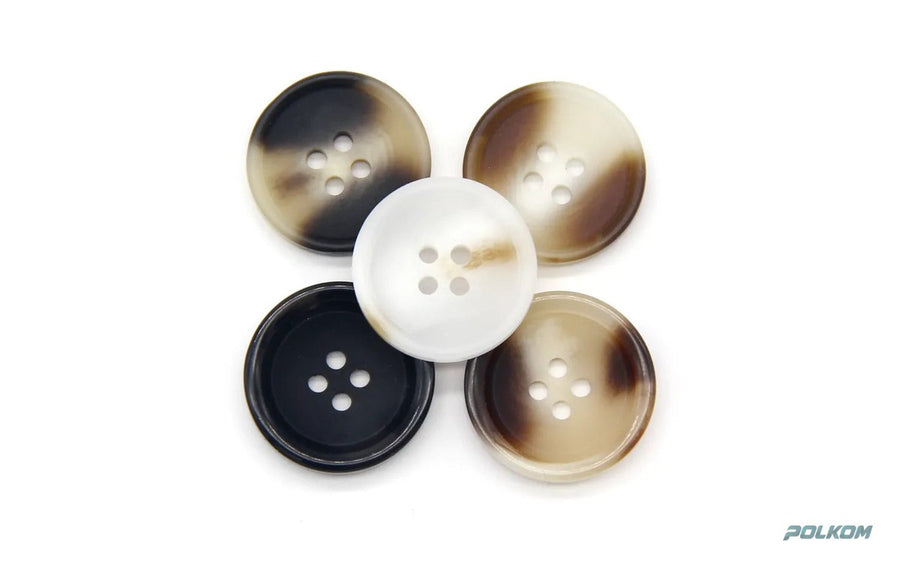
To order urea buttons wholesale without surprises, send the manufacturer a full specification – model, size in ligne, number of holes, colour, finish, logo and the garment's care regime – and approve physical samples before the series. A correctly described order saves corrections, delays and shade differences between batches. Below is a practical checklist for garment factories, brands and uniform manufacturers.
Urea buttons wholesale – what the specification should include
| Parameter | What to state | Example |
|---|---|---|
| Model | Catalogue code or a sketch with the profile | Flat, rounded rim, concave centre |
| Size | In ligne (L) or mm | 18L (11.4 mm) and 24L (15.2 mm) |
| Holes | 2, 4 or shank | 4 holes |
| Thickness | For a specific buttonhole or machine | According to the model |
| Colour | Code, Pantone or fabric swatch | Fabric swatch, batch X |
| Finish | Matt, satin, effect | Matt |
| Logo | Method and vector file | Tone-on-tone laser engraving |
| Use | Garment type and care regime | Shirt, 60 °C wash, industrial pressing |
| Quantity | By size and colour | Separately for each size |
| Packaging | Counting and labelling requirements | By size and colour |
The more precise the specification, the faster you will receive a quote and samples. You can browse the available models in the urea buttons category.
How to calculate the quantity
- Count the buttons on one garment by size – front, cuffs, collar, pockets, spare button.
- Multiply by the number of garments in each garment size.
- Add a reserve for rejects during sewing and for repairs – usually a few percent, depending on the factory's experience.
- If the garment will be reordered, consider a larger batch of one colour to ensure a consistent shade.
Minimum quantities depend on the article and on whether the colour is standard or custom – send an inquiry.
Samples: what to test
A sample is not a formality. Use it to check the button in the real production process:
- Button-sewing machine – does the button feed without jamming and without being scratched by the clamp.
- Buttonhole – does the button pass through easily, without stretching the buttonhole and without slipping out.
- Colour – comparison with the fabric in daylight and artificial light.
- Washing and ironing – several cycles following the care label regime, including an industrial press.
- Seam strength – a pull test after washing.
Inspection when receiving the batch
When the goods arrive, check cartons from different places at random:
- size conformity with a calliper – diameter and thickness;
- colour against the approved sample;
- holes – centred, clean, without edges that cut the thread;
- surface – no cracks, chips or stains;
- logo – legibility and position.
If you find a deviation, document it with photos and samples and contact the supplier before sewing. After sewing, every complaint is much more expensive.
The costliest mistakes in wholesale orders
Ordering without a sample
Especially with a custom colour. A difference in shade is noticed only when the buttons have been sewn onto hundreds of garments.
The wrong material for the care regime
If the garment is pressed or washed at a high temperature, a cheaper polyester button may turn out more expensive because of complaints. Conversely, with gentle home care, urea is not essential.
Split orders for different sizes
If 18L and 28L are ordered at different times, the shade may differ slightly. Order all sizes in one colour together.
An unclear logo
The logo must be legible on the smallest button size. Use a simplified version if necessary. Examples can be found in the engraved buttons category.
No reference sample
Keep the approved samples and codes. They are the basis for every subsequent top-up order and the only objective criterion in a dispute about colour or size.
What determines the price
- size and thickness of the button;
- complexity of the model and the number of finishing operations;
- standard colour or colour to a sample;
- presence and method of a logo;
- quantity per article and colour.
For a specific price, send a request for a quote with the specification.
Logistics and planning
Buttons are a small component, but a shortage stops the whole line. A few rules help avoid downtime:
- plan the button order together with the fabric order, not after cutting;
- for colours to a sample, allow time for trial buttons and a possible correction;
- specify the packaging – by size and colour, clearly labelled, so the articles do not get mixed up in the warehouse;
- for seasonal collections, order a reserve for top-ups instead of releasing a new small batch.
Production and delivery times depend on the article and quantity and are specified in the quote.
Why work directly with a manufacturer
Direct contact with the manufacturer shortens the chain for colour corrections and top-up orders. You can discuss technical questions – thickness, profile, behaviour in the machine – with the people who make the buttons, and receive samples faster.
Urea buttons wholesale from Polkom
Polkom is a Bulgarian manufacturer and wholesaler of garment accessories based in Sofia, with over 30 years of experience and more than 10,000 articles. We offer urea buttons from stock and to order – colour-matched to a sample and with logo, with fast sampling and delivery across the EU. Send your specification via our contact page, to info@polkom.com or on +359 876 76 60 50.