 Manufacturer · Fashion & Home Accessories





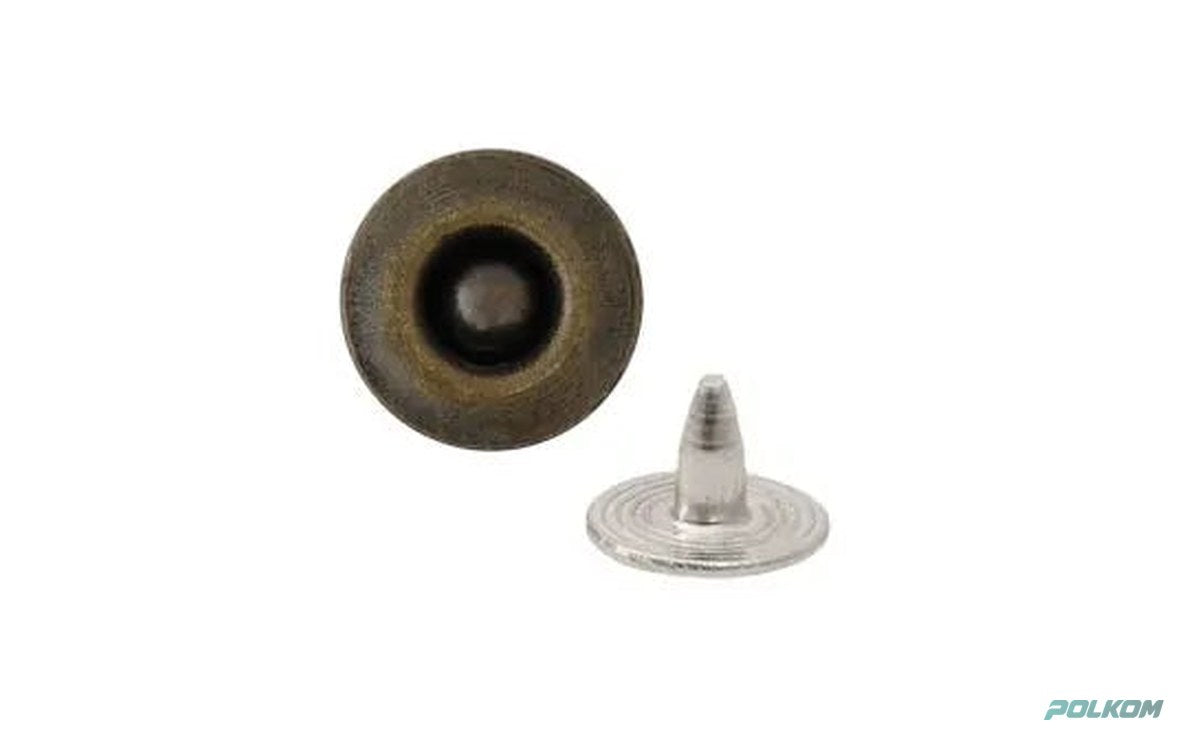
The large metal button on the waistband of jeans is called a jeans button or tack button, also known as a denim button or shank button. It is not sewn on but fixed from the inside with a metal tack (nail). The small metal studs at the corners of the pockets are rivets, which reinforce the seams. The two look similar, but they differ in function, construction and size.
What are metal buttons on jeans called?
In garment making and in the trade, the same button goes by several names:
- jeans button or denim button: the most common names;
- tack button: describes how it is fixed, with a tack instead of thread;
- metal shank button for denim: also used on denim jackets, skirts and shirts;
- jean tack button or no-sew jeans button: terms you will see in catalogues, repair kits and specifications.
A button whose cap turns around its axis is a rotating (swivel) button. One with a hole in the middle of the cap, through which the head of the tack shows, is an open-cap (donut) button. Types and sizes are covered in detail in our article on metal jeans buttons: types and sizes.
What are denim buttons called, part by part?
| Part | Also called | What it is |
|---|---|---|
| Cap | top, face | The visible front, often with a logo or lettering |
| Shank | post, neck | The hollow part under the cap that goes through the buttonhole |
| Tack | nail, pin | The back part with a disc and spike that pierces the fabric from the inside |
| Tack base | back, washer | The round disc that stays on the inside of the waistband |
During attaching, the spike of the tack enters the shank and is spread by the press. This gives a joint that cannot be taken apart and holds far better than a sewn button. For the practical side, read our guide on attaching metal buttons.
Denim buttons and rivets: what is the difference?
Buyers often call rivets "buttons" too, because from the front they look like small metal caps. The difference is in their job:
| Feature | Jeans button | Rivet |
|---|---|---|
| Function | Fastens the waistband | Reinforces a seam and decorates |
| Position | Waistband, cuffs and front of a jacket | Pocket corners, base of the fly, belt loops |
| Goes through a buttonhole | Yes | No |
| Usual diameter | 14–20 mm | 6–12.5 mm |
| Parts | Cap with shank and tack | Cap and base with a rivet post |
Both are attached with a press and a matching die and are usually ordered in the same finish so they look like a set. Exactly where rivets go is explained in jeans rivets: placement and sizes.
Where jeans rivets come from
The metal rivets on pockets go back to the beginnings of jeans as workwear. In 1873 a US patent was granted to Jacob Davis and Levi Strauss for reinforcing the pockets of work trousers with metal rivets. The idea was simple: the seam at a pocket corner is the first to tear, and the rivet takes the strain. Since then the rivet has become both a functional part and a recognisable style signature of denim.
Other metal parts on jeans
Apart from the button and the rivets, jeans and denim jackets can carry other metal details, each with its own name:
- metal zip on the fly, with an auto-lock slider that does not open by itself;
- snap buttons on denim shirts and jackets, often prong snaps for lighter denim (snap buttons);
- metal logo plate on a pocket or the waistband, fixed with prongs or rivets;
- eyelets: metal rings for openings, for example for a cord or ventilation.
Terms you will need when ordering
If you order jeans buttons and rivets wholesale, use precise terms so that the quote and the sample match your expectations:
- cap diameter in mm: 14, 17, 20 mm;
- fixed or rotating button;
- solid or open cap;
- tack length to suit the thickness of the waistband;
- material: brass or stainless steel;
- finish: for example antique brass, copper, black, gunmetal or nickel colour;
- logo: raised, recessed or around the rim of the cap.
The finish should match the zip and the rivets. How to choose the colour according to the denim wash is explained in colour of metal jeans buttons and rivets.
How to recognise a quality jeans button
Once you know what the parts are called, it is easier to judge their quality. When you check a sample or buy buttons, look at the following:
- the finish is even, including the rim of the cap, with no spots and no other colour showing through;
- the shank is centred and free of burrs that could cut the buttonhole;
- the tack spike is straight and sharp so that it pierces the denim without tearing it;
- the logo is crisp and equally deep all the way around;
- the button is nickel free, which matters for the skin around the waist and for the EU market.
The surest test is a trial fitting on the real waistband and a wash with the programme you will use in production. That shows whether the tack has the right length and how the finish holds up after washing.
Jeans buttons on different styles
Classic five-pocket jeans have one button on the waistband, rivets on the front pockets and coin pocket, and a metal zip. Button-fly jeans use four or five smaller buttons on the fly instead of a zip, plus a larger one on the waistband. A denim jacket carries buttons on the front, pockets and cuffs, often in two sizes. Denim skirts and dungarees combine buttons, rivets and sometimes adjustable buckles. In every case, the metal parts should come from one series and one finish.
Jeans buttons and rivets from the manufacturer
Polkom is a manufacturer of jeans buttons and rivets with over 30 years of experience. We make fixed and rotating buttons in brass and stainless steel from 14 to 20 mm, rivets from 6 to 12.5 mm, and matching sets in one finish with your logo. All our metal accessories are nickel free, and our products are covered by an OEKO-TEX® certificate. For samples and a quote, contact us.


