Manufacturer · Fashion & Home Accessories












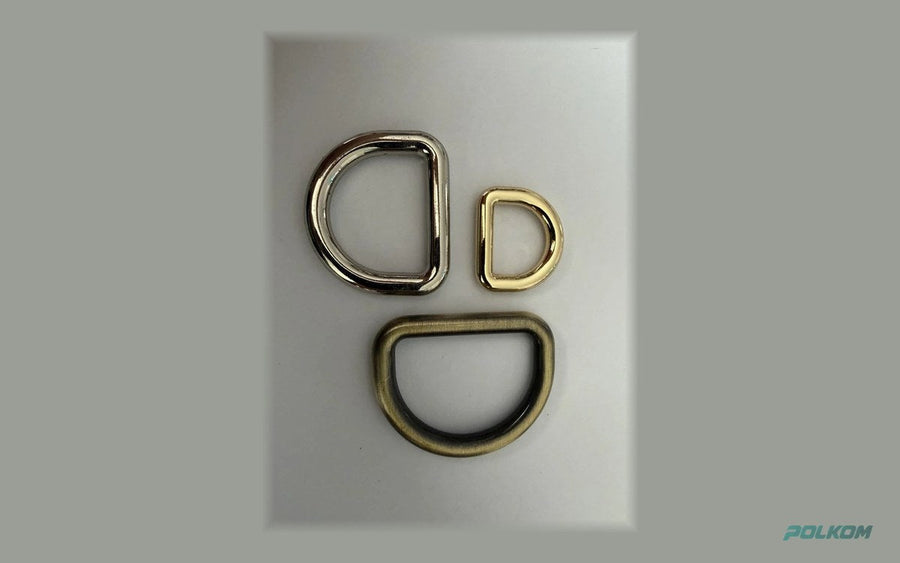
Ring sizes are given by the inner dimension – the clear opening the strap passes through. For D-rings and rectangular rings this is the inner width of the straight side; for round rings, the inner diameter. The inner dimension should equal the strap width plus a small allowance for its thickness; the wire thickness is specified separately.
Main ring dimensions and how they are measured
When ordering rings, the following parameters are usually used, all in millimetres:
- Inner width (W) – for D-rings, rectangular and triangular rings: the clear length of the straight side.
- Inner diameter (ID) – for round rings: the opening at its widest point.
- Outer diameter or width – the overall size, important for design and packaging.
- Inner depth – for D-rings: the distance from the straight side to the curve.
- Wire or section thickness – determines strength and visual weight.
Why the inner, not the outer, dimension
Two rings with the same outer diameter can have different openings if one is made of thicker wire. For the strap, only the clear opening matters. So always state in the specification whether the size is inner or outer – this is the most common cause of misunderstandings between product manufacturer and accessory source.
How to measure yourself
- Use a caliper, not a ruler. At small sizes a difference of one millimetre is significant.
- Measure on the inside, between the inner edges of the wire.
- On a D-ring measure the straight side; on a round ring, two perpendicular diameters to check that the ring is round and not slightly oval.
- Measure the wire thickness at a point without a seam.
- Also note the profile shape – round, flat, bevelled.
How much allowance to leave for the strap
A strap is not infinitely thin. When it is folded around the ring and stitched, two layers of material enter the opening, and its edges may be folded or bound. So:
- with thin woven tapes and grosgrain the allowance is minimal – the ring is the width of the tape or only very slightly wider;
- with dense webbing for backpacks and belts, leave a little more room so the webbing does not bunch in the corners;
- with leather straps with folded edges the allowance is largest, because leather is stiff and does not compress.
The safest method is to measure the finished strap – with folds and stitching – and check a ring sample with it.
Most requested ring sizes
| Inner width | Suitable strap | Typical application |
|---|---|---|
| about 10–15 mm | Narrow tapes, cords, thin leather straps | Purses, jewellery, dress belts |
| about 20 mm | Tapes and straps of about 20 mm | Women's handbags, collars for small dogs |
| about 25 mm | Tapes of about 25 mm | Shoulder bags, textile belts, backpacks |
| about 30 mm | Belts and shoulder straps of about 30 mm | Belts, sports bags |
| about 40 mm | Wide belts and straps | Men's belts, shopping bags |
| about 50 mm | Wide webbing | Travel and tactical bags, harnesses |
The chart is a guide. The exact size depends on the thickness and stiffness of the specific strap.
Size and product proportions
Size is not only a technical decision but a visual one. A small ring on a large bag looks accidental, while a heavy ring on a thin dress weighs it down. On fashion products, designers often choose a thicker wire or flat profile to emphasise the ring without changing the strap width. On belts, ring size is usually coordinated with the buckle, and on shoulder straps with the width of the tape.
Split ring sizes for key rings
Key rings are measured differently – usually by the outer diameter, with the width and thickness of the flat wire given separately. There is no strap allowance, but what matters is how many keys or charms they must hold and how easily they open. Denser wire holds more securely but is harder to open.
Wire thickness – how to choose
Wire thickness is rarely mentioned, but it determines both the strength and the character of the ring. Thin wire looks delicate and suits dresses, lingerie and small accessories. Medium thickness is standard for women's handbags and textile belts. Thick wire and solid die-cast profiles are chosen for men's belts, backpacks and products in a workwear or military style. The ratio between wire thickness and strap width should look natural – if in doubt, compare two samples on the real product.
Tolerances
In series production of rings there are small size deviations, especially on styles bent from wire. If the strap is exactly the width of the ring, even such a small deviation can make some of the rings unusable. So the size allowance is not only for convenience but also for production stability. When ordering to a drawing, specify which dimensions are critical and what tolerance is acceptable to you.
How to describe the size in an inquiry
To get an accurate quote, state:
- the ring shape;
- the inner width or inner diameter in mm;
- the wire thickness or desired profile;
- the strap material and its thickness;
- the finish and approximate quantity.
If you have an existing ring or strap, the easiest thing is to send a sample or a photo with a caliper next to it.
Rings to size from Polkom
Polkom is a Bulgarian manufacturer of haberdashery and accessories for fashion, furniture, footwear and bags, selling wholesale, with over 30 years of experience. We offer rings in a wide range of sizes and shapes, and if needed we make non-standard sizes to your drawing. Samples are made quickly, and delivery covers the whole EU. Send an inquiry with the dimensions and we will prepare a proposal.