Manufacturer · Fashion & Home Accessories





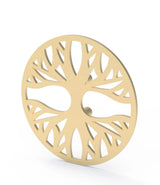

Die-cast or stamped metal logo plate – the choice depends on the relief, weight and shape you are looking for. A die-cast plate is cast from zinc alloy in a mould and allows a deep, multi-level relief, thickness and pins on the back – it is suitable for bags, belts and luxury accessories. A stamped plate is cut and embossed from thin sheet brass, steel or aluminium – it is light, thin and economical in large runs, which is why it dominates in clothing.
How a die-cast plate is made
In die casting, molten zinc alloy (often called zamak) is injected under pressure into a steel mould with the logo cut into it. After cooling, the plate is cleaned of casting flash, ground and given an electroplated finish. The mould can have several levels of depth, rounded and bevelled edges, holes and pins. The plate comes out of the mould almost ready for fitting.
Advantages
- Deep 3D relief with several levels
- Free shape – following the outline of the logo, with cut-out areas
- Pins, screw bosses or lugs cast together with the plate
- Solidity and weight that are perceived as quality
Limitations
- Greater thickness and weight – not suitable for thin fabrics
- Requires a mould to be made, which increases the initial cost
- Zinc alloy is more sensitive to corrosion if the finish is scratched
How a stamped plate is made
Stamping starts with sheet metal – brass, copper, stainless steel or aluminium – of a defined thickness. A stamping tool (die and punch) cuts the outline and forms the relief of the logo under high pressure. Prongs, holes and bends can be added. The plate is then polished and finished.
Advantages
- Thin and light – suitable for garments, swimwear, hats
- Prongs can be stamped from the same sheet
- Brass and steel are more durable than zinc alloy
- Cost-effective for very large runs, because the process is fast
Limitations
- The relief is shallower and usually on one level
- The back is a mirror image of the face – recessed where the face is raised
- Pins cannot be cast and have to be added separately
Comparison: die-cast or stamped metal plate
| Parameter | Die-cast | Stamped |
|---|---|---|
| Material | Zinc alloy | Brass, copper, steel, aluminium |
| Thickness | Usually above about 1.5 mm | Usually about 0.5–1.5 mm |
| Relief | Deep, multi-level | Shallow, single-level |
| Back | Flat, with pins or bosses | Mirror relief, with prongs or holes |
| Shape | Very free | Free, but without internal volume |
| Weight | Heavier | Light |
| Typical use | Bags, belts, wallets, luxury accessories | Jeans, jackets, hats, swimwear, children’s clothing |
Costs: what you pay for
Both technologies involve an initial tooling cost – a casting mould for die-cast plates, a stamping tool for stamped ones. It does not depend on the quantity and is spread over the order, so in small runs its share per piece is larger. In addition, the price is affected by size and weight, the complexity of the relief, the finish, enamel, the attachment and the quantity. A specific price is given after a request for a quote, once these parameters are known. If you already have tooling from a previous order, repeat runs are more cost-effective.
When to choose a die-cast plate
- The logo has several levels or a sculptural effect
- The plate is the main decorative element of a bag or belt
- Pins or screws are needed for invisible fitting
- You want the plate to match die-cast buckles and rings in the same style
When to choose a stamped plate
- The plate is for a garment that is washed and must be light
- Attachment is with prongs or by sewing
- The run is large and every gram and every second of fitting matters
- The logo is flat and graphic
Combined solutions
The two technologies are not mutually exclusive. A die-cast plate can have an engraved serial number, and a stamped one an enamelled logo. Some brands use a die-cast plate for their bags and a stamped plate with the same design for their clothing, so the collection stays consistent. Similar logic applies to metal buttons, which are also made die-cast or stamped from brass.
Finishes for both technologies
Both die-cast and stamped plates accept practically the same electroplated finishes – nickel colour (nickel free), gold, antique brass, antique copper, gunmetal, black, as well as matte, satin and polished versions. The difference lies in how the relief looks under the finish. On a die-cast plate, the deep areas can be left dark and the raised areas polished, which gives a strong antique effect. On a stamped plate, the relief is shallower and the contrast between levels is finer, so a combination of gloss and matte or enamel is often used. If the antique effect matters to you, a die-cast plate usually gives a more expressive result.
What the back of the plate tells you
A detail that is often overlooked is the back. On a stamped plate it mirrors the face and is visible if the plate is fitted where the reverse side is not covered. On a die-cast plate the back is flat and can carry a second inscription, an article number or an authenticity mark. On bags with an opening flap, this matters for the overall impression.
How to decide quickly
- Define the product and the material on which the plate will sit.
- Decide on the attachment method – it often determines the technology by itself.
- Assess how much depth the logo should have.
- Consider the weight and comfort in wear.
- Discuss the quantity so that the tooling cost can be spread.
Die-cast and stamped plates from Polkom
Polkom makes metal logo plates with both technologies and helps you choose according to the product, attachment and quantity. All Polkom metal products are nickel free. Send us your logo and a description of the product via the contact page – we will suggest the right option and a sample for approval.