Manufacturer · Fashion & Home Accessories












Contents
Eyelet durability depends on four things: the eyelet material, the metal thickness, the construction (washer, inner ring, flange width) and above all correct setting. Brass eyelets do not rust and withstand washing and moisture, galvanised steel suits tarpaulins used on land, and the stainless steel mesh in ventilation eyelets does not corrode. Most failures, however – a split shank, a pulled-out eyelet, deformed material – are due to setting mistakes, not the eyelet itself.
In this article we look at what makes an eyelet strong, how to set it so it lasts the whole life of the product, and how to recognise and fix the most common problems.
Eyelet durability by material
| Material | Series | Behaviour in moisture | Best suited for |
|---|---|---|---|
| Brass | KS, KP, KO, KF, KL, KT-01 to KT-04 | does not rust; may darken over time | apparel, footwear, bags, washable products, marine covers |
| Galvanised steel | KT-05 to KT-08 | the zinc layer protects the steel as long as it is intact | truck tarpaulins, trailers, awnings on land |
| Brass + stainless steel mesh | KM | does not corrode, the mesh keeps its shape | ventilation in jackets, footwear, caps, mattresses |
The finish matters too. Finishes are applied to the brass and can wear at the edge of the flange over time, especially on eyelets through which a cord is constantly pulled. For heavy-use products, choose a finish where wear is less noticeable – for example antique brass or gunmetal.
Metal thickness (MT)
MT is the thickness of the sheet metal the eyelet is made from. Thicker metal resists bending and pull-out better but needs more force when setting. Here is the range in our catalogue:
| Code | No. | D, mm | MT, mm | Comment |
|---|---|---|---|---|
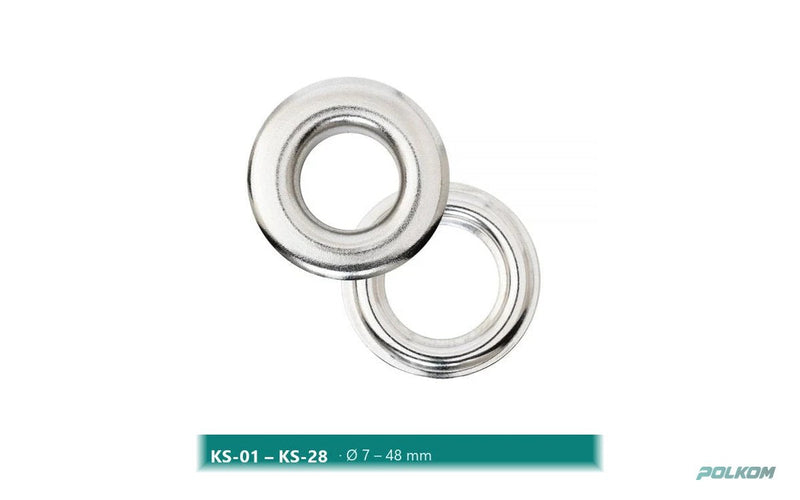
| KS-01 | 17 | 7 | 0.18 | the thinnest metal – fine laces and light garments |
| KS-12 | 5 | 15 | 0.2 | standard eyelet for sweatshirts |
| KS-13 | 5 | 15 | 0.25 | same number, thicker metal and an inner ring |
| KS-18 | 28 | 21.75 | 0.4 | narrow eyelet with a tall shank for heavy loads |
| KP-11 | 29 | 28 | 0.4 | flat eyelet with thick metal |
| KT-01 | 66 | 62.2 | 0.35 | grommet for tarpaulins; washers are 0.35–0.40 |
For products through which a cord is constantly pulled or which carry weight, compare MT together with the construction: an eyelet with an inner ring and thicker metal withstands significantly more than a thin standard eyelet with the same hole.
Construction and durability
- Washer – clamps the material from both sides and spreads the load. A metal washer is stiffer; a plastic washer is lighter and gentler on delicate fabrics.
- Inner ring – makes the eyelet stiffer; suitable for hoods, backpacks, curtains and awnings.
- Flange width – the wider the flange, the more widely the tension is spread. For leather, canvas and tensioned sheets, choose a wider flange.
- Toothed washer (KT-04) – grips smooth PVC materials and stops the eyelet from turning.
Setting that extends the eyelet’s life
- Choose the shank height according to the total thickness of all layers. The shank must pass through and leave enough to roll over.
- Prepare the spot – no seam, hem or step in thickness under the eyelet. With soft fabrics, add an interlining.
- Pre-punch the hole in dense, multi-layer and technical fabrics. The hole must not be larger than the shank.
- Use the exact die for the size and type of eyelet and for the washer. Check that it is not worn or deformed.
- Centre the die relative to the eyelet – an off-centre strike deforms the flange.
- Adjust the force – too strong a strike splits the shank, too weak does not roll it fully.
- Check the first pieces front and back before starting the run.
Common problems and solutions
| Problem | Common cause | Solution |
|---|---|---|
| The shank splits | strike too strong, wrong or worn die, shank too tall | suitable die, lighter strike, shorter shank |
| The eyelet pulls out under tension | thin material, hole larger than the shank, insufficient rolling | reinforcement, smaller hole, wider flange or washer |
| The material around the eyelet deforms | unsuitable fabric structure, poor tensioning, small flange | wider flange, reinforcing tape, tensioning during setting |
| The surface scratches or cracks | deformed die, strike too strong | replace or polish the die, less force |
| The eyelet loses its shape | off-centre die, die for a different size | centring, die for the exact size |
| The shank does not roll fully | weak strike, thicker material, short shank | stronger strike, longer shank, pre-punched hole |
You will find the same advice in the Common setting problems section of the eyelets page.
Caring for products with eyelets
- Wash garments with eyelets inside out – this way the eyelets do not hit the drum and the finish wears more slowly.
- Do not iron directly over the eyelets; iron around them or through a cloth.
- Rinse products exposed to seawater in fresh water and dry them before storage.
- Do not fold tarpaulins and awnings exactly along the line of eyelets – the material around them creases and breaks.
Samples and trial setting
The surest way to assess durability is a trial setting on your material. Send us samples of the fabric or leather – we will do a trial setting and, if needed, prepare a technical sheet with instructions. If the eyelets carry a logo, see also the Branding page. Rivets and cords in the same finish are often ordered together with eyelets.
Eyelets from Polkom
Polkom is a Bulgarian manufacturer from Sofia with over 30 years of experience in accessories for fashion, furniture, footwear and bags, as well as for technical textiles. An OEKO-TEX® certificate is available for all our products. Send an inquiry with a description of the product and material – we will recommend an eyelet and send samples.
Share this article