 Manufacturer · Fashion & Home Accessories











Contents
Eyelets for corsets and lace-up closures work under a higher load than almost any other eyelet in clothing. When tightened, the cord pulls on each hole individually, and if the eyelet is too small, too thin or set in a weak fabric, it distorts or pulls out. In this article we look at how to choose the size, type and placement of eyelets for corsets, bodices, bustiers, dresses with back lacing, boots and leather goods with lacing.
Where lacing eyelets are used
- corsets and bodices – back or front with tight lacing;
- bridal and evening dresses – lacing down the back instead of a zip or combined with one;
- bustiers, bodysuits and lingerie – decorative lacing on the front;
- leather jackets, waistcoats and trousers – lacing at the sides or on the sleeves;
- shoes and boots – for these see also the article eyelets for footwear;
- carnival and stage costumes, where the lacing is part of the look.
How to choose the eyelet size relative to the cord
The inner hole of the eyelet should be slightly larger than the thickness of the cord, so that it runs freely when tightened without rubbing against the edge. If the hole is too narrow, the cord wears and tightening becomes difficult. If it is too wide, the cord moves about and the lacing looks untidy.
| Product | Cord or lace | Suitable eyelet |
|---|---|---|
| Lingerie, bustiers, fine dresses | thin cord or satin ribbon | small flat eyelet |
| Bodice and evening dress | 3–5 mm cord or flat ribbon | standard or flat eyelet with a medium hole |
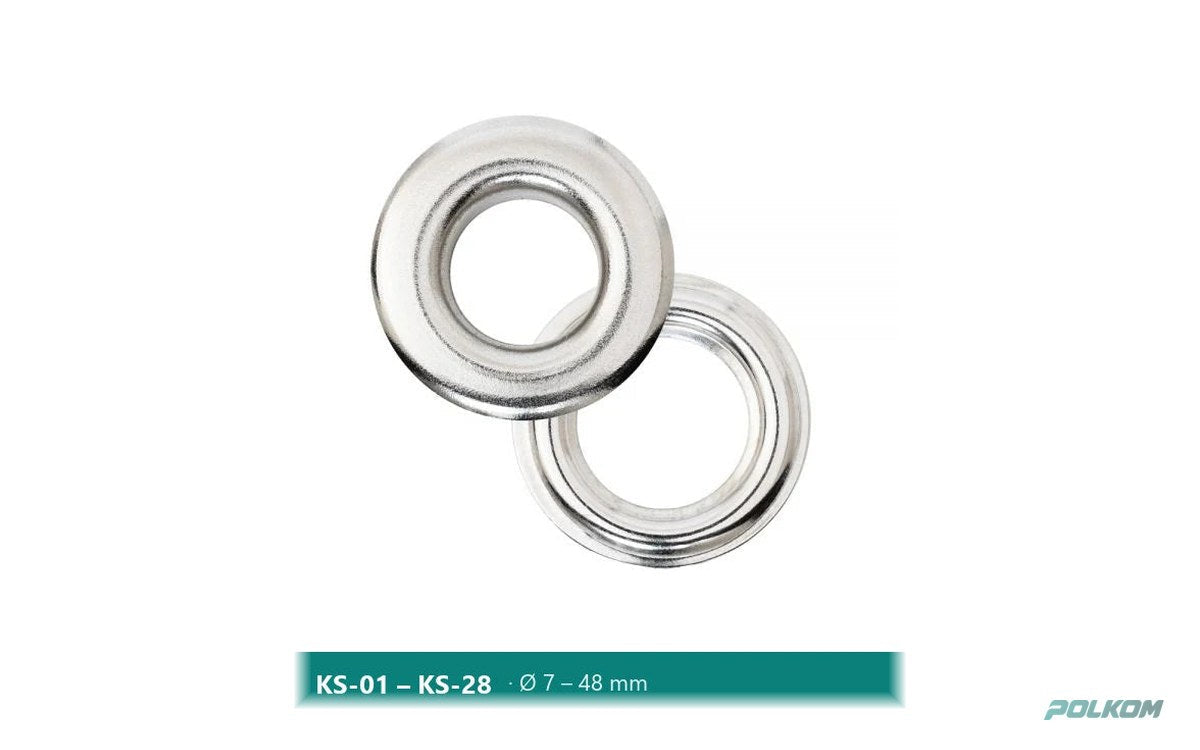
| Tightly laced corset | strong flat or round cord | double-sided eyelet or eyelet with washer |
| Leather jacket, waistcoat, boot | leather lace or thick cord | leather eyelet with a longer barrel |
You will find the exact outer diameters, heights and inner holes of each series in the eyelet size table. For cord thickness, see also cord thickness for clothing.
Eyelet with washer or double-sided eyelet
On corsets the load is at its highest, so a plain eyelet without a washer is often not enough. The washer at the back spreads the tension over a larger area, and a double-sided eyelet has a smooth, finished side both outside and inside – important when the inside of the garment touches the skin. You can read more about the differences in the article double-sided eyelets and eyelets with an inner ring.
Spacing between eyelets
The spacing between eyelets determines how evenly the tension is distributed and how the lacing looks.
- on corsets the eyelets are set closer together – that way the cord does not form large gaps and each hole takes less load;
- on decorative lacing the spacing can be wider, because the function is mainly visual;
- at the waist of a corset, where the tension is strongest, the eyelets are often placed closer together than at the top and bottom;
- the two rows must be exactly opposite each other – use a template rather than marking by hand.
Preparing the fabric and leather
An eyelet is only as strong as the material around it. On corsets, the eyelet area is reinforced with several layers of fabric, interfacing or tape, and often with vertical bones on both sides of the row. With leather, the thickness determines the barrel length of the eyelet: if the barrel is too short, the eyelet does not roll over properly; if it is too long, it buckles and deforms. See also eyelets for leather for more details.
Setting – by hand or with a press
For small runs and samples, eyelets are set with hand pliers or a hand press; in series production, with a machine press and dies matched to the eyelet size. A correctly chosen die rolls the eyelet evenly, without cracks along the edge. The steps are described in the article how to set eyelets.
Finishes and look
Eyelets on corsets and eveningwear are often part of the design. Polished gold, light gold, antique brass, gun metal and black finishes give the same cut a different character. Light finishes are sought for white and pastel garments, and antique tones and gun metal for leather. All Polkom brass eyelets are nickel free – with us, "nickel" is only the name of the silver-tone colour.
Eyelets from the manufacturer
Polkom is a manufacturer of eyelets in almost every size – round and oval, standard, flat and with washers, as well as eyelets with your logo. Together with the eyelets you can also order cords and cord ends in the same tone. For custom production the minimum quantity is 1000 pcs, samples cost 50–100 €, and the production run is ready 10–20 days after sample approval, with delivery across Europe.
Share this article


