Manufacturer · Fashion & Home Accessories
Contents
Buttons are made in several stages: a blank is prepared from the material (a cast sheet, stamped metal, a sliced nut or wood), the profile is shaped on a lathe, the holes are drilled, then the button is polished, dyed or coated and finally inspected. The technology differs according to the material, but the logic is the same.
How polyester buttons are made
Polyester is the most widely used button material in mass-market clothing. Production starts with liquid polyester resin, to which a hardener, pigments and effect additives are added.
- Casting – the resin is poured into a rotating drum or a mould, where a sheet or rod is formed. The rotation creates effects such as veining, marble or a pearl sheen.
- Cutting blanks – while the material is still semi-hard, round blanks are punched from the sheet, and the rods are sliced into discs.
- Curing – the blanks are left to harden completely.
- Turning – automatic lathes shape the face and back: rim, recess, relief.
- Drilling – 2 or 4 holes are drilled, or a socket for a shank is made.
- Polishing – the buttons are tumbled in drums with abrasives and polishing agents until the desired gloss or matte finish is achieved.
- Dyeing and finishing – if required, they are dyed to a sample colour or lacquered.
This technology allows a huge variety of colours and effects, as well as a very good shade match within a run. That is why polyester buttons are the main choice for manufacturers.
A similar technology is used for urea buttons, but there the material is a thermosetting resin that is pressed in heated moulds. This produces buttons that withstand higher ironing temperatures. Nylon and acrylic buttons, on the other hand, are made by injection moulding in multi-cavity moulds, which allows complex shapes with identical dimensions.
How metal buttons are made
Metal buttons are made in two main ways:
- Stamping – a press cuts and shapes parts from brass or steel strip, which are then assembled. Jeans buttons, snap buttons and many shank buttons are made this way.
- Die casting – molten zinc alloy is injected into a steel mould. The method gives detailed relief and three-dimensional shapes, suitable for logos and emblems.
After shaping, the metal is cleaned, ground and electroplated – given a finish in nickel colour (nickel free), copper, gold, antique or gunmetal. Some models receive enamel, lacquer or powder coating. Finally the finish and the strength of the shank or mechanism are checked. You will find details on the types in the metal buttons category.
How buttons from natural materials are made
Corozo
The nuts of the tagua palm are dried and then cut into discs. The discs are turned, drilled and polished. Corozo takes dye well, so it is coloured in almost any shade while keeping its natural veining.
Mother-of-pearl
Round blanks are cut from thick shells with a tube drill. They are thinned, turned and polished to bring out the natural lustre.
Horn and bone
The raw material is cleaned, cut into plates and processed similarly to corozo. Every button has a unique pattern.
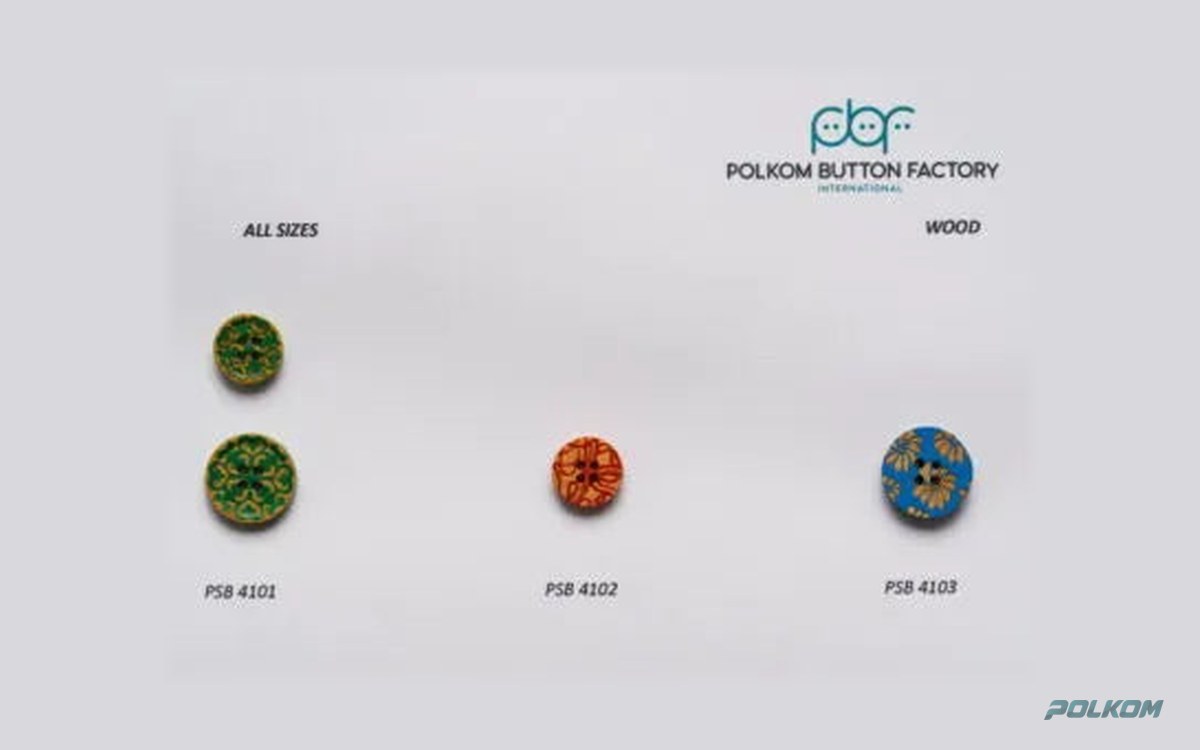
Wood
Blanks are cut from boards or rods of hardwood, then turned, drilled and sanded. Finally the button is left natural or given oil, wax, lacquer or paint.
Applying a logo
The logo can be added at various stages of production:
- in the mould – in metal casting or pressing, the logo comes out in relief;
- laser engraving – on a finished button of polyester, corozo, wood or metal;
- pad printing – for coloured logos on smooth surfaces;
- stamping – on metal parts of press-on buttons.
Quality control
Before packing, buttons are checked for:
- conformity of size and thickness;
- clean holes without sharp edges that cut the thread;
- consistent colour across the batch compared with the approved sample;
- resistance of the finish and dye to washing and ironing;
- strength of the shank or mechanism on press-on buttons.
What affects the price of a button
The price depends on the material, size, complexity of the shape, number of operations, finish, logo application and quantity. Natural materials require more manual work, and custom metal buttons require a mould to be made. That is why an exact price requires a request for a quote with the specific specification.
Why it helps to know how a button is made
When you understand the process, it is easier to formulate your requirements for the manufacturer. If you know that the marble effect is created during casting, you will expect slight differences between individual buttons. If your logo is complex and three-dimensional, you will prefer die casting to engraving. And if the colour must match the fabric exactly, you will send a physical sample instead of a catalogue number. This saves corrections and speeds up approval.
Packing and delivery
After inspection, buttons are counted and packed – most often in bags with a set number of pieces or in gross (144 pieces), a traditional unit in the button trade. Each bag is marked with the article, size, colour and batch. The batch number is important for repeat orders, because it helps achieve the same shade. For logo buttons, the packaging can also include the client and style reference.
Custom buttons from Polkom
Polkom is a Bulgarian manufacturer of buttons, based in Sofia. We make buttons to your design, colour and logo, produce fast samples and deliver across Europe. Send an inquiry with your idea or sample – we will suggest the right material and technology.
Share this article