 Manufacturer · Fashion & Home Accessories











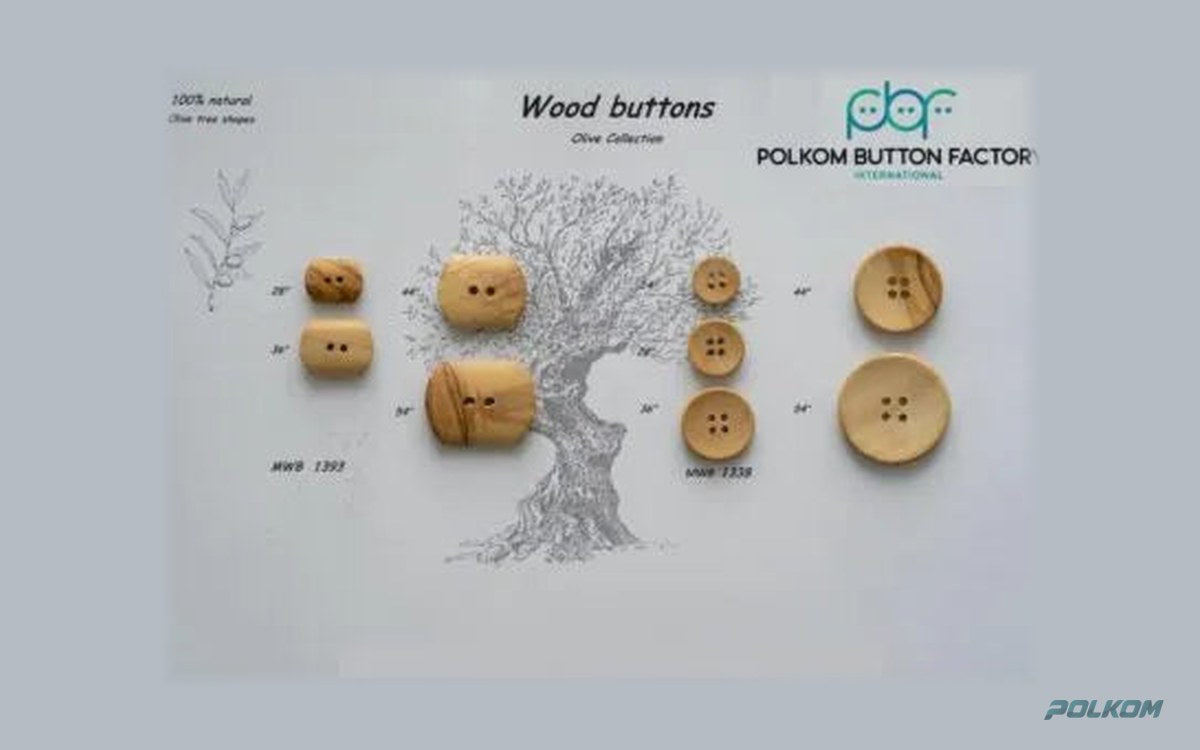
We call wooden buttons large from about 32L (20 mm) upwards – most often 40L–60L, or 25–38 mm, and over 40 mm for decorative pieces. They are used on coats, chunky knitwear, cardigans, bags and home textiles. A large size shows off the wood grain beautifully, but it needs more careful sewing and a correctly sized buttonhole.
Sizes of large wooden buttons
Buttons are measured in lignes (1L = 0.635 mm) or directly in millimetres. For large wooden buttons, catalogues often use millimetres, because the ligne numbers get large.
| Lignes | Millimetres | Use |
|---|---|---|
| 32L | 20 mm | cardigans, light jackets |
| 36L | 23 mm | jackets, knitted coats |
| 40L | 25 mm | coats, chunky-knit cardigans |
| 44L | 28 mm | winter coats, capes |
| 48L | 30 mm | coats, bags |
| 54L | 34 mm | oversized coats, statement buttons |
| 60L | 38 mm | decorative buttons, bags, cushions |
| over 64L | over 40 mm | decoration, home textiles |
Values are rounded. For irregular shapes – square, oval, teardrop – the length and width are given.
Where large wooden buttons are used
Coats and outerwear
On wool and tweed coats, one to three large wooden buttons create a strong accent. They look especially good on camel, brown, olive and grey styles. Duffle coats use elongated wooden toggles instead of round buttons.
Chunky knitwear
Hand-knitted cardigans and collared jumpers need a bigger button, because the buttonhole is wide and soft. A large wooden button does not slip out and showcases the knit. A shank button or one with a recessed centre is a good choice here.
Bags and accessories
Woven and knitted bags, laptop sleeves and pouches are often fastened with one large wooden button and a loop of cord or elastic. The button is both the closure and the main decorative element.
Home textiles
Cushion covers, bedspreads and knitted throws with wooden buttons look cosy and natural. Here the sizes are the largest, and the function is often purely decorative.
How to choose large wooden buttons
- Proportion – the button should suit the lapel width and overall silhouette; try a sample on the garment, not just in your hand.
- Thickness – large buttons must be thick enough not to crack; a thin large button is more vulnerable.
- Weight – wood is light, which is an advantage in large sizes: it does not drag the fabric down like metal.
- Wood species – the grain shows best on large buttons, so olive and walnut are popular choices.
- Finish – lacquer protects against moisture on outerwear worn in the rain.
How to sew on a large wooden button
- Use strong button thread, doubled.
- Leave a tall thread shank – as high as the fabric is thick at the buttonhole, because coats and knitwear are thick.
- Sew a backing button on the inside to take the strain and protect the fabric.
- Wrap the shank tightly and secure the knot on the inside.
- With a shank button, leave a little slack if the fabric is very thick.
The buttonhole for a large button is calculated as the diameter plus the thickness, with an extra 1–2 mm for domed styles. Coats use a keyhole buttonhole.
Large wooden or horn buttons
For coats, the choice is often between wood and horn. Horn buttons are heavier, with a deep lustre and a classic look, while wood is lighter, warmer and more casual in character. If the button needs to be exactly the same colour as the fabric, fabric-covered buttons are a better solution.
Shapes of large wooden buttons
In large sizes the shape is more noticeable than in small ones. Besides the classic round four-hole button, popular options include:
- wide-rim buttons – they look substantial and highlight the grain around the edge;
- domed shank buttons – no visible holes, with a clean face suitable for engraving;
- square and rectangular styles – for modern coats and bags;
- buttons with an irregular, “organic” edge – for collections with a handcrafted, artisan look;
- toggles – elongated buttons with one or two holes that fasten through a loop.
A logo on a large wooden button
The large surface is ideal for laser engraving – a logo, monogram or short text reads clearly and looks natural, because the laser lightly scorches the wood. On domed shank buttons the engraving covers the whole face, while on buttons with holes it is placed between them or around the rim.
How many large buttons on one garment
Large buttons look best in small numbers. On a coat, one to three buttons on the front are usually enough, and on a cardigan three to five. When there are many large buttons, the garment looks visually heavy. If you want more fastening points, combine one large statement button with smaller hidden buttons on the inside.
Caring for garments with large wooden buttons
Coats are usually dry-cleaned or hand washed. If the garment is to be washed, fasten the buttons, turn it inside out and use a delicate programme. Do not leave a wet coat to dry on a radiator – sudden temperature changes can crack the wood. For dry cleaning it is sensible to cover the buttons or remove them temporarily if they have a natural, unlacquered finish.
Large wooden buttons from Polkom
Polkom offers large wooden buttons in various wood species, shapes and finishes, as well as production in non-standard sizes, colours matched to a sample and with your logo. Send an inquiry with the size and type of product.




