Manufacturer · Fashion & Home Accessories
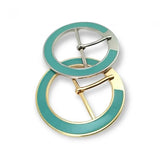






Metal rings for clothing are used mainly as adjustment and decorative elements: belts on dresses and trench coats, straps on dungarees and jackets, epaulettes, shoulder straps and neckline accents. For garments, lighter rings with a smooth profile and a finish that withstands washing and ironing are chosen. The size is determined by the width of the tape or belt that passes through the ring.
Where metal rings are used on clothing
Belts on dresses, trousers and trench coats
Two D-rings at the end of a fabric belt are the simplest way to adjust it without a buckle. They are used on dress belts, summer trousers, shorts, childrenswear and trench coats. A round ring in the middle of the belt serves as a decorative centrepiece through which both ends pass.
Dungarees and shoulder straps
On dungarees and pinafore dresses, the metal ring connects the shoulder strap to the bib. It is often combined with a buckle or slider to adjust the length.
Jackets and workwear
Adjustment straps on cuffs and waist, epaulettes and collar straps, D-rings for hanging keys and tools on workwear – everywhere here the ring must be strong and must not rust.
Decorative details
Rings at the neckline of swimsuits and dresses, on sleeve ties, at the side of skirts and on lingerie. Here shape and finish matter more than strength – round, oval or flat die-cast rings are often chosen.
How to choose a ring for clothing
- Weight. Garments should not become heavy. For thin fabrics choose thin wire or a hollow/light profile.
- Profile. Smooth and rounded, without sharp edges that could tear the tape or fabric.
- Size. The inner width should match the tape width plus an allowance for its thickness.
- Finish. It must withstand washing, detergents and sweat and must not stain the fabric.
- Coordination. In the same colour and finish as the buttons, zip, eyelets and buckles on the same garment.
Metal rings and washing
Clothing is washed many times, so the ring must tolerate water, detergents and mechanical friction. When choosing, keep in mind:
- brass and zinc alloy do not rust, but aggressive detergents may darken their finish;
- steel rings must have a good protective finish, otherwise rust leaves marks on the fabric;
- on swimwear and beachwear the ring is in contact with salt or chlorinated water – stainless materials or plastic are preferred here;
- dark and antique finishes are visually more durable, because small scratches do not show.
It is good practice to wash a sample garment with the ring fitted several times before approving the production run. If the ring is a light metal and the fabric is light, also check for finish marks.
Sewing the ring onto the garment
- Prepare a tab from the same fabric or from tape of a width that fits the ring.
- Pass the tab through the ring and fold it in half.
- Sew the tab into the garment seam or onto the garment with a double or zigzag stitch.
- In stressed areas, add a reinforcing interlining on the inside.
- Check that the ring moves freely and does not press against the seam.
In series production the tab is usually caught in the side seam or waist seam when the pieces are joined, so the stitching does not show on the right side.
Rings and ironing
During ironing a metal ring heats up quickly and can leave an imprint on the fabric or melt the synthetic tab around it. So the care instructions should recommend ironing on the reverse side or through a cloth, and in production you should choose tapes and threads that tolerate the temperature. Plastic rings should not be ironed directly, as they can deform. If the garment will go through a steam press in the factory, test a sample in that operation too.
Sizes most commonly used in clothing
| Product | Approximate inner width | Shape |
|---|---|---|
| Dress belt, thin tape | about 15–25 mm | D, round |
| Trench coat or jacket belt | about 30–40 mm | D, rectangular |
| Dungaree strap | about 25–40 mm | rectangular, with buckle |
| Neckline and swimwear details | about 15–30 mm | round, oval |
| Cuff strap | about 15–20 mm | D, rectangular |
Rings in different clothing styles
In sportswear, rings are functional: bag straps, hood adjustment, attaching accessories. Matt black or gunmetal finishes are common there. In womenswear, rings are an accent – gold round rings at the neckline, oval rings on belts, flat die-cast rings with a logo. In denim and workwear, antique brass and bronze tones dominate, matching rivets and metal buttons. For evening dresses and lingerie, small, delicate rings with a polished finish are chosen, sometimes combined with satin ribbons.
Common mistakes
- A heavy ring on a light fabric – the garment distorts and hangs incorrectly.
- A ring not tested in the wash – rust marks or darkening after the first wash.
- A finish different from the metal buckles and buttons on the same style.
- A ring too narrow for a thick wool belt.
Metal rings for clothing from Polkom
Polkom is a Bulgarian manufacturer of accessories for fashion, furniture, footwear and bags, selling wholesale and working with brands, garment factories and ateliers across Europe. In the rings category you will find styles for clothing in various shapes and finishes, and if needed we make rings to your design and also attach the accessories. Send an inquiry with a description of the style and the sizes you need.