 Manufacturer · Fashion & Home Accessories











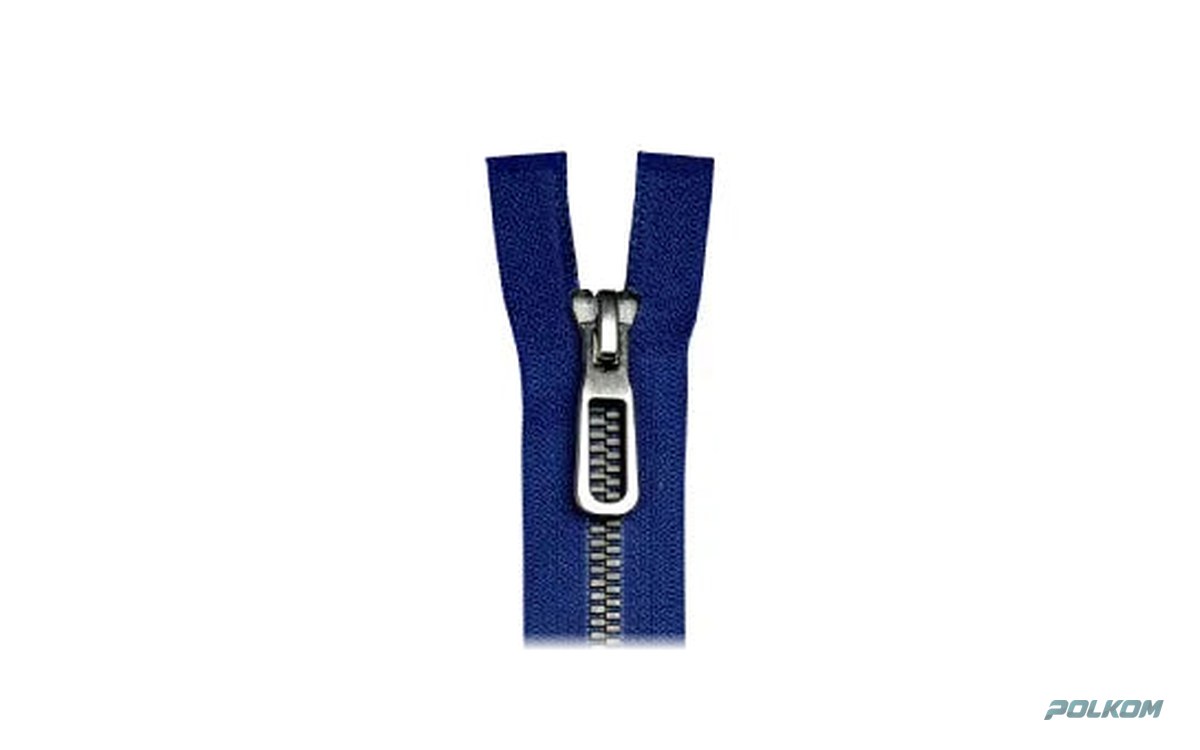
For a plastic jacket zip, the usual choice is an open-end moulded zip No. 5 for light and transitional jackets and No. 8 for winter, ski and work jackets. On styles that reach below the hip, a two-way open-end zip is used so that the jacket can be opened from the bottom. The length is determined by the pattern for each size, and the slider must be easy to grip with gloves on.
Why a plastic zip for a jacket
The moulded plastic zip is the most widespread choice for jackets, and not by chance. It is light, does not get cold in winter, does not rust from snow and rain, and the slider moves smoothly even at sub-zero temperatures. In addition, the colour of the teeth can match or contrast with the tape, which is a powerful design tool for sports collections.
Which size
| Type of jacket | Recommended size | Note |
|---|---|---|
| Sweatshirt, light sports top | No. 5 | Light and flexible |
| Spring jacket, windbreaker, softshell | No. 5 | Sometimes No. 3 on very light styles |
| Winter and down jacket | No. 5–8 | No. 8 for more volume |
| Ski jacket | No. 8 | Often two-way |
| Parka, long coat | No. 8–10 | Two-way open-end |
| Work jacket | No. 8–10 | Strong tape, large puller |
| Children’s jacket | No. 5 | Chin guard |
Jacket pockets usually have a zip one size smaller than the centre front zip – e.g. No. 5 on the pockets with a No. 8 centre front.
Open-end or two-way
The centre front zip of a jacket is always open-end – the two halves must separate completely. The question is whether a second slider is needed.
- Open-end with one slider – for short jackets to the waist or hip, sweatshirts, gilets.
- Two-way open-end – for jackets below the hip, parkas and ski jackets. The lower slider lets you open the bottom part when sitting, driving or riding a ski lift.
Detachable parts – hood, lining, sleeves – are attached with separate, smaller open-end zips.
How to determine the length
The length of an open-end zip is measured from the top of the slider to the bottom of the box. For a jacket it is the distance from the top edge of the collar to the bottom edge of the hem, minus the edge finishing. Since an open-end zip cannot be shortened at the bottom, the length must be exact for each size. In series production a separate length is ordered for each size – the difference between neighbouring sizes is usually 1–3 cm.
Example of a size chart
In your inquiry, list the lengths and quantities in a table: XS – 60 cm, S – 62 cm, M – 64 cm and so on. These figures are only an example; the real measurements come from your pattern.
Slider and puller
On jackets the slider is used often, sometimes with gloves and in the cold. Therefore:
- choose an auto-lock (self-locking) slider so that the zip does not slide down when walking;
- use a larger or extended puller – metal, rubberised or made of cord;
- on a two-way zip, the two sliders must be oriented so that the pullers do not knock against each other;
- for brands – a puller with a logo, in the brand colour.
Extended pullers made of cord with an aglet or a cord stopper are practical on ski and outdoor jackets.
Tape and teeth colour
On a moulded zip, the teeth can be the colour of the tape (monochrome, a more classic look) or in contrast – for example a black tape with light teeth, or neon teeth on sports styles. Choose the tape colour against a swatch of the main fabric, not from a photo – on-screen colours are often misleading.
Details that make the difference
Windproof placket
On winter jackets, the zip is covered on the inside by a fabric placket that stops the wind. There may also be an outer storm flap with buttons or hook and loop.
Zip garage for the chin
A small fabric “pocket” at the top into which the slider is tucked. It protects the chin from chafing – an essential detail on children’s jackets.
Reinforced bottom end
The box and pin are the most stressed parts. For heavy jackets, zips with reinforced film at the bottom end and a strong bartack when sewn in are chosen.
Replacing a plastic zip on a jacket
If you are replacing a damaged zip on a finished jacket, note the parameters of the old one: size number (usually stamped on the back of the slider), length from the slider to the end of the box, open-end or two-way, tape width and colour. The new zip must have the same tape width so that the seam falls in the old place and the topstitching on the outside does not shift. If the problem is only the slider, it is often enough to replace it without unpicking the jacket.
Common mistakes
- No. 3 on a winter jacket – the chain splits open at the bottom.
- One length for all sizes – on the large sizes the zip is too short.
- A non-locking slider – the zip slides down by itself.
- A small puller – hard to grip with gloves.
- Ironing directly on the teeth during final pressing.
Sample and test
Before the run, sew a sample into a prototype and test it: zipping up with gloves, sitting down with the two-way zip, washing according to the label. You can see the full range in the moulded plastic zips category, and other options under zips.
Polkom – custom jacket zips
Polkom is a Bulgarian manufacturer of accessories for fashion, furniture, footwear and bags, based in Sofia, with over 30 years of experience. We offer moulded zips for jackets in various sizes, with lengths per garment size, colour matched to a sample and sliders with a logo, together with cord stoppers and cords. Send an inquiry with the pattern or a description of the style.




