Manufacturer · Fashion Accessories

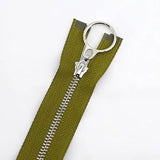


A skirt hook and bar is placed on the waistband, just above the top of the zip – the hook on the inside of the overlapping end and the bar on the underlap. It keeps the waist firmly closed, takes the strain when the wearer sits down and stops the zip from opening. For skirts with a waistband in a heavy fabric a metal hook and bar is used, while light skirts without a waistband use a smaller hook and bar or a wire hook and eye.
Why a skirt needs a hook and bar
The waist of a skirt is the point of greatest load: when sitting, bending and walking it is pulled in every direction. If the only fastening is a zip, all the tension falls on its top end and the slider. Over time the slider begins to open by itself and the zip tape tears around the top stops. The hook and bar takes this load and leaves the zip with the sole job of closing the opening.
Where the hook and bar goes on a skirt
Skirt with a waistband
This is the classic case. The waistband has an overlap – one end passes over the other by a few centimetres. The hook is sewn or pressed on the inside of the upper end, close to the edge, and the bar on the lower end, directly beneath it. When the skirt is fastened the hook and bar is completely hidden.
Skirt without a waistband (with a waist facing)
Here there is no overlap; the two sides of the zip meet. In this case a small hook and eye is used, placed on the very edge above the zip so that they hook "edge to edge". For very light skirts prefer a wire hook and eye – it is finer and adds no weight.
Skirt with a side zip
With a side zip the hook and bar goes on the side seam, again above the zip. The waistband must be reinforced with interfacing in this area, because side seams take a lot of strain.
Skirt with a back zip
With a back zip the hook and bar sits at the centre back. Check that it does not press when the wearer sits – against hard chair backs a bulky hook and bar can be uncomfortable. Choose a flatter model.
Hook and bar and invisible zip
Most skirts today are made with an invisible zip. It is elegant, but its top end is delicate. The hook and bar must be placed so that the zip tape is not under tension once fastened. The practical rule: the zip is sewn in so that the slider reaches the lower edge of the waistband, and the hook and bar sits in the waistband itself. If the zip runs through the waistband to the top edge, a small hook and eye is used above it. Choose a suitable model from our invisible zips and match the length to the position of the hook and bar.
Which hook and bar for which skirt style
| Skirt style | Recommended fastening | Note |
|---|---|---|
| Straight (pencil) skirt with waistband | Metal hook and bar | High strain when sitting |
| Flared or A-line with waistband | Standard hook and bar | Medium load |
| Skirt without waistband, invisible zip | Small hook and eye or wire hook and eye | Edge-to-edge closure |
| Pleated skirt | Hook and bar + button | Pleats load the waistband |
| Denim skirt | Metal button, sometimes a hook and bar | Denim style |
| Elasticated skirt | No hook and bar | The elastic takes up the expansion |
| Jersey skirt | Usually no hook and bar | The fabric is stretchy |
Size and material of a skirt hook and bar
Skirts usually have a narrower waistband and finer fabrics than trousers, so the hook and bar is smaller. It should fit within the width of the waistband without its edge showing. On thin fabrics choose a finish in the tone of the fabric – black for dark fabrics, silver or light for light ones – so that it does not show through. For skirts that are washed often, prefer brass or a durable finish.
How to sew a hook and bar on a skirt – in brief
- Close the zip and lay the ends of the waistband in the correct position.
- Mark the edge of the upper end.
- Sew the hook on the inside of the upper end, 2–3 mm from the edge, without the thread passing through to the right side.
- Engage the hook and mark where the bar should go.
- Sew the bar on the lower end and check that the waistband lies straight.
Skirt hooks and bars in series production
For a series of skirts for a brand or retail chain it is important that the hook and bar sits in the same place across all sizes. To achieve this, templates are made for the position of the hook and bar relative to the edge of the waistband and the zip seam. If the workshop has a press, press-on hooks and bars speed up the process and make the result consistent, but on delicate fabrics a sew-on model is often gentler on the cloth. Before starting the series, make samples in all sizes and check that the waistband overlap is the same – in larger sizes the waistband is longer and a difference in position can be noticeable. Record the type, size and finish of the hook and bar in the tech pack so that it is repeated in subsequent orders.
Common mistakes with skirt hooks and bars
- Hook and bar too large for a narrow waistband – its edge shows and it distorts the waistband.
- No interfacing – the fabric around the hook stretches and the hook and bar sags.
- Inaccurate position relative to the zip – the zip is strained and opens.
- Light hook and bar on a dark, thin fabric – it shows through.
- Hook and bar on a stretch jersey skirt – unnecessary; elastic in the waist is better.
See all models in our hooks and bars category.
Skirt hooks and bars from Polkom
Polkom, a manufacturer of garment accessories, supplies wholesale hooks and bars, zips and sewing trims to brands, workshops and ateliers across Europe. We will help you choose a hook and bar and an invisible zip that work together and send samples for a trial attachment. Send an inquiry via our contact page.