Manufacturer · Fashion & Home Accessories




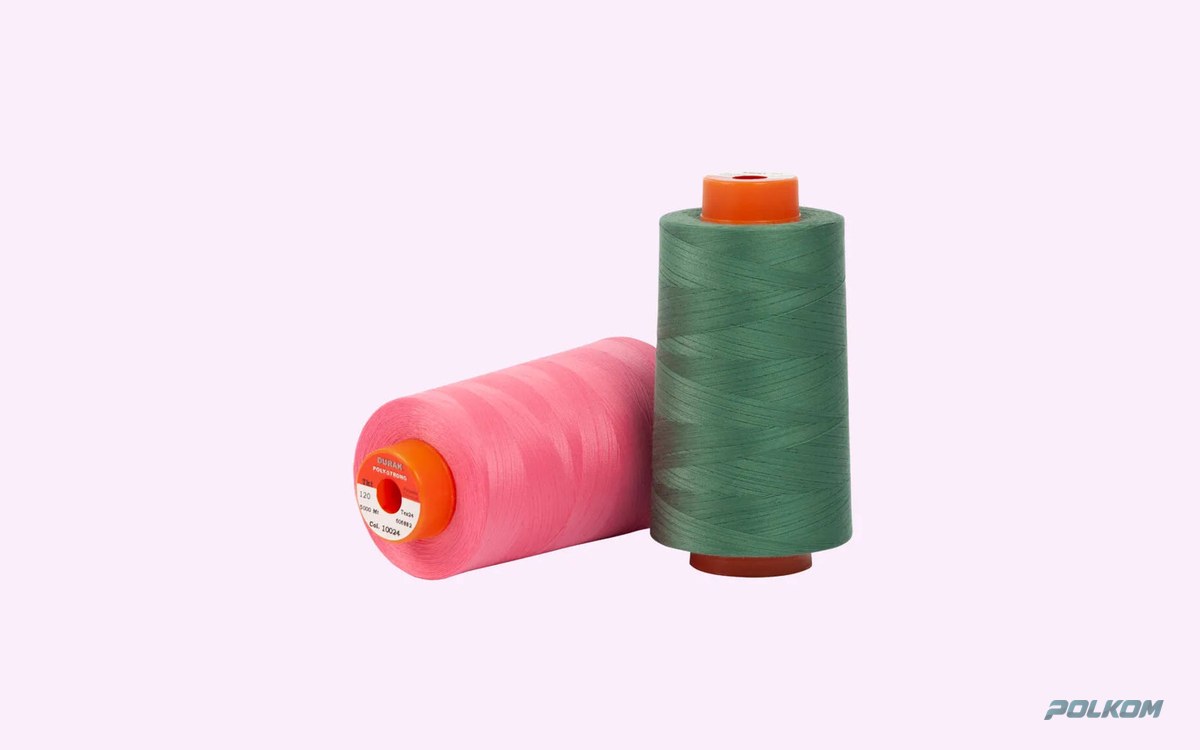
Thread cones or spools – the choice depends on the machine and the volume. Cones hold thousands of metres of thread, unwind from the top and are intended for industrial lockstitch, overlock and coverstitch machines. Spools hold a small amount of thread, unwind from the side and are convenient for domestic machines, ateliers and hand work. For series sewing, cones are almost always more economical and more reliable.
What the differences are between a cone and a spool
Cone
A cone is a cardboard or plastic tube with a conical profile on which the thread is cross-wound. It stands upright on a thread stand, and the thread is drawn upwards through a guide above the machine. This way it unwinds freely without the tube turning. That allows high speed and even tension even when the cone is almost empty.
Spool
A spool (reel) is cylindrical, often with a notch in the rim for securing the end. On domestic machines it is placed horizontally or vertically on a pin and turns as you sew. On some spools the thread is parallel-wound (stacked) and must unwind from the side, while on others it is cross-wound and can also be drawn off the top.
Other packaging
- King spool – a large quantity of thread in a straight form, often for embroidery or thick threads.
- Mini king, cone tube – an intermediate size for ateliers and embroidery.
- Pre-wound bobbins – ready-wound bobbin thread, convenient for embroidery and quilting.
Thread cones or spools: a comparison
| Criterion | Cone | Spool |
|---|---|---|
| Amount of thread | Thousands of metres | Usually up to a few hundred metres |
| Machines | Industrial lockstitch, overlock, coverstitch | Domestic machines, hand sewing |
| Unwinding | From the top, the tube does not turn | From the side or the top, the spool turns |
| Sewing speed | Suitable for high speed | For moderate speed |
| Price per metre | Lower | Higher |
| Number of colours in stock | Fewer, but in large quantities | Many colours in small quantities |
| Changes during a run | Rare | Frequent, time is lost |
Why winding matters for the machine
The thread must unwind with a constant force. If it is pulled unevenly, the top tension changes and the seam becomes uneven. With a cone this stability is built into the design itself, which is why industrial machines work exclusively with cones. With spools the direction of unwinding must match the winding: a parallel-wound spool unwound from the top twists the thread, while a cross-wound spool placed on a horizontal pin can jump and snag the thread.
Can a cone be used on a domestic machine
Yes, with a separate cone stand placed behind the machine. The thread passes through a guide higher than the tube and then enters the usual threading path. Without a stand, a cone should not be placed on the spool pin – it will turn unevenly and the thread will break or bunch up.
When a cone is more economical
- You sew in series and one colour is used for many pieces.
- You work with an overlock or coverstitch machine, which requires 3–5 threads at the same time.
- You want fewer stops for thread changes and less leftover thread.
- You need the same colour dye lot for the whole order.
When a spool is more suitable
- An alterations and made-to-measure atelier, where colours change constantly.
- Samples, prototypes and small runs with many colours.
- Hand sewing, attaching buttons, tacking.
- Sets for sale in haberdashery shops.
How to choose the cone size
The length on a cone depends on the thickness of the thread: the finer it is, the more metres fit on one tube. Choose a size you will use up in a reasonable time – thread that has sat for years, even in a light, dry place, loses strength. If your annual consumption of a given colour is low, it is better to take smaller cones than one large one that will age on the shelf. For the core production colours – black, white, navy, grey – large cones are the most economical.
What to check on delivery
- Whether all cones of one colour are from the same dye lot.
- Whether the winding is tight and even, without loose layers or visible knots.
- Whether the label states the thread type, ticket number or tex, colour and length.
Cones or spools on overlock and coverstitch machines
Here the answer is clear-cut: overlock and coverstitch machines work with cones. They draw thread at high speed from three, four or five positions at once, and any uneven unwinding shows immediately in the seam. Small spools on these machines are used up quickly, and changing in the middle of a seam wastes time and risks a different shade. If you have to use a spool, place it on a pad that stops it from jumping and reduce the speed.
Storing cones and spools
Keep threads in closed boxes or cabinets, away from direct sunlight and heaters. Cover opened cones with thread nets so that they do not unwind or collect dust. Sort them by colour and lot and use the older deliveries first.
Sewing threads on cones from Polkom
Polkom supplies sewing threads on cones for industrial sewing – polyester, core-spun and textured – as well as cotton threads for natural products. As a Bulgarian manufacturer and supplier of garment accessories, we will help you determine the type, thickness and winding according to the machines in your workshop. Minimum quantities depend on the article. Send an inquiry via Contact with the colours and approximate volume, and for the full range see threads.