Manufacturer · Fashion & Home Accessories




Hook and bar or button – the choice depends on the style of the trousers and the load on the waistband. A trouser hook and bar is hidden, keeps the waistband flat and takes a lot of strain, which is why it is the standard on suit and classic trousers. A button is visible, easy to fasten and part of the design on jeans, chinos and casual styles. On high-quality trousers the two are often combined: a hook and bar on the front edge and an inside button that takes part of the load off it.
Hook and bar or button – the key difference
A trouser hook and bar is a flat hook with a matching bar, hidden between the layers of the waistband. A button fastens through a buttonhole and stays visible or semi-concealed. The difference is not only visual: the two fastenings distribute the load in different ways. The hook and bar spreads it over a wide, flat area, while the button takes it at a single point, through the thread and the buttonhole.
Comparison by criteria
| Criterion | Hook and bar | Button |
|---|---|---|
| Visibility | Hidden | Visible, part of the design |
| Waistband line | Straight and clean | A slight bulge around the buttonhole is possible |
| Load | Spread over an area | Concentrated at one point |
| Fastening | Takes a little getting used to | Intuitive and quick |
| Attachment in series production | Fast with a press | Sewing and buttonholing, or pressing for jeans buttons |
| Branding | Invisible | A logo on the button is possible |
| Repair | Easy to replace on a sew-on model | Button easy to replace, but the buttonhole wears |
When to choose a hook and bar
- Suit and formal trousers – a waistband without a visible fastening is a hallmark of classic tailoring.
- Women's trousers with a clean waistband – without a button and buttonhole the silhouette is smoother.
- Heavy wool fabrics – thick cloth is hard to buttonhole, and a hook and bar needs no buttonhole.
- Styles with a wide waistband – a large-plate or double hook and bar keeps the whole waistband flat.
- Series production with a press – a press-on hook and bar is attached in seconds.
When to choose a button
- Jeans – the metal jeans button is part of the signature look and carries the brand.
- Chinos and casual trousers – a visible button underlines the relaxed style.
- Styles with a decorative fastening – for example high-waisted trousers with several buttons.
- When you want branding – the button can carry a logo, engraving or a special material.
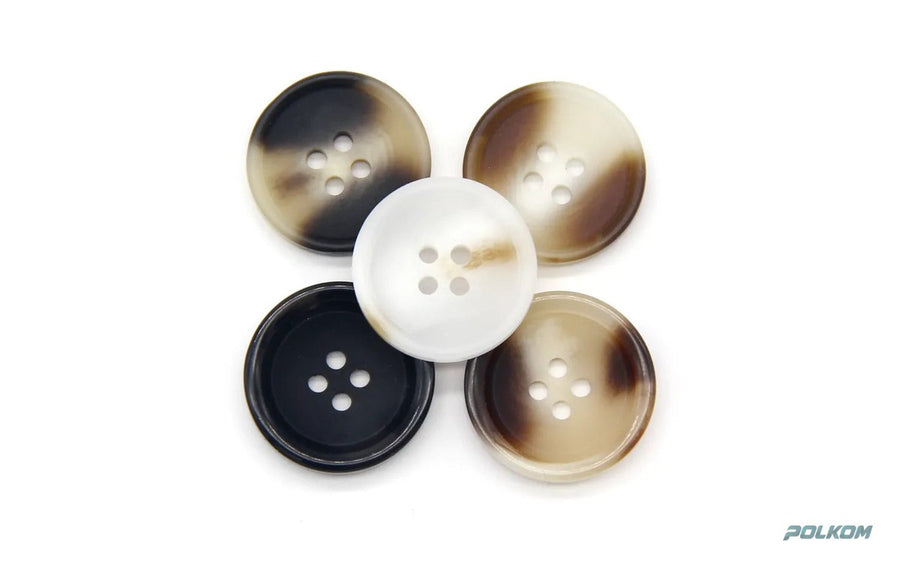
You will find a wide choice of waistband models among our buttons and metal buttons.
The hook and bar + inside button combination
On men's suit trousers the classic solution is a combination. The waistband has an extension (tab) on the inside that fastens with a flat button. On top, on the front edge, sits the hook and bar. This way:
- the inside button takes most of the strain;
- the hook and bar holds the edge of the waistband exactly in place and gives a straight line;
- if one element fails, the other still holds the trousers up.
The combination is also found on higher-end women's trousers, especially high-waisted styles.
Hook and bar or button for different product groups
Women's trousers
For women's styles the choice is often aesthetic. High-waisted, wide-leg trousers look best with a clean waistband and a hook and bar, while on denim or cargo styles a visible button is part of the character. On thin summer fabrics the hook and bar should be small and in a tone matching the fabric so that it does not show through.
Workwear and uniforms
Here durability and speed of attachment are decisive. A press-on hook and bar or a press-on metal button withstands industrial laundering and needs no buttonhole. Adjustable hooks and bars with several positions allow the same uniform to be worn comfortably by people with different waist sizes.
Children's trousers
For children, easy fastening matters. A button or snap button combined with elastic in the waistband is usually more practical than a hook and bar, which requires more precise hooking.
Strength and durability
A well-attached hook and bar rarely tears off, because the load is distributed. Its weak point is bending of the hook if it is fastened at the wrong angle. With a button, the weak points are the thread and the buttonhole – over time the thread wears and the buttonhole stretches. With pressed jeans buttons the thread problem disappears, but the shank must suit the thickness of the waistband.
Care and washing
Both types of fastening should ideally be closed before washing. Brass hooks and bars and buttons do not rust, while with steel ones the plating is what matters. Buttons made of natural materials need gentler washing than metal hooks and bars, so for workwear a hook and bar or a metal button is the more practical choice.
Cost and production
The final cost depends on the type of hook and bar or button, the material, the finish and the attachment method. A hook and bar needs no buttonhole, which saves one operation. A button can be more expensive if it carries a logo or is made of a natural material, but it adds value as a design element. For exact prices, send a request for a quote with your specification.
How to decide
- Does the fastening need to be visible? If not – hook and bar.
- What is the fabric? For heavy wool cloth – hook and bar.
- Does the waistband need branding? If so – a button with a logo.
- Do you want maximum security? Combine the two.
Browse the models in our trouser hooks and bars category.
Hooks and bars and buttons from one supplier
Polkom manufactures and supplies wholesale trouser hooks and bars, buttons, zips and garment accessories – over 10,000 articles for brands and workshops across Europe. You can source the complete waistband set from one place, with samples and matching finishes. Send an inquiry via our contact form.