Manufacturer · Fashion & Home Accessories











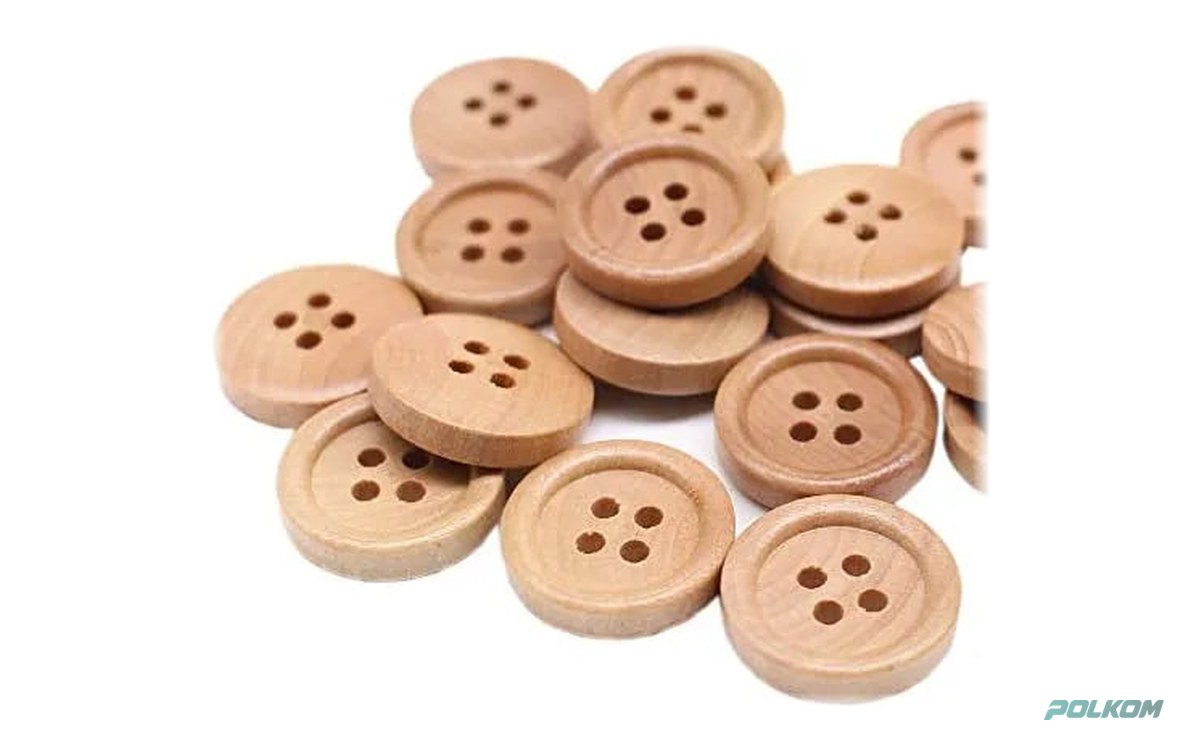
The underbutton is a small, flat button sewn on the inside of the coat directly opposite the large outer button. Both buttons are sewn simultaneously with the same thread so that the stress from fastening is distributed onto the inner button rather than just a few fabric threads. If you are wondering how to sew a button on a coat, the underbutton is the solution for heavy wool and cashmere fabrics where the large button alone would otherwise tear the facing.
Why coats need an underbutton
Coat buttons are large – often from 32 to 44 ligne (about 20–28 mm) or more – and heavy, especially when made of horn, corozo, metal or bone. When fastened, the facing stretches, and during wear, the button constantly pulls the fabric outward. Sewing the button only to the fabric and interfacing causes three problems:
- the thread pulls the fabric threads, creating a hole around the button;
- the fabric puckers and the button “sags” downward;
- if the thread breaks, the button takes a piece of the facing with it, making repairs visible.
The underbutton acts like a washer for a screw: it absorbs the force and distributes it over a larger area. This technique is used in coats, greatcoats, pardessus, heavy blazers and dense vests.
How to sew a coat button with an underbutton
- Mark the position of the outer button relative to the buttonhole and pierce through to the inside with a pin to locate where the underbutton will be.
- Prepare the thread. Use strong polyester thread or special button thread, doubled, in the fabric colour.
- Start from the inside. Place the underbutton and secure the thread with a small stitch beneath it.
- Pass through the facing to the outer side and through the hole or shank of the large button.
- Leave the shank space. Insert a toothpick or thick needle between the outer button and fabric – the shank for coat buttons is longer, usually the thickness of the facing with the buttonhole.
- Return through the facing and through the opposite hole of the underbutton. Repeat 6–8 times for each hole pair.
- Wrap the shank. Remove the toothpick, pull the outer button up, and tightly wrap the thread around the shank under it.
- Secure inside under the underbutton with several small stitches and a knot.
It is important that the underbutton is not sewn with a shank – it must lie flat against the fabric; otherwise, it will catch on the lining and sweater.
Which size underbutton to choose
| Outer Button | Recommended Underbutton |
|---|---|
| up to 28L (about 18 mm) | around 14–16L, flat, with 2 or 4 holes |
| 30–36L (about 19–23 mm) | around 16–18L |
| 40L and above (over 25 mm) | around 18–20L |
The main rules are:
- the number of holes matches – if the outer button has 4 holes, the underbutton also has 4 holes;
- the underbutton is thin and flat so it is not visible through the lining;
- the hole spacing is close to that of the outer button so the thread passes straight;
- for shank buttons, the underbutton may have 2 holes.
Material and colour of the underbutton
In mass production, underbuttons are usually polyester or plastic – transparent or matching the lining colour. They are light, inexpensive and inconspicuous. For luxury coat buttons – horn, corozo, bone – some brands use an underbutton of the same material or tone. This detail is noticed by the customer when opening the coat and shows care in craftsmanship.
Avoid metal underbuttons for wool fabrics because sharp edges can wear the fabric inside, and generally avoid textured buttons – the underbutton should be smooth.
Large coat buttons: other considerations
- Buttonhole length. The length of the buttonhole equals the diameter of the button plus its thickness. Add a little extra for protruding buttons.
- Interfacing. The coat facing should be fused in the area of buttons and buttonholes.
- Weight. Very heavy buttons on light fabric pull the facings down even with an underbutton. Choose the material according to the fabric.
- Decorative buttons. Sleeve and pocket buttons are not stressed and do not require an underbutton.
Common sewing mistakes
- Thread too tight. The underbutton presses into the fabric and leaves a mark on the outer side.
- Misaligned holes. If the underbutton is rotated relative to the outer button, the thread passes crookedly and puckers the facing.
- Stitch through lining. The underbutton is sewn to the facing, not the lining – otherwise, the lining pulls with every fastening.
- Underbutton too large. It bulges visibly and catches when dressing.
- Different thread. Both buttons must be sewn with the same thread to share the load.
In production
In the workshop, underbuttons are sewn by hand or with specialised machines that sew both buttons simultaneously and wrap the shank. Therefore, the coat specification should include a separate line for the underbutton: model, size, colour and quantity per item. Missing underbuttons are a common cause of complaints for coats with heavy buttons. If you use standard polyester buttons as underbuttons, choose one model for the entire outerwear collection – this increases quantity and simplifies selection.
Coat buttons from Polkom
Polkom is a manufacturer of accessories for fashion, footwear and bags, perfume and cosmetics packaging, and furniture accessories, with over 30 years of experience and headquarters in Sofia. We produce large and luxury coat buttons together with matching underbuttons, in colour by sample and custom logo. All products are OEKO-TEX® certified. Send us your fabric and design in a request – we will offer a set and samples.