Manufacturer · Fashion & Home Accessories












A horn button is a button made from natural animal horn – most often buffalo or cattle horn. It is one of the oldest and most respected buttons in the tailoring craft. Classic English and Italian suits, tweed jackets and wool coats are traditionally finished with horn buttons. The reason is simple: every button has a unique pattern, a pleasant weight and lasts for years.
What a horn button is made from
The main raw material is the horn of buffalo, cattle or other large horned livestock. Horn is a by-product of animal farming – the animals are not raised for it. That is why horn buttons are regarded as a sensible use of a material that would otherwise be discarded.
Chemically, horn is keratin – the same protein that hair and nails are made of. It is dense, flexible and does not break easily, which explains the durability of horn buttons.
How horn buttons are made
Production requires more manual work and care than synthetic buttons:
- Selection – the horns are sorted by density, colour and pattern.
- Cutting – slabs are cut from the densest, outer part of the horn.
- Cutting blanks – round or shaped discs are separated from the slabs.
- Turning – the profile, rim and central recess are formed.
- Drilling – most often 2 or 4 holes.
- Polishing – the buttons are sanded and polished, sometimes treated with oils or wax.
Because every horn has its own structure, no two buttons are completely identical. When sorting, the manufacturer selects buttons of similar tone for one garment, but the natural variation remains – and that is precisely the mark of authenticity.
Colours and patterns
The natural colour range of horn is exceptionally rich:
- deep black and graphite;
- dark brown and chocolate;
- caramel, honey and sand tones;
- light, almost translucent areas;
- marbled and mottled patterns with mixed shades.
The light and dark areas blend differently in every button. The surface can be polished to a gloss or left matte for a more casual, “country” character.
Horn button or imitation – how to tell them apart
Mass production often uses polyester buttons that imitate horn. They are cheaper and completely uniform, which is sometimes an advantage. Here are a few ways to recognise natural horn:
- The pattern – in real horn it is irregular and different on every button; an imitation usually repeats the same motif.
- The touch – horn feels cooler and denser, with a more “organic” feel.
- The weight – a natural button is often slightly heavier than a plastic one of the same size.
- The edge – fine layers are sometimes visible in the edge of horn.
If your budget or quantity calls for a more economical solution, see our imitation horn (faux horn) buttons. For the natural versions, browse the horn buttons category.
Benefits of horn buttons
Strength
Horn is a tough material that withstands daily buttoning and mechanical stress better than many plastics.
Natural origin
Horn buttons are entirely natural and biodegradable, with no synthetic additives in the material itself.
Prestige
In classic tailoring, a horn button is seen as a sign of quality. Buyers of high-end suits often pay particular attention to the buttons.
Uniqueness
Every garment gets buttons with a unique pattern, which reinforces the sense of a crafted product.
Which garments they are used for
- men’s suits and tuxedos;
- jackets and blazers;
- wool coats and greatcoats;
- high-end shirts;
- knitted cardigans and jumpers;
- leather and suede products.
For a comparison with the other popular natural material, see also our corozo buttons – they are lighter and can be dyed in any colour, while horn wins with its natural pattern.
Sizes and customisation
Horn buttons are available in a wide range of sizes – from small buttons for shirts and cuffs to large models for coats. The size is given in lignes (1L = 0.635 mm) or in millimetres. Typically, a jacket uses 24L–32L at the front and 20L on the sleeves, and a coat 36L and above.
Horn buttons can be customised with:
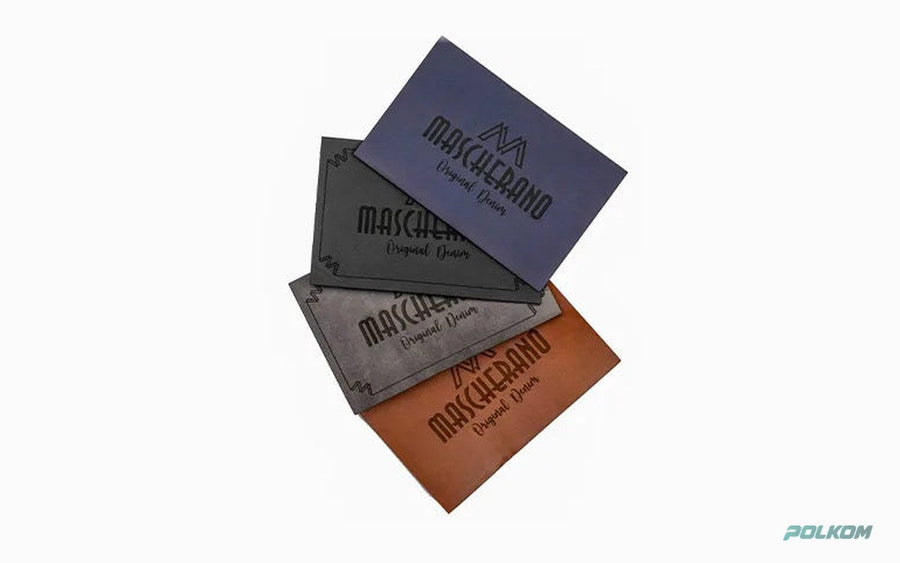
- laser engraving of a logo or monogram;
- different profiles – flat, concave, with a rim;
- different thicknesses;
- a matte or gloss finish.
How to choose horn buttons for your collection
Before ordering, it helps to answer a few practical questions:
- What is the tone of the fabric? Dark horn buttons look natural on navy, grey and black wool, while light and marbled ones suit beige, camel and tweed.
- How much contrast do you want? A button in a similar tone looks discreet and elegant, while a contrasting one becomes an accent.
- Which profile suits the style? A classic suit usually has a concave button with a rim, while a casual jacket can take flatter, chunkier models.
- How many sets do you need? For a jacket, plan buttons for the front and the sleeves, often in two sizes, plus spares.
It is good practice to ask for a sample and compare it directly with the fabric in daylight. That way the natural variation of the horn is assessed before production, not after it.
Caring for horn buttons
Horn does not like prolonged contact with hot water and strong detergents. That is why garments with horn buttons are best washed at a low temperature or dry-cleaned, according to the label. When ironing, the iron should not touch the button directly. If needed, the surface can be refreshed with a few drops of oil, which restores its natural sheen.
Horn buttons from Polkom
Polkom is a Bulgarian manufacturer from Sofia with over 30 years of experience in accessories for fashion, furniture, footwear and bags. We offer horn buttons wholesale to brands, manufacturers and ateliers across Europe, as well as custom production with a logo. We make samples quickly, advise on choosing the size and tone, and can attach the buttons to finished garments.
Minimum quantities depend on the article – send an inquiry to info@polkom.com or call +359 876 76 60 50 (also WhatsApp and Viber).