Manufacturer · Fashion & Home Accessories











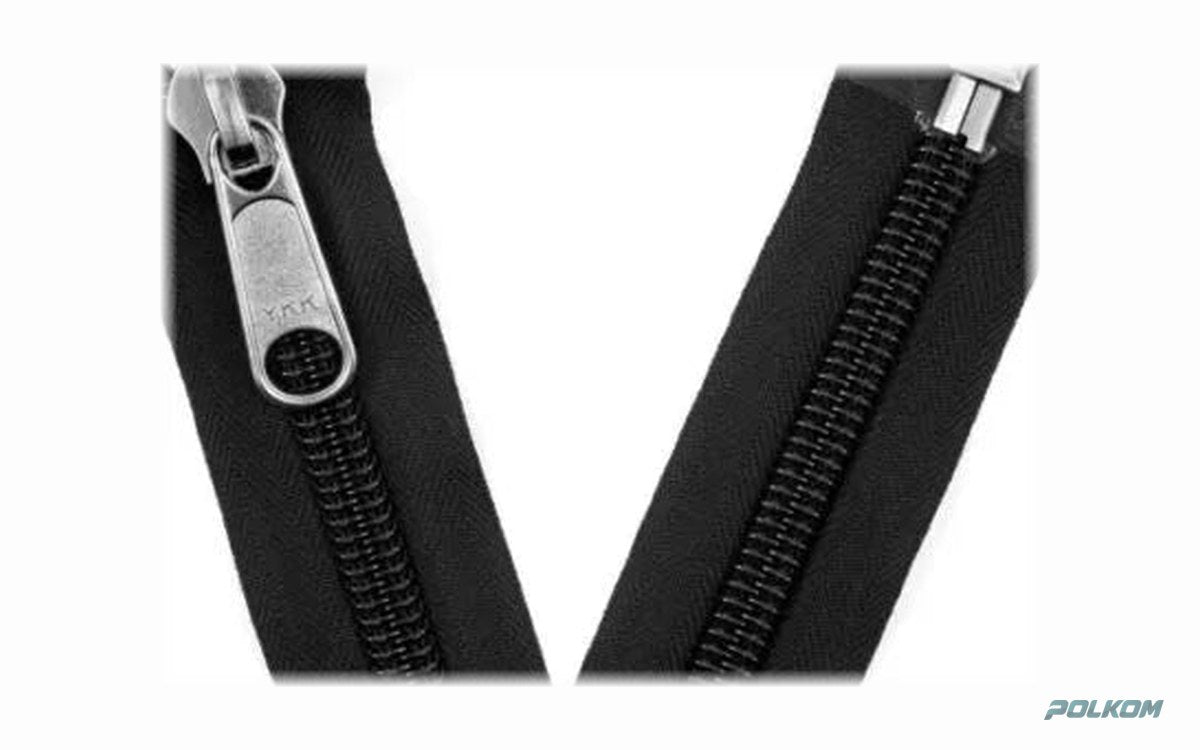
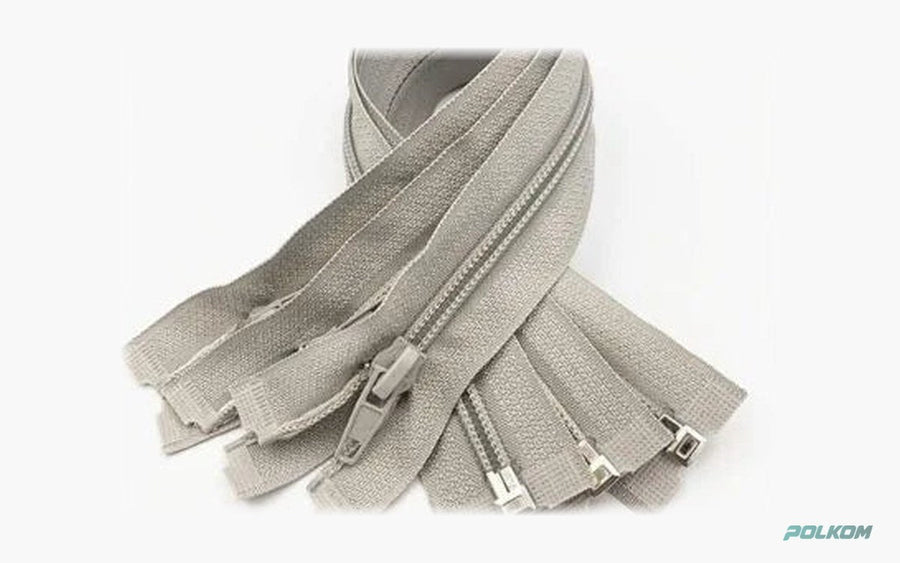
A zipper by the meter is a continuous spiral chain on a tape, wound on a roll, from which you cut exactly the length you need. Sliders and stoppers are attached separately. This type of zipper is used when a production requires many different lengths – bags, cases, cushions, upholstery, tents – and it is not practical to stock ready-made zippers in every size.
What is zipper by the meter
With ready-made zippers, the manufacturer has already set the length, attached the slider, and sealed the ends with stoppers. With zipper by the meter, you receive only the “raw” chain – the two tapes with interlocked spirals, usually on rolls of tens or hundreds of meters. Everything else is added in your workshop:
- Sliders – purchased separately and must match the chain’s number and type.
- Top stoppers – metal clamps or heat welds that stop the slider at the upper end.
- Bottom stopper – for non-separating zippers; often the seam crossing the zipper acts as the stopper.
- Pullers (zipper pulls) – standard or decorative, if the slider has no fixed pull.
In practice, zipper by the meter is almost always spiral. The reason is simple – the spiral is uniform along the entire length and can be cut cleanly anywhere, while moulded and metal zippers require more complex cutting and end finishing. In our spiral zippers category, you will find both forms.
Zipper by the meter or ready-made zipper – when is each more cost-effective
| Situation | Zipper by the Meter | Ready-Made Zipper |
|---|---|---|
| Many different lengths in one series | Suitable | Requires many SKUs |
| Long zippers (over 1–1.5 m) | Suitable | Often made to order |
| Separating zipper for jacket or sweatshirt | Not suitable | Suitable |
| Minimal manual work in workshop | Requires slider attachment | Ready to sew |
| Samples and prototypes | Convenient – cut as needed | Depends on available lengths |
Zipper by the meter is a logical choice for non-separating and two-way closures, where both ends are sewn into seams. For separating zippers (sweatshirts, jackets), a ready-made zipper with a pin and box at the bottom end is needed – these parts are not manually attached in a standard workshop.
How to order zipper by the meter
To get an accurate quote, prepare the following information:
- Spiral number – usually No. 3 for light textiles, No. 5 for bags and cases, No. 8 and No. 10 for tents, awnings, luggage, and upholstery.
- Colour – of the tape and spiral; by fabric sample or colour reference.
- Quantity in meters and preferred roll length.
- Type and number of sliders – automatic locking, non-locking, two-way, “head-to-head” for two-way opening.
- Pullers – standard, rubberised, corded, or with logo.
- Chain type – standard or reverse coil, if the product has a water-repellent look.
How many sliders per meter to plan for
The number of sliders depends not on meters but on the number of items and the opening method. Calculate how many zippers you will cut from the roll and multiply by sliders per zipper: one for normal opening, two for two-way. Add extras for defects and samples. Sliders must match the chain’s number and type – a slider for No. 5 spiral won’t fit a No. 5 moulded zipper, and a standard coil slider won’t fit a reverse coil chain.
How to work with zipper by the meter in the workshop
- Cutting. The polyester tape is cut with a hot knife or soldering iron to seal the edges and prevent fraying. Cold cutting is possible if the end immediately goes into a seam.
- Slider attachment. The two tapes are separated at the end, inserted simultaneously into the slider, and aligned; see our article on how to attach a zipper slider for details.
- Closing the ends. Metal top stoppers are attached or the ends are sewn across with several dense stitches.
- Inspection. The zipper is opened and closed several times along its length before sewing onto the product.
For serial production, workshops use devices for quick slider insertion and presses for stoppers, but manual methods also yield reliable results if the numbers match.
Storage of rolls
Zipper by the meter is stored in its original packaging, in a dry place away from direct sunlight, which can alter the tape’s shade over time. Rolls should not be loaded with heavy objects to avoid deforming the spiral. When an order includes several batches of the same colour, mark them and use one batch per product to avoid minimal tone differences between parts. Leftover roll pieces are convenient for samples, repairs, and small accessories like wallets and cases.
Common mistakes
- Ordering sliders of a different chain type or from a different manufacturer with a different profile.
- Missing top stoppers – the slider comes off the chain at the first sharp pull.
- Uneven insertion of the two tapes into the slider – the zipper closes unevenly and distorts the seam.
- Too fine a number for a large opening – with tents and cases, the spiral separates under load.
If you hesitate between spiral and other chain types for heavy-duty products, compare with moulded zippers. See the full range in the zippers category.
Zipper by the Meter from Polkom
Polkom is a manufacturer and wholesaler of accessories for fashion, furniture, footwear, and bags based in Sofia with over 30 years of experience. We supply spiral zippers by the meter with suitable sliders, stoppers, and pullers, including logo options, and send samples before production. Prices depend on number, colour, slider type, and quantity; minimum order quantities vary by item. Send a request for quote specifying the parameters listed above.