Manufacturer · Fashion & Home Accessories











Contents
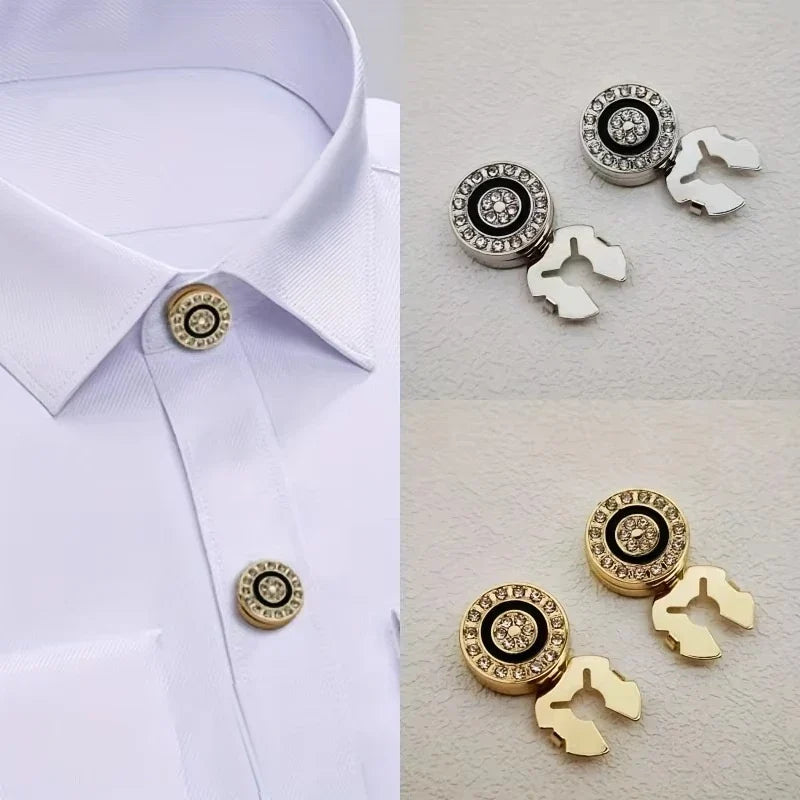
Button covers are decorative metal caps that clip onto a button already sewn on, using a small spring clip underneath. They change the look of a shirt, blouse or jacket in seconds, with no sewing and without touching the button itself. The right cover is chosen according to the diameter and height of the button it will sit on.
Button covers – how they work
Every cover has two parts: a decorative face and a base with a hinged clip. The clip works like a small spring-loaded jaw – it opens, goes around the button and, when closed, grips its edge from below. The cover stays firmly in place, while the sewn-on button remains intact underneath and still fastens the garment through the buttonhole.
It is important to understand what the cover does not do: it does not replace the fastening. The buttonhole still works with the original button, and the cover is purely a decorative layer on top. So when fitting, button the garment first and then clip on the cover.
Fitting step by step
- Fasten the button through the buttonhole as usual.
- Open the clip of the cover fully.
- Place the cover centred over the button, so the clip goes around its edge.
- Close the clip with light pressure until it clicks.
- Check that the cover does not turn and is not tilted.
Removal works in reverse: open the clip and lift the cover off. Take the covers off before washing, so they do not get scratched and do not strain the buttonhole in the drum.
How to choose the size for your button
Size is the most common cause of problems – a cover that is too small will not reach around the button, one that is too large wobbles. Measure the button diameter with a calliper and check its thickness, especially if it is domed. Buttons are also sized in lignes (L), where 1L = 0.635 mm.
| Garment | Typical button size | What to check |
|---|---|---|
| Men's and women's shirts | 16L–18L (about 10–11.5 mm) | thin flat button – the clip must grip tightly |
| Blouses and dresses | 14L–24L (about 9–15 mm) | the spacing between buttons, so the covers do not touch |
| Jackets and waistcoats | 24L–32L (about 15–20 mm) | shank buttons sit higher |
| Uniforms | depends on the model | one size for the whole garment range |
The decorative face can be wider than the button – that is exactly where the effect comes from. The base and clip, however, must match the button size. When ordering a series, send a sample of the actual button or its exact diameter.
Which garments button covers are used on
- Shirts – covers on the collar and cuffs for formal wear; an alternative to cufflinks on a standard cuff.
- Blouses and dresses – a decorative row of covers with crystals or pearls changes the style of the same garment.
- Jackets and waistcoats – gold or silver metal covers for an evening or nautical look.
- Uniforms and corporate wear – matching covers with the company logo, fitted over standard buttons.
- Bridal and eveningwear – pearl and crystal covers for a single day, with no alteration to the garment.
If you are looking for an option for double cuffs, see the article Men's Cufflinks – Types and Alternatives. Covers are a convenient solution precisely when the shirt has ordinary buttons and you do not want to alter it.
Button covers as a brand accessory and promotional product
For fashion brands, covers are a way to sell a "new look" for a garment that already exists. One shirt model can be offered with a set of covers in two or three designs, and the customer chooses which to wear. For companies, logo covers are a discreet corporate gift that staff wear on their own clothing.
Decoration options include:
- a smooth or embossed metal face in gold, silver or antique colour;
- crystals and rhinestones, clear or coloured;
- imitation pearls and enamel in various colours;
- an engraved, embossed or enamelled logo;
- plain blanks for your own design.
Covers are often presented in a gift box with a lapel pin in the same style – see lapel pins with logo.
Cover or new button – when to use which
A cover works best when you want temporary or interchangeable decoration, when the garment is already sewn, or when the same garment needs several looks. If the decorative button is a permanent part of the design, it makes more sense to sew it on directly – in that case browse metal buttons or the full range of buttons for clothing. A cover adds height on top of the button, so with very narrow buttonholes or under close-fitting lapels, try a sample first.
Common mistakes when choosing
- Ordering from a photo of the garment alone, without measuring the button.
- Covers with heavy crystals on a thin blouse – the fabric is pulled down.
- The same cover for buttons of different heights within one collection.
- A logo with many fine details that cannot be read on a small metal face.
Care and storage
- Remove the covers before washing, ironing and dry cleaning.
- Store them in a box with compartments, so the crystals and finish do not get scratched.
- Do not force the clip open – the spring is small and precise.
- Clean the metal face with a dry, soft cloth.
Custom button covers from the manufacturer
Polkom is a manufacturer of button covers with its own production in Sofia – to your design, in the finish you choose and with your logo. All metal parts are nickel free. The minimum quantity is usually 1000 pcs per model, the sample is prepared according to the design, and production takes 10–20 days after approval. The logo can be in any format, preferably a vector PDF. Send the button size and your idea through a request for a quote.
Share this article