Manufacturer · Fashion & Home Accessories











Standard shirt buttons are spaced every 7–9 cm, while on jackets and coats the distance is 9–13 cm. However, spacing is never determined by ruler alone. First, key points are fixed – collar, chest line, and waist – then the remaining buttons are evenly distributed between them. This ensures the garment doesn’t gape when moving and fits the body properly.
Key points: where to start marking
Experienced pattern makers don’t start from the top down, but from places where fastening bears stress. One misplaced button can cause a gap when sitting or raising the arms.
- Top point. For shirts – the collar stand button and the first front button below it. For jackets – the fold point of the lapel.
- Chest line. For women’s shirts and blouses, a button must fall exactly on the fullest part of the chest. Missing this is the most common cause of gaping.
- Waist. For fitted styles and jackets, a button at the waistline holds the silhouette. For men’s double-breasted jackets, the top fastening button is usually just above the natural waist.
- Bottom point. The last button is placed at a distance from the hem that allows comfortable sitting, or omitted entirely on shirts worn tucked in.
Button spacing for shirts, jackets and coats
The values below serve as a guideline for adult sizes. For children’s garments, spacing is reduced proportionally to height.
| Garment | Typical spacing | Button size | Buttonhole direction |
|---|---|---|---|
| Men’s shirt | 7–9 cm | 14–18L | Vertical on placket, horizontal on collar and cuff |
| Women’s shirt and blouse | 6–8 cm, with button on chest line | 14–18L | Vertical |
| Shirt dress | 6–9 cm | 14–20L | Vertical |
| Jacket | 9–11 cm between fastening buttons | 24–32L | Horizontal |
| Coat | 10–13 cm | 36–44L | Horizontal |
| Vest and knitwear | 5–8 cm | 20–28L | Vertical or horizontal |
More information about button sizes in lignes is available on the quantities and sizes page.
How many buttons along the length
The number of buttons is not just a style question. Here is a practical calculation method:
- Measure the fastening length – from the top key point to the last button.
- Divide by the desired spacing from the table and round.
- Check if one button falls on the chest line (for women’s styles) or waist (for fitted styles). If not, adjust the distribution, not just one button.
- Equalize the intervals. Uneven spacing is immediately noticeable, especially with contrasting buttons.
When extending the model for larger sizes, usually the number of buttons stays the same and the interval increases. If the interval exceeds the upper limit in the table, add another button for larger sizes and specify it separately in the grading.
Overlap and buttonhole position
Buttons are sewn along the garment’s centre front. The overlap – distance from centre front to edge – is usually about the button diameter so the button doesn’t extend beyond the edge. Larger buttons require a larger overlap.
Horizontal buttonholes start slightly beyond the centre front towards the edge (about 2–3 mm) because when fastened the button sits at the end of the buttonhole. Vertical buttonholes are centred on the button. The buttonhole length equals the button diameter plus its thickness.
Small positions: collar, cuff, pocket
Besides the front, shirts and jackets have buttons often overlooked in marking:
- Collar stand. The button is centred vertically on the stand, with a horizontal buttonhole. Usually the same button model as the front is used, sometimes one size smaller.
- Button-down collar. Two small buttons are placed so collar points lie naturally without tension. Position is checked with the collar buttoned and tie worn.
- Cuff. One or two buttons; for adjustable cuffs two buttons are sewn side by side about 1.5–2 cm apart. The sleeve placket often has a small extra button.
- Pockets and epaulettes. The button is centred on the pocket flap width, about 1–1.5 cm from the edge to hide the lining when fastened.
How to specify buttons in the tech pack
The technologist receiving the tech pack should be able to mark buttons without questions. Specify:
- Number of buttons per position – front, collar, cuff, pocket, spare;
- Size in lignes and model or article number;
- Distance of the first button from a reference point, e.g. collar seam;
- Spacing between buttons and tolerance, e.g. ±3 mm;
- Buttonhole direction and length;
- Size grading changes;
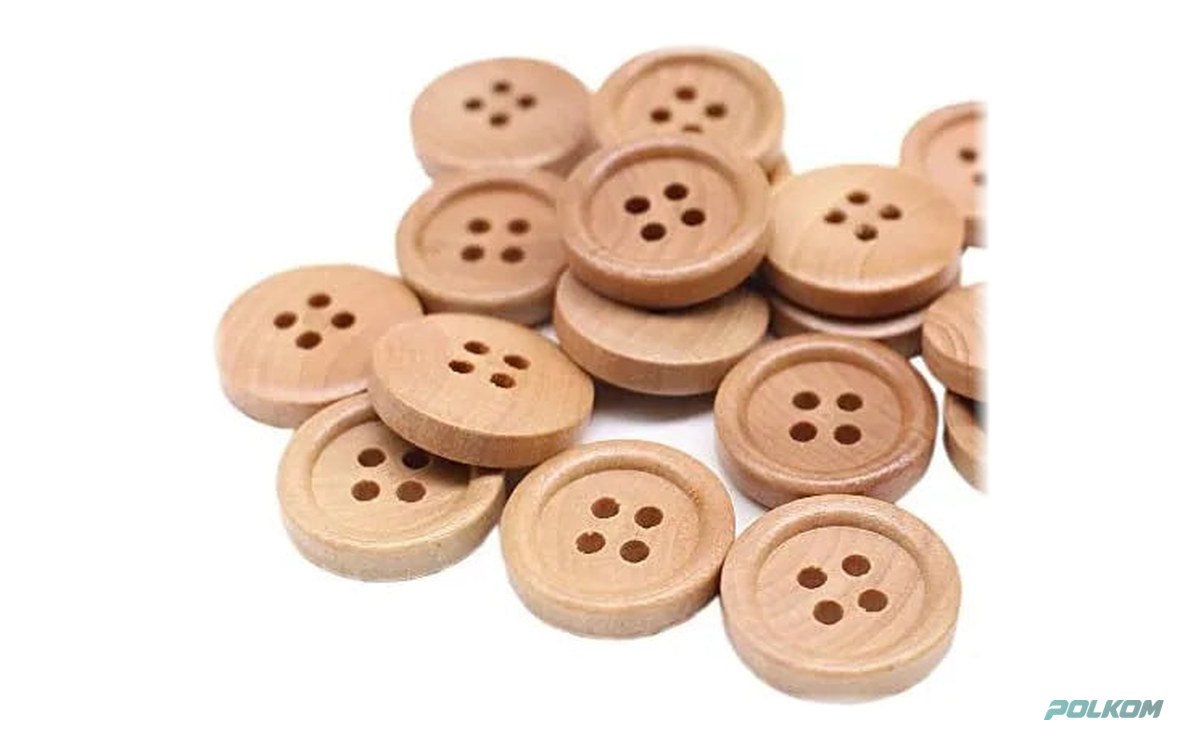
- Sewing method – number of stitches, cross or parallel for four-hole buttons.
Common mistakes
- Distributing buttons “by eye” on the prototype and transferring without measuring to the pattern.
- Missing a button on the chest line in women’s shirts.
- Too large spacing on coats – causing gaping in wind and movement.
- Same spacing for all sizes without checking smallest and largest.
- Different buttons on cuff and front without reason – a small but noticeable detail.
Choosing buttons for shirts
Shirts have the most buttons of any garment, so quality is most visible there. Classic are flat four-hole polyester and mother-of-pearl buttons. Explore polyester buttons for mass production or mother-of-pearl buttons for higher-end garments. The full range is in the buttons for garments category.
Polkom – Manufacturer of Buttons for Ready-to-Wear
Polkom is a manufacturer of accessories for fashion, footwear and bags, as well as perfume and cosmetic packaging and furniture accessories, based in Sofia with over 30 years of experience. We assist technologists and brands in selecting button sizes and counts for each model, produce samples and custom logo buttons. All products are OEKO-TEX® certified. Send us your pattern or tech pack via the contact form.