Manufacturer · Fashion & Home Accessories











Contents
Eco friendly buttons are buttons made from renewable natural materials – corozo, coconut shell, wood, horn, mother-of-pearl – or from recycled raw material such as recycled polyester. Corozo buttons and coconut buttons are among the most popular choices. Which one is right depends on the type of garment, the washing method and the look you are after. Here we compare the materials side by side so you can pick the right one for your collection.
What makes a button eco friendly
There is no single criterion. When assessing buttons, brands usually look at several things at once:
- origin of the raw material – a renewable plant or animal material, or a secondary raw material;
- processing – how much chemistry and energy are needed for dyeing and finishing;
- safety – whether the material has been tested for harmful substances;
- durability – a button that lasts the whole life of the garment is more sustainable than one that has to be replaced;
- traceability – whether the recycled content is proven by a document.
Comparison of materials for eco friendly buttons
| Material | Origin | Look | Washing and ironing | Suitable for |
|---|---|---|---|---|
| Corozo | nut of the tagua palm | smooth, dense, easy to dye | withstands washing; avoid long soaking | shirts, jackets, coats, knitwear |
| Coconut | coconut shell | natural texture, brown tones | washes well at moderate temperatures | summer, linen and beachwear |
| Wood | various types of wood | warm, natural look, can be engraved | sensitive to prolonged moisture | coats, cardigans, children's wear and home textiles |
| Horn | natural horn | unique veining, every button different | gentle washing, no high temperatures | suits, coats, high-end clothing |
| Mother-of-pearl | real shell | pearly lustre, play of colours | withstands washing; protect from knocks | shirts, blouses, formal wear |
| Recycled polyester | secondary polyester raw material | any colour and effect, like standard polyester | as wash-resistant as standard polyester | mass-market collections, workwear and children's wear |
Natural materials – a short overview
Corozo
Corozo buttons are made from the dried nut of the tagua palm, known as vegetable ivory. The material is turned, polished and dyed while keeping a slight natural structure. It suits almost any garment and is one of the most popular choices of eco brands.
Coconut
Coconut buttons have a distinctive texture and warm brown shades that are hard to imitate. They are a natural choice for linen shirts, summer dresses and garments with a natural look.
Wood
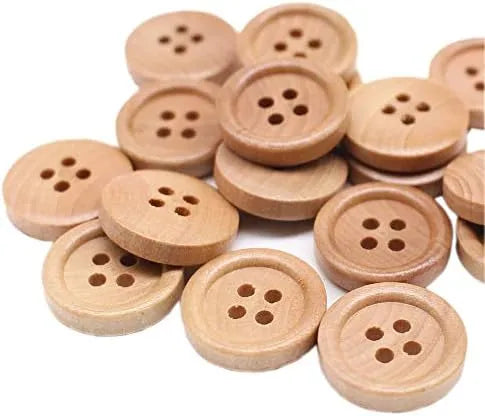
Wooden buttons offer a wide variety of tones and shapes and take laser engraving very well. They suit coats, knitwear and children's clothing, and the surface can be lacquered or have a natural matte finish.
Horn and mother-of-pearl
Natural horn and mother-of-pearl buttons made from real shell are a premium choice – every piece is slightly different, which underlines their natural origin. They are used for suits, shirts and luxury collections.
Recycled buttons
When the look has to be the same as a standard polyester button – exact colour, marble or horn effect, a large series – the solution is recycled polyester. It behaves like the standard material in washing and ironing but uses secondary raw material. Recycled versions are available on request, and the recycled content is proven with a certificate.
Certificates: OEKO-TEX® and GRS
The two standards answer different questions and are often required together:
- OEKO-TEX® shows that the product has been tested for harmful substances. Polkom offers an OEKO-TEX® certificate for all its products.
- GRS (Global Recycled Standard) traces recycled content along the supply chain. Polkom holds a GRS certificate and offers recycled products on request.
You will find more about the documents on the Certificates page.
How to choose eco friendly buttons for your collection
- Start with the garment's care: if the label allows washing at 60 °C, choose a material that withstands it.
- Think about the look: a uniform colour in every batch is easier with corozo and recycled polyester, while natural variation is part of the charm of horn, coconut and mother-of-pearl.
- Consider logo and marking: wood, corozo and coconut can be laser engraved without paint.
- Check the combination with thread and labels – an eco collection looks consistent when the other accessories are chosen with the same logic.
- Order samples and test washing and ironing on a sewn prototype.
Eco friendly buttons by garment type
The practical choice depends mostly on what the garment is and how it will be worn and washed:
- shirts and blouses – corozo, real-shell mother-of-pearl and recycled polyester in small sizes, as they withstand frequent washing;
- linen and summer collections – coconut and light wooden buttons that highlight the natural texture of the fabric;
- coats and jackets – corozo, horn and wood in larger sizes, with a matte or semi-matte finish;
- knitwear and cardigans – wood and coconut, light and warm-looking;
- denim and workwear – recycled polyester in more solid designs when high durability is needed;
- children's clothing – smooth corozo or lacquered wooden buttons without sharp edges.
Good practice is for an eco collection to use one or two materials rather than all of them at once. This makes the look more coherent and orders easier to plan. If the same garment is made in both a standard and an eco version, keep the shape and size of the button and change only the material – that way the pattern and the buttonhole stay the same.
Caring for garments with natural buttons
- wash at the temperature on the label, preferably with the garment turned inside out;
- avoid long soaking for wood and horn;
- iron around the buttons, not directly on them;
- for dry cleaning, point out the natural buttons.
Eco friendly buttons from Polkom
Polkom is a manufacturer of accessories for fashion, footwear and bags from Sofia with over 30 years of experience. Our range of buttons includes corozo, coconut, wood, horn, mother-of-pearl and polyester, and to order we make designs with a logo and in a colour matched to your sample. Minimum quantities depend on the article. Send us an enquiry via the contact page and you will receive samples and a quote.
Share this article