Manufacturer · Fashion & Home Accessories












Curtain eyelets are large rings, most often with an inner diameter of around 35–40 mm, through which the curtain is threaded directly onto the curtain pole. The inner diameter must be at least 8–10 mm larger than the pole so the curtain slides freely. The eyelets are set at equal intervals, usually 15–20 cm, and in an even number, so that both ends of the curtain turn towards the wall.
How curtain eyelets work
An eyelet curtain has no rings, hooks or tracks. The pole passes directly through the holes and the fabric forms soft, even folds. This solution is popular for heavy curtains, blackout curtains and modern interiors. Technically, the eyelet protects the fabric from tearing and ensures smooth sliding along the pole.
Types of curtain eyelets
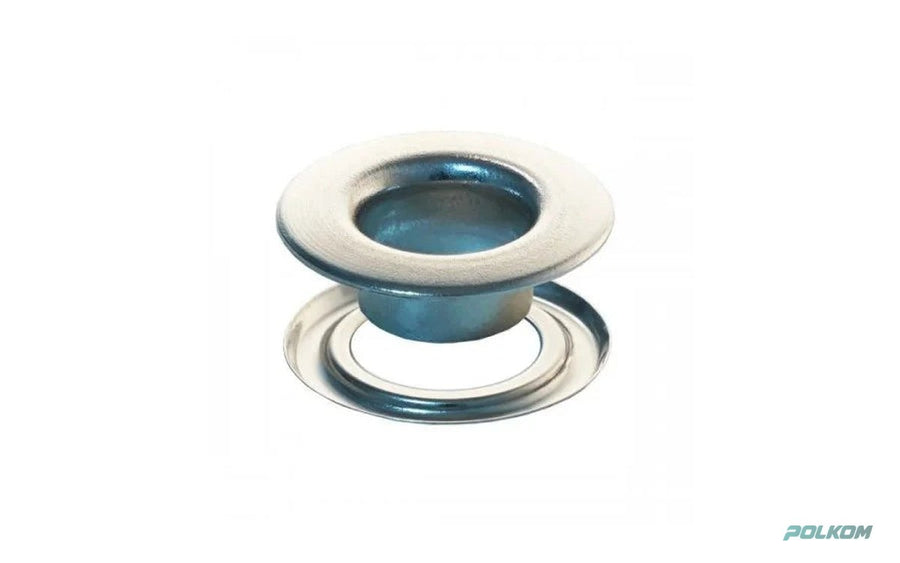
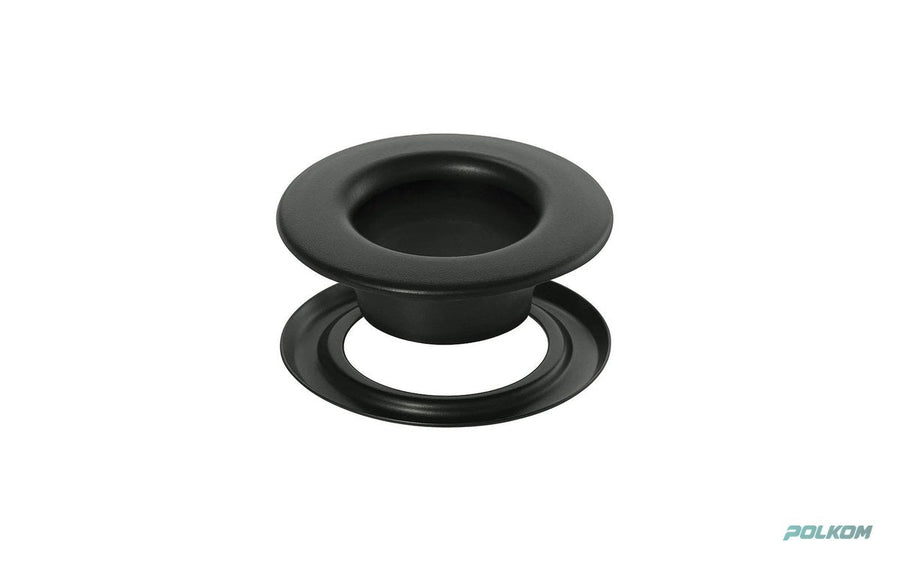
- Two-part plastic eyelets – the most common. They consist of a front and a back part that snap together by hand, without tools. Light, quiet and available in many colours, including with a metallic effect.
- Metal eyelets – made of brass, steel or aluminium. Heavier and more durable, they require a press or a hole punch and hammer. They give a more substantial look.
- Plastic eyelets with a metal finish – they look like metal but are fitted like plastic ones.
- Oval and square eyelets – decorative options for designer interiors.
Eyelet size relative to the curtain pole
| Pole diameter | Recommended inner diameter of the eyelet |
|---|---|
| up to around 16 mm | around 25 mm |
| up to around 25 mm | around 35 mm |
| up to around 28–30 mm | around 40 mm |
| thicker poles | around 50 mm and more |
The table is a guide. If the eyelet is too narrow, the curtain will catch when pulled. If it is too wide, the folds become uneven and the curtain hangs lower than expected.
Spacing between eyelets and an even number
The distance between the eyelet centres determines the depth of the folds. At around 15 cm the folds are shallower and the curtain takes up less space when drawn back. At around 20 cm the folds are deeper and fuller. It is important that the spacing is equal across the whole width.
The number of eyelets must be even. This way both ends of the curtain finish with an eyelet facing the same direction – back towards the wall – and the curtain looks symmetrical. The first and last eyelets are usually placed about 5–7 cm from the side edge.
How much fabric you need
For attractive folds, the fabric width should be about 1.5–2 times the length of the curtain pole. For eyelet curtains a fullness ratio of around 2 is often used, especially with thinner fabrics. For the height:
- measure from the top of the pole to the desired length (to the floor, to the sill);
- add the distance from the eyelet centre to the top edge of the curtain – usually around 4–5 cm, as the top edge stands above the pole;
- add allowances for the top and bottom hems.
Eyelet tape (stiffening tape)
The top of the curtain is reinforced with a stiff tape, usually about 10 cm wide. It keeps the eyelets upright, prevents the fabric from stretching and makes the top edge straight. The tape is sewn or ironed into the hem, and the eyelet holes are cut through the fabric and the tape at the same time. There are also tapes with pre-marked circles for cutting. See also the tapes and ribbons in our catalogue.
How to fit eyelets to a curtain – step by step
- Fold the top of the curtain over with the stiffening tape inside and stitch it.
- Mark the eyelet centres – first the two end ones, then distribute the rest evenly.
- Draw the circles using the template usually supplied with the eyelets, or along the inner edge of the eyelet.
- Cut out the holes with sharp scissors, slightly smaller than the marked circle.
- Place the front part on the front and the back part behind, and snap them together with pressure (plastic) or close them with a press (metal).
- Thread the curtain onto the pole so that the first and last eyelets face the wall.
Curtain eyelets in series production
In series production of curtains, eyelets are set with a bench press or pneumatic machine with a spacing template, which guarantees identical folds on every piece. Metal curtain eyelets are closed on the same principle as eyelets for clothing, but with large-diameter dies. The eyelet colour is usually coordinated with the colour of the curtain pole – matte silver, chrome, antique brass, black or white – or with the fabric colour. When ordering large quantities, it is practical to have the eyelets delivered together with the stiffening tape and the cutting template.
Common mistakes
- An odd number of eyelets – one end turns outwards.
- Eyelets too narrow for the pole – the curtain catches.
- No stiffening tape – the fabric around the eyelets stretches and the folds distort.
- Uneven spacing – the folds differ in depth.
- Too large a hole cut – the eyelet turns and can fall out.
Eyelets for home textiles from Polkom
Polkom is a Bulgarian manufacturer of accessories and haberdashery, supplying wholesale to garment and textile producers. In the eyelets category you will find models in various sizes and finishes, and for series production of curtains and home textiles we can also offer eyelets colour-matched to a sample. Send an inquiry with the pole diameter, the colour and the quantity.