 Manufacturer · Fashion & Home Accessories











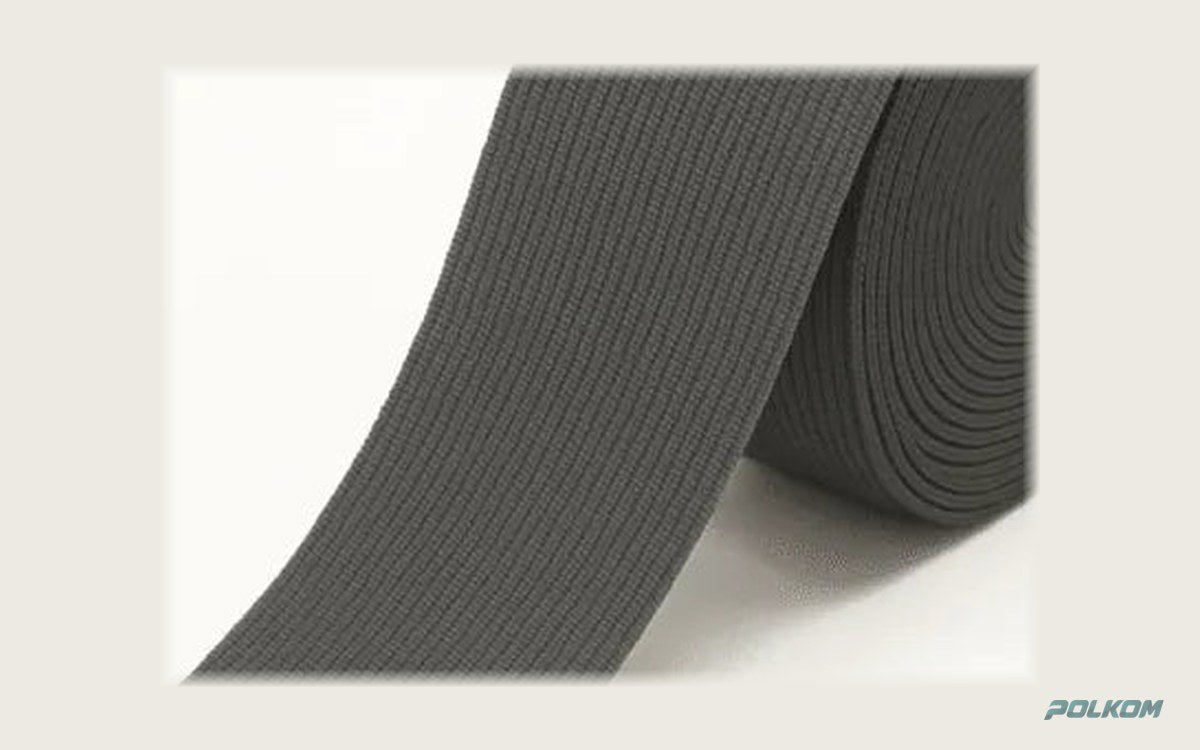
Elastics for clothing are among the most widely used materials in garment production. They hold up trouser waistbands, shape sweatshirt cuffs, keep lingerie in place and let children's clothes grow with the child. A poorly chosen elastic, however, can twist, lose its stretch after a few washes or press on the skin. In this guide we explain the main types of elastic, how to choose the width and what to look out for when ordering wholesale.
Main types of elastics for clothing
All elastics contain elastic yarns (rubber or elastane), covered with or woven between polyester, polyamide or cotton yarns. The difference between the types comes from the way the band is constructed.
Woven elastic
Woven elastic is made on a loom, where the yarns interlace at right angles. The result is a dense, stable band that keeps its width when stretched and does not narrow at the edge. It is less stretchy but very durable. It is used for trouser and skirt waistbands, workwear, outerwear and bags. See the range in woven elastic.
Knitted elastic
Knitted elastic is produced on a knitting machine and has a softer, more flexible structure. It stretches easily and adapts to the body, so it suits garments in direct contact with the skin – lingerie, pyjamas, children's clothing, sportswear. It may narrow slightly when stretched, which is not a problem when inserted in a casing. Browse knitted elastic.
Jacquard elastic
The jacquard technique allows lettering, logos and patterns to be woven into the elastic itself. This is the most common way of branding underwear, leggings, sports shorts and bottoms. Unlike printing, the woven motif does not wear off in the wash.
Round elastic
Round elastic (elastic cord) has a cylindrical cross-section and is used as a cord – for hoods, jacket hems, gym bags, face masks and decorative ties. It is usually combined with cord stoppers and cord ends.
Decorative elastics
Elastics with lurex yarn, brocade, picot edges, ruffles or a textured structure combine function and decoration. They are found in women's, children's and swimwear collections, where the elastic is visible.
Elastic widths and what they are used for
Elastics are typically available in widths from 1 to 10 cm, on 25-metre rolls. These are the most commonly used widths:
- 1–1.5 cm – cuffs, necklines, lingerie, children's clothing, sleeves;
- 2–3 cm – pyjama waistbands, skirts, everyday trousers, sports shorts;
- 3.5–5 cm – legging waistbands, joggers, underwear with visible elastic, sportswear;
- 6–10 cm – wide waistbands, bodices, supports, sports belts, shaping elements.
Non-standard widths can also be made if needed. For even wider solutions, read our article on wide elastic of 10–20 cm.
How to choose the right elastic
The choice depends on several factors that are best considered together:
- Method of attachment – will the elastic go into a casing or be sewn directly onto the fabric? When sewn on directly, woven elastic holds its shape better.
- Required stretch – how far must the elastic stretch when the garment is put on? Knitted elastics allow greater elongation.
- Contact with skin – for lingerie and children's clothing choose a soft knitted elastic or one with a brushed inner side.
- Load – workwear and heavy fabrics need a denser, wider elastic.
- Visibility – if the elastic will be visible, think about colour, a jacquard logo or a decorative edge.
- Care – check what temperature the product will be washed at and whether it will be tumble dried.
The safest approach is to make a sample of the product and wash it several times. That way you will see how the elastic behaves in real conditions.
Colours and matching the fabric
Elastics are produced in practically every colour. Besides the basics – white, black, navy, grey, beige and ecru – red, green, pink, purple, yellow and neon tones are available. For corporate collections and brands with a clearly defined palette, the colour can be matched to Pantone or to a fabric sample.
Bear in mind that the elastic and the fabric sometimes take dye differently, so for important colours always ask for a sample before series production.
Logo elastic
Elastic with a woven-in logo is one of the most effective ways for a brand to be present on a garment. It is visible on underwear, sportswear and leggings and works as an advertisement every time it is worn. Besides the jacquard technique, silicone or pigment printing and reflective elements for sports and workwear are also used.
Common mistakes when working with elastics
- Elastic too narrow for the waistband – it twists in the casing and digs into the skin. Choose a width that matches the casing width.
- Incorrectly calculated length – elastic is usually cut 10–15% shorter than the circumference, but the exact ratio depends on the type. Check it on a sample.
- Stretching too much when sewing – when sewing with zigzag or overlock, excessive stretching can break the elastic yarns.
- Skipping the wash test – some fabric and elastic combinations shrink differently, causing puckering.
Care and durability
Elastic yarns are affected by high temperatures, chlorine and some fabric softeners. To help the elastic keep its properties for longer:
- wash at the temperature stated on the label;
- avoid bleach and aggressive detergents;
- do not iron the elastic at high temperature;
- do not dry for long periods on a radiator or in a tumble dryer on a high setting.
Wholesale elastics from Polkom
Polkom is a manufacturer based in Sofia, Bulgaria, with over 30 years of experience in producing and wholesaling haberdashery and accessories for fashion, furniture, footwear and bags. In the elastics category you will find woven, knitted, jacquard and round elastics in various widths and colours. Large stock allows fast dispatch, and for special requirements we make custom elastics – with a logo, in a specific colour or in a non-standard width.
We deliver across the European Union and make samples quickly. Minimum quantities depend on the article – send an inquiry with the desired type, width and colour to info@polkom.com or call +359 876 76 60 50.




