Manufacturer · Fashion & Home Accessories











Embroidery price is not determined by the logo size in centimetres, but mainly by the number of stitches the machine must make. Added to this are digitization (one-time file preparation), the number of colours and thread changes, the type of item and the quantity. Understanding these five factors lets you reduce the cost of your embroidered logo without sacrificing its appearance.
Embroidery price: why stitch count is the main measure
The embroidery machine works at a set speed measured in stitches per minute. Each stitch takes time, and machine and operator time are the biggest costs. Therefore, embroiderers calculate price per thousand stitches, not by area. Two logos of the same size can have very different stitch counts:
- Outline logo or text – few stitches, quick production.
- Logo with solid fill – tatami fill covers the entire area, multiplying the stitch count.
- Satin stitch – used for letters and narrow elements; shiny but unstable on wide columns and replaced by fill.
The easiest optimisation is to let the fabric “work” as background: instead of a filled rectangle behind the logo, embroider only the symbol and letters.
Digitization – a one-time cost
Before embroidering, the machine needs a file with instructions for every stitch: direction, density, sequence and backing. This process is called digitization (punching). It is paid once per design and size. If a logo is embroidered on the chest and back in different scales, usually two files are needed because density does not scale automatically.
For repeat orders, the file already exists and this cost is waived. Therefore, request the file in machine format (e.g. DST) to be saved and specify thread codes in it – so the next batch will be identical.
Colours, thread changes and embroidery logo price
Multi-head machines have a fixed number of needles, each with a separate colour. A three-colour logo is embroidered without interruption; a twelve-colour logo may require manual thread changes and more trimming. Each trim and transition adds seconds, which multiply over thousands of pieces.
Practical tips:
- Combine close shades – the difference between two greys is rarely visible in embroidery.
- Use multicolour thread for gradient effects instead of alternating several colours.
- Small elements under 1 mm do not embroider cleanly – remove or thicken them.
Item and position: embroidery on clothing price
The logo’s placement affects cost as much as the logo itself. Chest embroidery on a T-shirt or polo uses a regular hoop. Sleeve, pocket, already sewn backpack or hat require special hoops, slower speed or manual positioning.
| Item / Position | What Increases Cost |
|---|---|
| T-shirt, polo – chest | Normal case; knitwear requires stabiliser |
| Jacket with lining, vest | Thick package, difficult hooping, sometimes lining unpicking |
| Hat – front panel | Cylindrical hoop, limited design height |
| Sleeve, trouser leg | Narrow hoop, slower work |
| Towel, fleece | Cover film needed to prevent stitches sinking |
| Finished bags, backpacks | Limited access, manual placement |
Embroidering on uncut or just cut parts is faster and cheaper than on finished garments.
Quantity and machine embroidery price
For small quantities, setup costs dominate: thread loading, test, hoop adjustment. For large quantities, these costs spread over all pieces. Also, multi-head machines embroider several items simultaneously with one setup. Therefore, unit price for custom machine embroidery drops noticeably as quantity grows.
Combining helps here too: if the same logo is on T-shirts, sweatshirts and hats, order them together. The file and colours are the same, and setup is done fewer times.
Materials: thread, stabiliser and needles
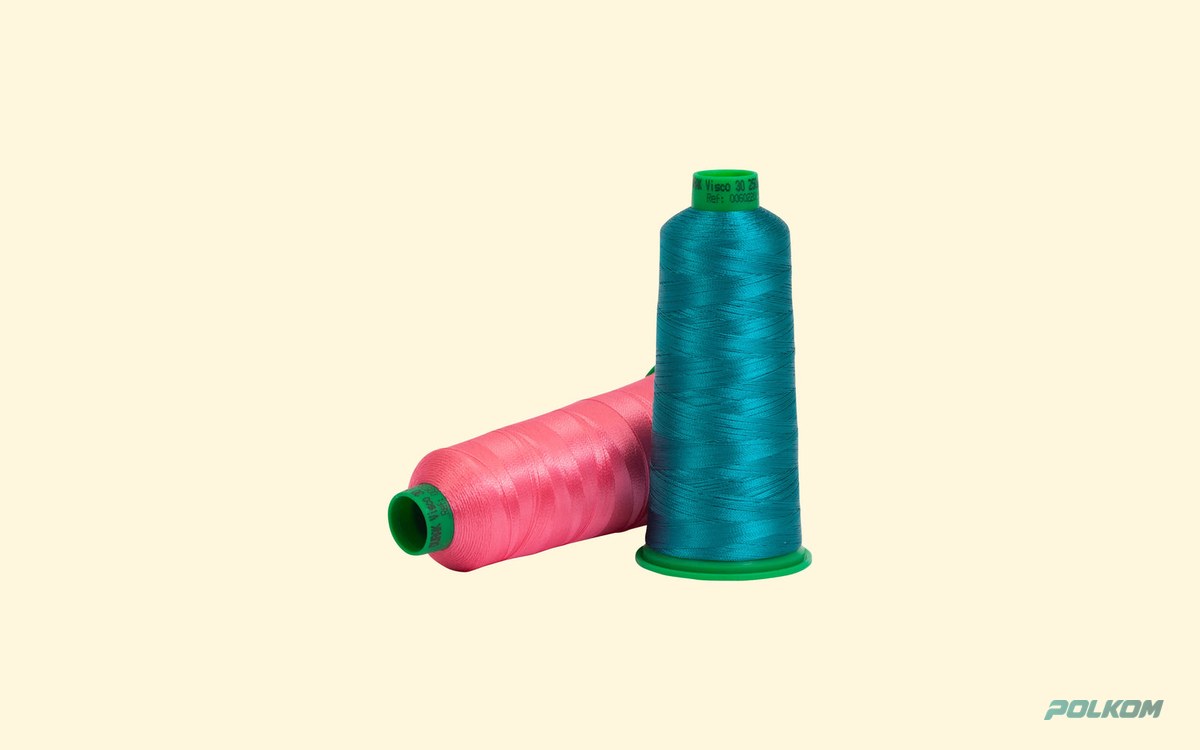
Thread is a small part of the total cost but determines how long the embroidery will look good. The type depends on the item:
- Trilobal polyester – strong shine, withstands industrial washing and chlorine; for workwear, uniforms, towels.
- Viscose – soft, silky shine; for fashion and lingerie, with gentler washing.
- Matte polyester – high lightfastness for sun-exposed items.
- Metallic threads – luxury accent but require lower speed, affecting price.
The standard thickness for logos is number 40, and for small text number 60. The full range is available in the embroidery threads category, and bobbin thread and spools among threads for production.
How to reduce price without losing quality
- Simplify the logo for embroidery – a separate version without gradients and microtext.
- Remove embroidered background if it is not part of the identity.
- Reduce colours to those visibly different.
- Choose a position accessible with a regular hoop.
- Embroider on cut parts when possible.
- Combine quantities for different models.
- Keep the file and thread codes for repeat orders.
When a patch is more cost-effective than embroidery
For very detailed logos, small text or many colours, direct embroidery becomes expensive and not always legible. Then an alternative is a woven patch: it reproduces fine details, is produced in series and sewn or heat-applied on each item. Patches are convenient when the same logo must appear on many different products – jackets, hats, backpacks.
Embroidery threads from Polkom
Polkom is a manufacturer of accessories for fashion, footwear and bags, for perfumes and cosmetics, packaging and furniture accessories, with over 30 years of experience and headquarters in Sofia. For embroidery workshops and brands, we offer embroidery threads in wide colour palettes, bobbin thread, spools and woven patches with logos. All products have OEKO-TEX® certification, and recycled versions are available on request. Send us colour codes, thickness and quantities via the contact form to receive a quote and sample.