Manufacturer · Fashion & Home Accessories
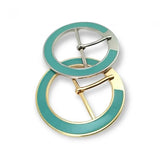






An enamel metal plate is a plate in which the recessed areas of the logo are filled with coloured enamel, while the metal outlines remain visible and separate the colours. There are two main types – soft and hard enamel – plus an epoxy coating, which is poured on top as a clear dome. Soft enamel gives a tactile relief and a lower unit cost, hard enamel a smooth, jewellery-like surface and higher durability.
How an enamel metal plate is made
The base is a stamped or die-cast plate in which the logo is formed as a system of “cells” enclosed by thin metal walls. Each cell is filled with enamel of a specific colour. The walls prevent the colours from mixing and at the same time outline the design. After filling, the plate is fired or cured, and with hard enamel it is also ground to a flat surface.
That is why a design for enamel is prepared differently from a design for engraving. Each colour must be a closed area, and there must always be a metal line between adjacent colours. Very thin coloured details cannot be filled cleanly – for those, printing or etching is better.
Soft enamel
With soft enamel, the enamel is filled below the level of the metal walls. After drying, the coloured areas remain slightly recessed, and the outlines can be felt with a finger. This creates a striking, tactile look and emphasises the relief of the logo.
- A wider range of colours and the possibility of many shades on one plate
- More cost-effective in runs, because there is no grinding stage
- The recesses can collect dirt if the plate is in a place with a lot of friction
Hard enamel
With hard enamel, the enamel is filled up to or above the edge of the walls, fired at a high temperature and then ground and polished until the metal and the enamel are level. The surface is as smooth as glass and very scratch resistant.
- A luxurious, jewellery-like look
- High resistance to wear and washing
- More limited shades and a higher unit cost due to the extra processing
Epoxy coating (dome)
Epoxy resin is a clear layer applied over soft enamel or over a printed image. It levels the surface, gives a magnifying effect and protects the colours. It is a good solution when you want smoothness without the cost of hard enamel, but the resin is softer than hard enamel and can scratch with heavy friction.
Comparison
| Parameter | Soft enamel | Hard enamel | Soft enamel + epoxy |
|---|---|---|---|
| Surface | Textured relief | Smooth, polished | Smooth, slightly domed |
| Colours | Wide range | More limited | Wide range |
| Abrasion resistance | Good | Very high | Medium to good |
| Suitable for | Caps, jackets, backpacks | Luxury bags, leather goods | Children’s and sports products |
Colours and Pantone matching
Enamel is coloured to a Pantone reference, but the final shade depends on the thickness of the layer and the colour of the metal beneath it. Light colours on a gold finish look warmer, and on nickel colour cooler. That is why, for brands with a strict corporate colour, we recommend a sample with several variants of the shade. White and very light colours require a denser layer so that the metal does not show through.
Does enamel withstand washing
Properly cured enamel withstands machine washing of the garment, especially if it is turned inside out. The risk comes from knocks against the drum, very high tumble-dryer temperatures and aggressive detergents with bleach. For items washed often, it is better to choose hard enamel or a plate placed where there is less friction. If the plate is on workwear subject to industrial washing, discuss with the manufacturer whether enamel is suitable or whether engraving would be better.
Where enamel works best
- On caps and visors, where a coloured logo is visible from a distance
- On backpacks and sports bags as a bright accent
- On children’s collections, where colour is part of the identity
- Combined with metal buttons with enamel in the same colour for a consistent style
Enamel also combines with other clothing accessories – charms, zip pullers and buckles in the same finish, so that the branding is consistent.
How to prepare the logo for enamel
- Simplify the detail. Lines below about 0.3 mm are difficult to form as metal walls, and very small coloured areas do not fill evenly.
- Close every coloured area. If two colours touch without a dividing line, add a thin metal outline.
- State the Pantone for each colour. CMYK and RGB values are only a guide; enamel is matched to solid Pantone colours.
- Choose the metal colour. The outlines will be in the chosen finish – gold, nickel colour (nickel free), black or antique – and they become part of the design.
- Decide whether there will be epoxy. If so, bear in mind that the clear layer slightly changes the perception of the colours.
The price of an enamelled plate depends on the size, number of colours, type of enamel, finish, attachment method and quantity. For a specific estimate, send a request for a quote with the file and the desired parameters.
Common mistakes
The most common mistake is too many colours on a small plate – from a distance they merge and the logo loses clarity. Another is choosing soft enamel for a place with constant friction, for example the bottom of a backpack, where the recesses fill with dust. A third is approving a colour only on screen, without a physical sample.
Enamel logo plates from Polkom
Polkom makes metal logo plates with soft and hard enamel, epoxy coating and various metal finishes to the client’s design. All our metal finishes are nickel free. We help adapt the logo for enamel and prepare a sample for colour approval. Send the file and Pantone references via the contact page to request a quote.