Manufacturer · Fashion & Home Accessories












Engraving or embossing buttons – the choice depends mainly on the material and the quantity. Laser engraving is more flexible, needs no die and works on almost all materials; a relief is made with a die, gives a raised or recessed three-dimensional logo and is typical of metal buttons and larger runs.
Engraved or embossed buttons: the key difference
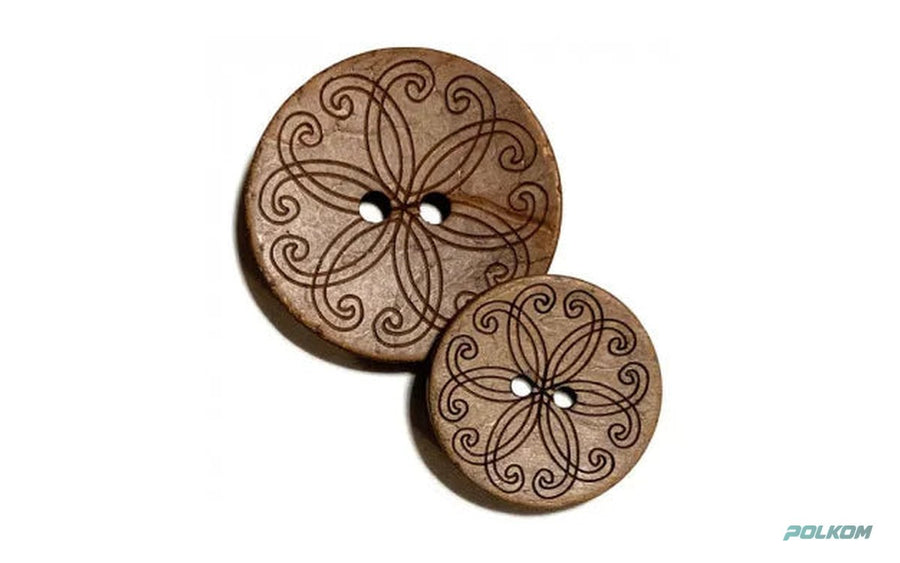
Engraving removes material – the laser cuts the logo into the surface. The result is a flat, recessed outline that can be filled with colour. With embossing the material is shaped – the logo is stamped into the metal or moulded into the resin using a die. The result has volume, catches the light and can be felt with your fingers.
Comparison by criteria
| Criterion | Laser engraving | Relief with a die |
|---|---|---|
| Materials | polyester, corozo, wood, bone, coconut, coated metal | mainly metal; moulded polyester styles |
| Tooling | not needed | a die is made |
| Suitable quantity | small and medium runs, but large ones too | medium and large runs |
| Detail | very fine lines and small text | better with simpler shapes |
| Look | flat, recessed, with contrast | three-dimensional, luxurious, plays with light |
| Changing the design | quick and easy | requires a new die |
When to choose laser engraving
- You work with natural materials – corozo, wood, bone, coconut.
- You are ordering a smaller run or testing a new collection.
- The logo has fine lines or text.
- You want to brand a stock model without waiting for tooling.
- You plan different logos for different lines or seasons.
When to choose a relief
- You are ordering metal buttons for jackets, blazers, coats or jeans.
- The logo is a permanent element of the brand and will be used for years.
- You want volume and a classic look, especially with a patina or antique finish.
- Quantities are large enough to spread the cost of the die.
Raised or recessed relief
A raised relief is more visible and is a classic on uniforms and blazers. A recessed one is more discreet and more resistant to wear, because the logo is not rubbed directly. With patinated finishes, the recessed areas hold the darker tone and the logo stands out naturally.
Combined solutions
The two methods are not mutually exclusive. Common combinations:
- relief + enamel – the recessed areas are filled with coloured enamel;
- relief on the rim + laser in the centre – a die-struck ornament with a personalised inscription;
- engraving + colour fill – on polyester buttons the grooves are filled with a contrasting colour.
How the choice affects the price
With a relief there is a one-off cost for the die, spread over the quantity. On a small run it weighs more; on a large one it becomes negligible per piece. Laser engraving needs no tooling, but every button goes through the machine, so engraving time is the main factor. You will get an exact comparison for your case in the quote – state the quantity and sizes in your inquiry.
How to decide quickly
If you are unsure, answer three questions: what material is the button, how many pieces are needed and how complex is the logo. Metal, large quantity and a simple logo – relief. Natural material, smaller run or fine detail – laser. Anything in between is best decided with a sample.
How the two methods look on different garments
Jackets and blazers
Here tradition is on the side of relief. A metal button with a raised crest, monogram or anchor is a recognisable element of the classic blazer. A laser-engraved logo on a polyester or corozo button is a more modern and discreet alternative, suitable for casual jackets.
Coats
On coats the buttons are large and the logo has room. Engraving on corozo, horn or imitation horn looks natural and understated, while a relief on metal gives a more formal, military character.
Jeans and workwear
Jeans buttons almost always have a relief logo around the rim or in the centre. The reason is practical – a relief on metal withstands abrasion, high-temperature washing and mechanical stress better than any other option.
Shirts and knitwear
Small buttons rarely carry a relief, because the volume gets in the way when buttoning. Here laser is almost the only sensible choice, and the logo is reduced to a symbol or initials.
What to check on the sample
- whether the volume of the relief hinders buttoning through the buttonhole;
- whether the laser engraving is even across the whole surface;
- whether the colour fill is clean, without smudges at the edges;
- whether the logo is legible from the distance at which people look at the garment.
Preparing the file for both methods
Both engraving and relief need a vector file, but the requirements differ. For laser, clean outlines and minimum line thickness matter. For relief, the height (depth) of the individual elements also matters – the die designer needs to know which parts should stand out and which should stay in the background. If the logo has several levels, mark them with different colours in the file. Fonts are always converted to outlines. With relief, avoid very narrow spaces between letters – the metal may fill them and the lettering lose clarity.
Repeat orders
With laser engraving, a repeat order is easy – the file and parameters are kept. With relief, the die is kept for future runs, so no new tooling is made on a repeat unless you change the design or size. If you are planning a long-term collection, relief is an investment that pays off with every subsequent batch.
Advice and samples from Polkom
Polkom has been manufacturing engraved and embossed logo buttons for over 30 years. We will review your logo, suggest the right method and make a sample. Send an inquiry with the style, material and quantity.