Manufacturer · Fashion & Home Accessories











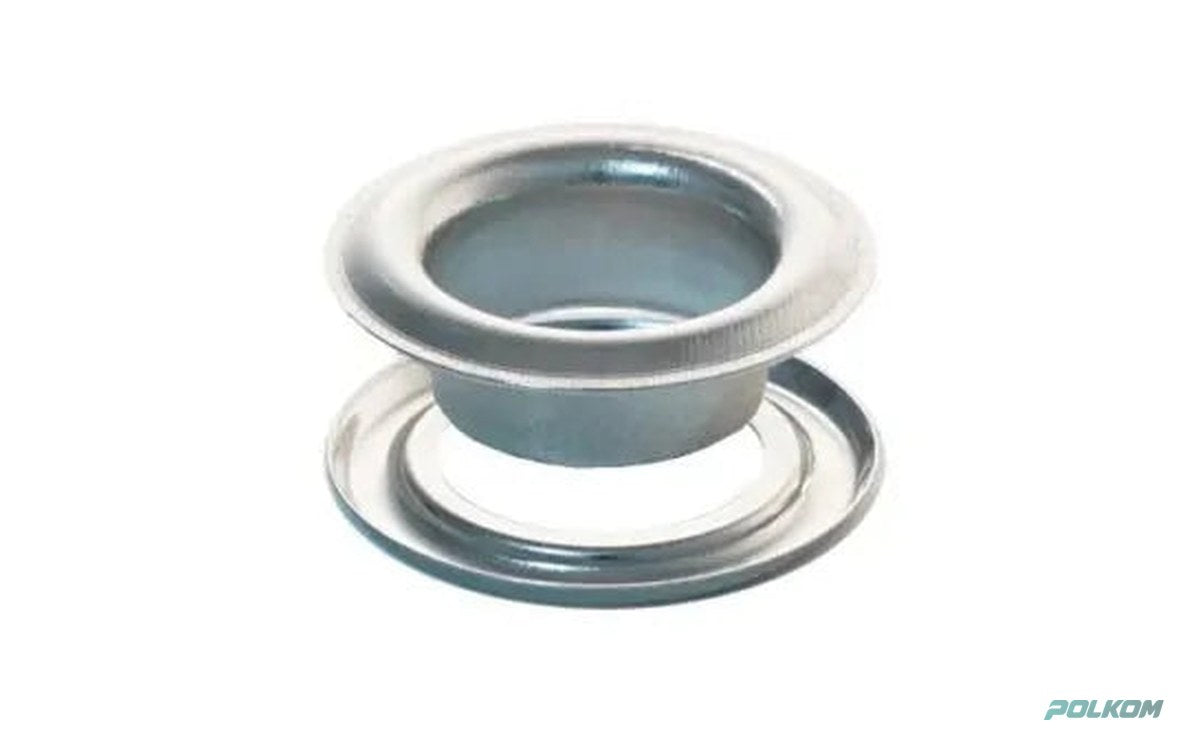
Eyelet numbers (No. 17, 18, 2, 3, 4, 5, 24, 26, 28, 30, 31, 32, 34, 66 and others) are a trade designation of size, not a diameter in millimetres. The smallest eyelets are No. 16–18 with a hole of about 3–4 mm, No. 2–5 cover holes from about 4 to 8 mm, No. 24–34 from about 9 to 28 mm, and No. 66 is the large grommet for tarpaulins with a hole of about 38–40 mm. In the chart below you will find the exact outer diameters and holes from our catalogue for each number, and the typical use.
The chart is useful when you have an old specification with a number, want to find an equivalent or need to quickly judge what lies behind a number in someone else's tech pack.
Eyelet numbers – size chart
D – outer flange diameter, d – inner hole, in mm. Where one number covers several types (standard, flat, mesh, double-sided, etc.), the range of all articles with that number is given.
| No. | Articles | D, mm | d, mm | Typical use |
|---|---|---|---|---|
| 16 | KP-01 | 6.1 | 3.2 | fine laces, baby clothing, lingerie, bodysuits |
| 17 | KS-01, KP-02 | 7 – 7.5 | 3.5 – 3.6 | fine laces, baby clothing, lingerie, bodysuits |
| 18 | KS-02 | 8 | 4 | fine laces, bodysuits, shirts |
| 2 | KS-03, KS-04, KP-03, KM-01 | 8.3 – 8.5 | 4.3 – 4.7 | shirts, blouses, hats, light shoes |
| 3 | KS-05, KS-06, KS-07, KP-04, KM-02, KM-03 | 9.5 – 11 | 4.3 – 5.6 | shirts, blouses, hats, light shoes |
| 4 | KS-08, KS-09, KP-05, KP-06, KM-04 | 11.5 – 13.2 | 4.9 – 6 | blouses, hats, light shoes, sneakers |
| 5 | KS-12, KS-10, KS-11, KS-13, KP-07, KM-05 | 13.5 – 15.9 | 7.38 – 8 | sneakers, sports shoes, sweatshirts, workwear |
| 24 | KS-14 to KS-17, KP-08, KM-06 | 16 – 19 | 9.3 – 9.4 | boots, jackets, belts, leather goods |
| 25 | KP-09 | 21.55 | 12 | boots, jackets, belts, bags |
| 26 | KS-19, KS-20 | 24.5 | 11.7 – 11.8 | belts, leather goods, bags |
| 28 | KS-21, KS-18, KS-22, KP-10 | 21.75 – 28 | 13 – 15.45 | bags, backpacks, awnings, advertising banners |
| 29 | KP-11 | 28 | 15.9 | bags, backpacks, awnings, advertising banners |
| 30 | KS-23, KS-24 | 28.5 – 28.61 | 14.7 | bags, backpacks, awnings, thick edges |
| 31 | KS-25, KP-12 | 31.3 – 31.51 | 17.2 – 17.3 | bags, backpacks, awnings, advertising banners |
| 32 | KS-26 | 31.8 | 21.25 | curtains, marine and yacht covers, sunshades |
| 34 | KS-27, KS-28, KP-13 | 46 – 48 | 27.6 – 27.7 | curtains, marine and yacht covers, sunshades |
| 66 | KT-01, KT-02, KT-05 | 62 – 62.2 | 38.26 – 39.6 | truck tarpaulins, heavy curtains |
No. 66 also includes the oval eyelet KT-07 measuring 60 × 40 mm. The oval eyelets of the KO series have their own numbering from No. 1 to No. 6 (outer length from 11 to 37 mm) and should not be confused with the round No. 2–5.
Why the numbering is not sequential
The number is a historical trade mark, not a measurement. That is why by number No. 2, 3, 4 and 5 look smaller than No. 17 and No. 18, when in fact it is the other way round – No. 17 and 18 are the smallest round eyelets after No. 16. For the same reason No. 28 includes articles with D from 21.75 mm (the narrow KS-18) to 28 mm (KS-22 with an inner ring). The number gives an approximate idea of the hole, but the exact size depends on the type.
- Different manufacturers use different numbering – the same number from two manufacturers can mean different sizes.
- One number can include eyelets with different shank heights – for example No. 5 ranges from 4.57 to 6.4 mm.
- Flat and standard eyelets with the same number have similar but not identical dimensions.
How to use the chart
If you only have a number
Find the number in the chart and look at the hole range. Then open the corresponding row in the catalogue – with us every article has its own code and full dimensions D, H, d and MT. If the number comes from another source, compare the dimensions in millimetres, not just the number.
If you have a sample
Measure the inner hole, the outer flange diameter and the shank height with a calliper. With these three values you will find the closest article more accurately than by number. How each parameter is measured is explained in the article on eyelet sizes.
If you only have a cord or tape
The inner hole should be about 0.5–1 mm larger than the cord. Measure the cord and look in column d for the nearest larger hole. For flat tapes, choose an oval eyelet.
Common mistakes when ordering by number
- Ordering by number only, without the type – No. 5, for example, has six different articles.
- A number from another manufacturer's specification accepted without checking the dimensions.
- Confusing a round No. 2 eyelet with an oval No. 2 eyelet from the KO series.
- Choosing by hole without checking the shank height against the thickness of the material.
The most requested numbers
- No. 2 and No. 3 – the most versatile small eyelets for shirts, blouses, hats and light shoes.
- No. 5 – the classic eyelet for sweatshirt drawcords and for sneakers.
- No. 24 – for jackets, boots and belts; there is also a domed and a ventilation version here.
- No. 28 and No. 34 – bags, backpacks, curtains and sunshades.
- No. 66 – grommets for truck tarpaulins and awnings.
Each of these numbers is available in the finishes on our colour card, and in selected sizes of the KS, KP and KT series also with a raised logo (see Branding). Eyelets are often ordered together with cords and rivets.
Eyelets by number from Polkom
Polkom is a Bulgarian manufacturer based in Sofia with over 30 years of experience in accessories for fashion, furniture, footwear and bags. In the eyelets category you will find all numbers with their exact dimensions. Send an inquiry with the number, the sample or the cord size – we will find the exact article and send samples.