Manufacturer · Fashion & Home Accessories












Flame-resistant threads are made from fibres that do not melt or support combustion – most commonly meta-aramid and para-aramid. They are essential in protective clothing because ordinary polyester or polyamide thread melts at around 250 °C, causing seams to fail even if the fabric is flame resistant. Meta-aramid maintains its structure up to about 370 °C and is the primary choice for sewing flame-protective garments, while para-aramid withstands up to about 500 °C and is used where very high strength is also required.
Why polyester is unsuitable for protective clothing
Polyester and polyamide are thermoplastics. This is an advantage in mass production – the thread is strong, smooth, and inexpensive. However, in contact with flame, this property becomes dangerous:
- the thread softens and melts before the fabric is affected;
- the seam loses strength and garment parts separate;
- molten polymer drips and can cause burns;
- open seams allow heat and flame to reach the body.
Therefore, protective clothing tests check not only fabrics but also seams. A flame-protective suit sewn with polyester thread will fail flame testing.
Flame-resistant threads: meta-aramid and para-aramid
Aramids are aromatic polyamides with a very stable molecular structure. They do not melt but gradually carbonise at very high temperatures. Their flame resistance is an inherent fibre property and does not wash out.
| Property | Meta-Aramid | Para-Aramid |
|---|---|---|
| Temperature resistance | Up to about 370 °C | Up to about 500 °C |
| Behaviour in flame | Does not melt, self-extinguishing | Does not melt, self-extinguishing |
| Strength | Good | Very high, low elongation |
| Colours | Various colours | Usually natural yellowish |
| Typical use | Sewing flame-protective clothing, flame-resistant embroidery | Thermal insulation, gloves, cut protection, mattresses |
In Polkom’s catalogue, meta-aramid threads are available in several thicknesses and colours, while para-aramid threads come in natural colour. Find specific options in the protective clothing threads category.
Flame-retardant polyester threads – when they suffice
There is also a more economical group: polyester and polyamide threads with flame-retardant surface treatment. When removed from flame, they self-extinguish by melting but cannot withstand direct high temperatures like aramid. They are suitable for:
- furniture and upholstery with fire safety requirements;
- curtains, decorative and home textiles for public buildings;
- workwear without direct flame contact.
For protective clothing for firefighters, welders, and foundry or energy workers, aramid thread remains the choice.
Industrial sewing threads for protective clothing: thickness and seams
Thread thickness is indicated in tex – the higher the number, the thicker the thread. Guidelines for protective clothing:
- Thinner threads – for embroidery of badges and fine decorative seams.
- Medium thickness – for main seams of jackets, trousers, and coveralls.
- Thicker threads – for heavy-duty seams, gloves, straps, and leather details.
The needle must match the thread thickness, and machine tension adjusted for aramid’s lower elongation. Para-aramid stretches very little, so seams on elastic parts must be designed to avoid breaking during movement.
Aramid thread colour
Meta-aramid can be dyed, so seams can match fabric colours – dark blue, black, olive, red, or high-visibility colours for safety garments. However, the palette is smaller than polyester threads and not every shade is exactly achievable. Para-aramid usually remains its natural yellowish colour. If the design requires contrasting decorative seams, check available colours during model development, not after fabric ordering.
Thread types and UV: storage precautions
Aramid fibres have a weakness often underestimated: low resistance to ultraviolet rays. Prolonged sun exposure fades colour and reduces strength. Practically, this means:
- Store spools in boxes away from windows and direct light.
- Do not leave finished garments on display or in sunlight for long periods.
- For outdoor use, plan seams covered by fabric or binding.
- Manage stock so threads do not stay too long in storage.
Strong threads for sewing: the complete system
Flame-resistant clothing is a system. Besides thread, check:
- Fabric – certified to the relevant standard;
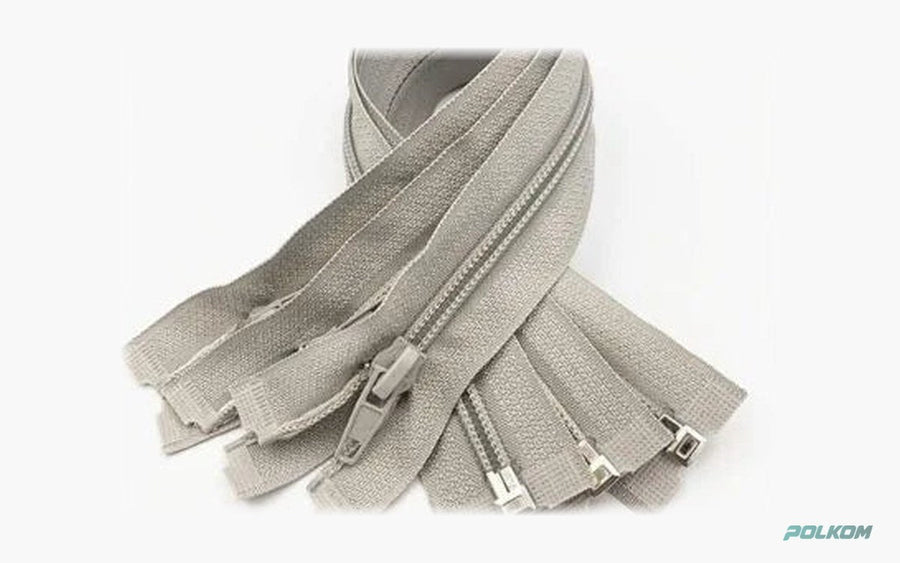
- Zip – with flame-resistant tape and metal teeth;
- Hook and loop fasteners and tapes – flame-resistant versions;
- Labels and badges – embroidered with aramid thread or made from suitable materials.
The most common standards for protective clothing testing are EN ISO 11612 (heat and flame), EN ISO 11611 (welding), and EN ISO 14116 (limited flame spread). Material testing methods include EN ISO 15025 and EN ISO 6941.
Polyester or aramid threads – how to choose
Ask yourself three questions. Is there a risk of direct flame, sparks, or molten metal? If yes – choose aramid. Is fire safety required without direct flame, for example in furniture? Then flame-retardant polyester may suffice. If there are no such requirements, ordinary core-spun polyester sewing threads are most suitable. The full range is available in the threads category.
Polkom – flame-resistant and technical threads manufacturer
Polkom is a manufacturer of accessories for fashion, footwear, bags, perfumes and cosmetics, packaging, and furniture accessories, based in Sofia with over 30 years of experience. We offer meta- and para-aramid threads, flame-retardant treated threads, technical and sewing threads with colour cards and samples. Send your application, thickness, and quantity via the inquiry form.