Manufacturer · Fashion & Home Accessories











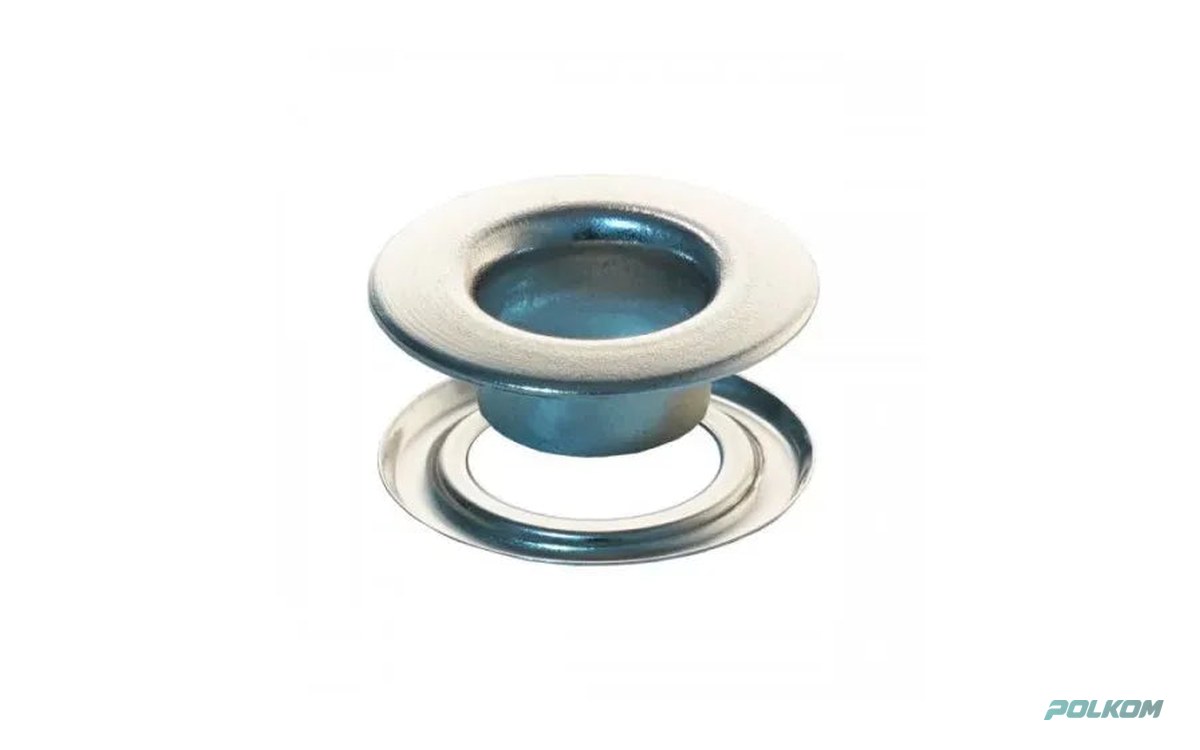
Flat eyelets have an even, flat flange that barely rises above the material and gives a clean, minimalist look. Standard eyelets have a rounded flange and many more shank variants – long shank, narrow, double-sided, with an inner ring. If you are looking for a discreet detail and a smooth surface, choose a flat eyelet; if the product is thick, multi-layered or heavily loaded, the standard series will give you a more precise solution.
Below we compare the two series from our catalogue – KP flat eyelets and KS standard eyelets – by profile, size and application, with a table of the matching numbers side by side.
Flat or standard eyelets – the main differences
| Criterion | KP flat eyelets | KS standard eyelets |
|---|---|---|
| Flange profile | flat, even | rounded, more voluminous |
| Outer diameter (D) | from 6.1 to 48 mm | from 7 to 48 mm |
| Number of articles | 13 | 28 |
| Types | standard and wide (KP-06) | standard, long shank, narrow, double-sided, with inner ring, domed, large hole |
| Construction | eyelet + metal or plastic washer | eyelet + metal or plastic washer |
| Materials | woven fabrics, denim, knitwear, leather, felt | woven fabrics, denim, knitwear, leather, faux leather, felt |
| Logo | yes, on selected sizes | yes, on selected sizes |
Matching numbers – a size comparison
For most numbers, the two series have a similar outer diameter and hole, so the choice is primarily visual. Sizes in mm: D – outer diameter, H – shank height, d – inner hole.
| No. | Flat KP | D / H / d | Standard KS | D / H / d |
|---|---|---|---|---|
| 17 | KP-02 | 7.5 / 4.65 / 3.5 | KS-01 | 7 / 4.6 / 3.6 |
| 2 | KP-03 | 8.5 / 5.3 / 4.44 | KS-03 | 8.5 / 5.15 / 4.7 |
| 3 | KP-04 | 9.7 / 5.45 / 4.9 | KS-05 | 9.5 / 5.5 / 5 |
| 4 | KP-05 | 11.7 / 6.7 / 4.9 | KS-08 | 11.6 / 5.2 / 5.9 |
| 5 | KP-07 | 15 / 5.4 / 7.38 | KS-12 | 15 / 6.4 / 7.68 |
| 28 | KP-10 | 25.05 / 6.9 / 13 | KS-21 | 25 / 7.15 / 13 |
| 31 | KP-12 | 31.51 / 7.85 / 17.2 | KS-25 | 31.3 / 7.96 / 17.3 |
| 34 | KP-13 | 48 / 7.3 / 27.6 | KS-27 | 46 / 9.7 / 27.7 |
Two differences deserve attention. At No. 4, the flat KP-05 has a higher shank (6.7 vs 5.2 mm) but a smaller hole (4.9 vs 5.9 mm) – it is better suited to a thicker material and a thinner tie. At No. 34, the standard KS-27 has a much higher shank (9.7 vs 7.3 mm) and passes through thicker layers.
When to choose a flat eyelet
- Minimalist design – shirts, blouses and denim shirts, where the metal accessories should be delicate.
- A smooth surface – items that touch the skin or are worn under other garments: bodysuits, baby and children’s clothing, knitwear.
- Very small holes – KP-01 (No. 16) with D 6.1 mm and a 3.2 mm hole is the smallest eyelet in our entire range, suitable for fine ties.
- Intermediate sizes – numbers 25 (KP-09, D 21.55 mm) and 29 (KP-11, D 28 mm) exist only in the flat series.
- A wider flange with a small hole – the wide KP-06 (D 13.1 mm, d 6 mm) distributes the load over a larger area.
When to choose a standard eyelet
- Thick and multi-layered areas – the long-shank eyelets KS-04 (H 6.1 mm) and KS-06 (H 5.89 mm) pass through more layers at a small diameter.
- Items that are also seen from the inside – the double-sided eyelets KS-07, KS-09 and KS-11 look the same on both sides.
- Heavy load – eyelets with an inner ring (for example KS-13, KS-22, KS-28) are stiffer and more stable under frequent use.
- A voluminous, classic look – the domed KS-16 (No. 24, D 19 mm) is an expressive accent on jackets and bags.
- A large hole at a medium diameter – KS-26 (No. 32) has a 21.25 mm hole at D 31.8 mm.
How D, H and d are measured is explained in the article on eyelet sizes.
How the two series look on the product
At the same outer diameter, a flat eyelet looks smaller and more “graphic”, because the flange is even and reflects light more uniformly. A standard eyelet has a rounded edge that casts a shadow and looks more voluminous and more classic. The difference is especially visible with finishes such as gold, black nickel colour and antique brass. If you are undecided, order samples from both series in the same finish and set them on your material.
Setting
Both series are set with a dedicated die for each size – on a hand press, a lever press or an automatic machine. The die for a flat eyelet is not interchangeable with the die for a standard eyelet of the same number, because the flange profile is different. When switching from one series to the other, also check the dies available in the factory. You will find more tips in the Setting section.
Logo and finishes
On selected sizes in both series, a logo, lettering or pattern can be embossed on the flange. The flat flange of KP gives an even surface on which the logo reads clearly, while the rounded flange of KS gives the relief more volume. See the options on the Branding page. The finishes are common to both series – from nickel colour to gold, copper and gunmetal, all nickel free. Eyelets are often combined with rivets and cords in the same finish.
Flat and standard eyelets from Polkom
Polkom is a Bulgarian manufacturer based in Sofia with over 30 years of experience. In our catalogue you will find all eyelets with exact dimensions, and to order also with your logo, with delivery throughout Europe. Send an inquiry with the product and the material – we will send you samples from both series.