Manufacturer · Fashion & Home Accessories












Contents
Horn buttons for coats are usually chosen larger – typically 36L–44L (about 23–28 mm) for the front and 24L–28L for sleeves, epaulettes and pockets. For heavy wool coats, thicker buttons with four holes or a shank sewn with high thread are preferred, while duffle coats use horn toggles. The colour is selected to match the fabric: dark horn for classic coats, marbled for camel hair and tweed.
Why horn suits coats
A coat is a garment bought for years. It is made from dense, expensive fabrics – wool, cashmere, camel hair, melton – and requires a button that balances the fabric’s weight. Natural horn has sufficient density and thickness, does not chip on impact, and its natural pattern adds warmth to the garment. Horn buttons are a classic choice for high-end coats – from men’s Chesterfields to women’s classic silhouettes.
Sizes of horn buttons for coats
| Model / Location | Size | Approx. Diameter |
|---|---|---|
| Classic single-breasted coat, front | 36L–40L | 23–25 mm |
| Double-breasted coat, front | 40L–44L | 25–28 mm |
| Large oversized coat, statement button | 48L and above | 30 mm and above |
| Epaulettes, belt, sleeve tabs | 24L–28L | 15–18 mm |
| Sleeve (decorative buttons) | 24L | 15 mm |
| Inner button (for double-breasted) | 28L–32L | 18–20 mm |
The table is a guideline; the final size depends on buttonhole length, lapel width and model proportions.
Shapes and construction
Four-hole buttons
The most classic option. Four holes distribute stress and allow secure sewing. Suitable for Chesterfields, double-breasted coats and classic women’s models.
Shank buttons
The shank lifts the button above the fabric, enabling it to pass through thick buttonholes without puckering. Suitable for very dense fabrics and decorative models with textured faces.
Toggles
Elongated horn buttons fastened with loops of cord or leather. Typical for duffle coats and sporty winter coats. Horn is the traditional material for toggles alongside wood.
Colour matching the fabric
- Black, dark blue, anthracite – black or dark brown horn, preferably with minimal veins.
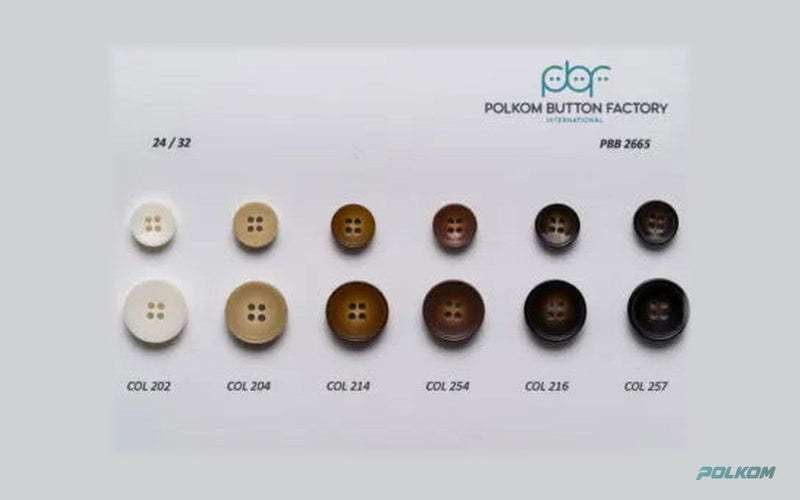
- Camel hair, beige, brown – marbled horn with honey and light areas.
- Tweed and herringbone – marbled horn with pronounced pattern, matte finish.
- Grey and mélange – grey-brown horn or dark horn with lighter veins.
- Coloured women’s coats – dark horn as neutral contrast or coloured horn with visible pattern.
Durability and sewing
Coat buttons endure heavy use: heavy fabric, frequent fastening with gloves, and friction from bags and belts. Therefore, the following sewing rules apply:
- Thread shank – height must match fabric thickness at the buttonhole; for melton and double-faced fabric, the shank is higher.
- Backing button – a small flat button on the inside absorbs stress and protects fabric from tearing.
- Strong thread – polyester or silk button thread, thicker than regular sewing thread.
- Securing – the shank is wrapped with thread and secured to prevent loosening.
Horn, imitation or other natural material?
Natural horn offers the most authentic feel, but each button is unique and the price is higher. For larger series requiring full uniformity, many brands choose imitation horn buttons. Another natural alternative is corozo, which can be dyed in a wider range of tones. The choice depends on the collection’s positioning and whether natural origin is part of the product story.
Care for coats with horn buttons
Coats are usually dry-cleaned, which horn tolerates well. Avoid ironing or steaming directly over buttons. If the coat gets heavily wet in rain, let it dry naturally away from radiators – horn is a natural keratin material and dislikes rapid drying. Periodically check the thread shank and reinforce it if needed before the button falls off.
Common mistakes in selection
- Too small a button that gets lost on the large coat surface.
- Thin button for very heavy fabric – bends and breaks.
- Sewing without a shank, causing fabric puckering and difficult fastening.
- Omitting the backing button on double-faced and heavy fabrics.
- Sets with buttons on the front that differ too much in tone.
Choosing a set for one coat
With natural horn, each button has its own pattern. To achieve a harmonious front, the set for one coat is selected by hand – buttons close in tone go on visible places, and those with more pronounced differences go on sleeves, epaulettes or inside. For serial orders, this selection is part of batch preparation.
Logo on coat buttons
Large coat buttons offer enough space for discreet laser-engraved logos or monograms. The engraving reveals a lighter tone of the material and looks natural. Brands often engrave only the large front buttons, leaving smaller sleeve and epaulette buttons plain.
Horn buttons for coats by Polkom
Polkom manufactures horn buttons from natural buffalo horn for coats and outerwear – in various sizes, shapes and finishes, with logo engraving options. We produce samples quickly, deliver across the EU and can sew buttons on request. Send us your model, sizes and fabric sample via the inquiry form; minimum order quantities depend on the item.
Share this article