Manufacturer · Fashion & Home Accessories












Anti-counterfeit labels combine several security features that are difficult to replicate simultaneously: a woven label with very fine details or metallic thread, a unique or QR code for verification, a holographic sticker or RFID chip in the hang tag, and a seal that prevents the label from being transferred to another product. No single element is foolproof – protection comes from the combination and the brand actively verifying the codes.
Why Counterfeits Start with the Label
Buyers and customs officers rarely examine the fabric closely. They focus on the neck label, hang tag, and metal accessories. That is why counterfeiters copy these first. A crude printed label, inaccurate font, or missing code is often the first sign that the item is not genuine. The more complex the label is to reproduce, the more expensive and risky the counterfeit becomes.
Anti-Counterfeit Labels: Security Features in Woven Labels
The woven label is an excellent carrier of security because copying it requires the same technology – jacquard loom, identical threads, and precise programming. Possible features include:
- High resolution (HD) – very fine threads allow microtext and thin lines that merge in cheap copies.
- Metallic thread – gold or silver thread in a small logo detail; difficult to imitate colour and shine precisely.
- Hidden element – a small letter, symbol or pattern deviation known only to the brand.
- Specific width, folding and edge finishing – a combination rarely exactly replicated by counterfeiters.
- Woven batch serial code – enables tracing which order the item belongs to.
See the options available for woven labels, including HD execution and metallic threads.
Labels with QR Codes and Unique Codes
Printed and hang tags can carry variable data – a different serial number or QR code for each item. The buyer scans the code and checks in the brand’s system whether it exists and if it has already been verified. If a code appears multiple times, it signals copying.
Key points for an effective system:
- Codes must be unique and unpredictable – not sequential numbers that are easy to guess.
- The database is maintained by the brand; the label is only the carrier.
- The verification page must be on the brand’s domain to prevent substitution.
- The QR code must be large and high-contrast enough to scan by phone.
A static QR code linking to the brand’s website is not protection – it can be copied in seconds. Protection comes from code uniqueness and verification.
Holograms and RFID Labels
A holographic sticker on the hang tag is a quick visible sign of authenticity, especially when the product passes through many intermediaries. It works best when it has an individual number and is destroyed if peeled off.
RFID labels contain a chip and antenna allowing contactless reading of a unique identifier. They are mainly used for inventory and logistics, but the chip’s unique number can also serve for authenticity verification. The chip is usually embedded in the cardboard hang tag or a separate textile label. Polkom does not manufacture RFID chips but produces the labels carrying them according to brand specifications.
Seals and Fasteners Against Label Swapping
A common fraud is not a full copy but swapping the label: an original hang tag is transferred onto a counterfeit or more expensive item. Label fasteners with logos solve this problem – they close once and cannot be reopened without cutting the cord. The branded fastener in the brand’s colour is an additional element counterfeiters must reproduce.
Branded Clothing Labels and Accessories as Protection
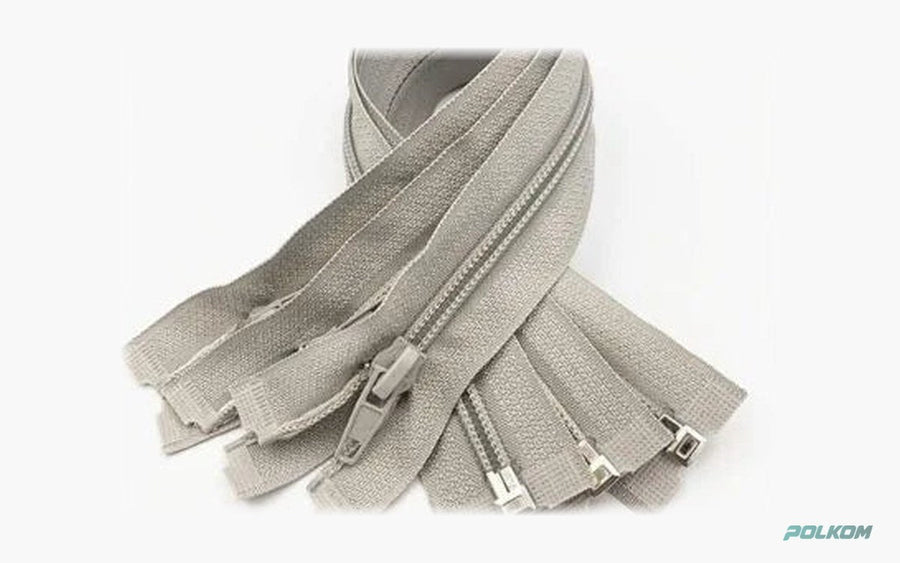
Protection does not end with the label. Metal accessories with embossed logos – buttons, zip sliders, plates, rivets – are made with moulds and are hard to copy precisely. When the logo appears in several places on the item, each with different technology, the counterfeit becomes noticeably more expensive. Some brands add hidden details in the lining or jacquard elastic with logo.
How Brands Verify Authenticity
| Level | Who Checks | Elements |
|---|---|---|
| Visible | Buyer | Hologram, QR code, woven label quality, fastener |
| Semi-hidden | Trade partners, customs | Microtext, metallic thread, specific folding, batch code |
| Hidden | Brand itself | Secret symbols, RFID identifier, comparison with reference samples |
Keep reference samples from every label order. When in doubt, comparing with the original is often the fastest check.
Common Mistakes in Brand Protection
- Relying on only one element, e.g. a hologram that can be freely bought.
- Sequential serial numbers that are easy to guess.
- No verification – codes are printed but scans are not monitored.
- Changing label design without documentation – own staff no longer know what is original.
- Different label versions in different factories, facilitating swapping.
Anti-Counterfeit Labels: Where to Start
- Assess the risk – which products are copied and where copies are sold.
- Choose at least one visible and one hidden element.
- Use high-detail woven logo labels for the main label.
- Add unique codes on the hang tag and seals against swapping.
- Document the specification and keep reference samples.
Polkom – Manufacturer of Labels and Accessories with Your Brand
Polkom is a manufacturer of accessories for fashion, footwear and bags, perfumes and cosmetics, packaging and furniture accessories, based in Sofia with over 30 years of experience. We produce woven labels in HD and with metallic threads, printed and cardboard labels with variable data and QR codes, logo fasteners and metal accessories with embossed logos. Browse all labels and send an inquiry via the contact form.