Manufacturer · Fashion & Home Accessories











Contents
The most common mistakes when ordering logo buttons are: a logo too detailed for the small size, inaccurately specified sizes, a material that cannot withstand the garment's care, a sample that is skipped or only glanced at, ordering in instalments, no spares and an incomplete inquiry. Each of them leads to delays, extra costs or buttons that do not look the way you expected.
Mistake 1: A logo designed for a screen, not for a button
A logo that looks great on the website often has thin lines, small text and gradients. On a button 12–15 mm in diameter these details merge or disappear.
How to avoid it: prepare a simplified, single-colour version of the logo specifically for the buttons. For the smallest sizes use only the mark or initials. Check legibility by printing the logo at actual size.
Mistake 2: Inaccurate sizes
"A medium button" or "like the one in the photo" is not a size. Buttons are measured in lignes (L) or millimetres, and 1L = 0.635 mm. A difference of 2–4 lignes looks small on paper, but on the garment it is immediately visible, and the button may not pass through the buttonhole.
How to avoid it: measure the button diameter with a calliper or send a sample garment. Check that the buttonhole length matches – it should be slightly larger than the diameter plus the thickness of the button.
Mistake 3: A material that does not suit the care
A beautiful wooden button on a garment that is industrially washed at a high temperature, or a metal button with a delicate patina on workwear – these are recipes for complaints.
How to avoid it: start from the care label. If the garment is washed often, polyester buttons are the most trouble-free. For dry-clean-only garments and more delicate care you have more freedom – for example corozo, wood or metal. Tell the manufacturer how the garment will be cared for.
Mistake 4: The sample is checked in a hurry
The sample is the last chance to change something without it being expensive. Often it is approved from a photo or looked at only from the front.
How to avoid it: check the sample against a list:
- legibility of the logo from the distance at which the garment is seen;
- centring and orientation relative to the holes;
- the tone of the button against the real fabric, in daylight;
- passing through the buttonhole and the feel when buttoning;
- the back of the button and the shank – whether they snag the fabric.
Sew the sample onto a piece of fabric and ask the machinist for an opinion too.
Mistake 5: Ordering in instalments
Brands sometimes order the buttons for one collection several times – first for the samples, then for the first batch, then for additional sizes. With natural materials and complex finishes, each new batch may have a slightly different tone, and a difference between two buttons on the same garment is unacceptable.
How to avoid it: order the entire quantity for the collection at once if possible. If not, keep the approved sample as a reference and ask for a comparison with it for each subsequent batch.
Mistake 6: No spares
Sewing always involves rejects – a button that broke during machine sewing, a defect, lost pieces. In addition, many brands attach a spare button to the garment.
How to avoid it: plan a reserve on top of the net quantity. Exactly how much depends on the type of sewing and on whether you supply a spare button with each garment. Discuss it with the sewing factory.
Mistake 7: An incomplete inquiry
An inquiry such as "How much do logo buttons cost?" cannot get an accurate answer. Several rounds of questions follow, and time passes.
How to avoid it: include in your first email:
- the logo in vector format;
- the type of garment and how it is cared for;
- the material or a photo of the desired style;
- the sizes and the quantity for each size;
- the colour of the button and of the fill;
- the required deadline and the delivery address.
Bonus: an underestimated lead time
Buttons are ordered last, but they must arrive first – before sewing begins. New styles and dies take time, and the sample may go through several corrections.
How to avoid it: include the buttons in the collection schedule from the design stage. Ask for a lead time for the sample and separately for the production run, and leave a buffer for corrections.
One more mistake: a logo on every button
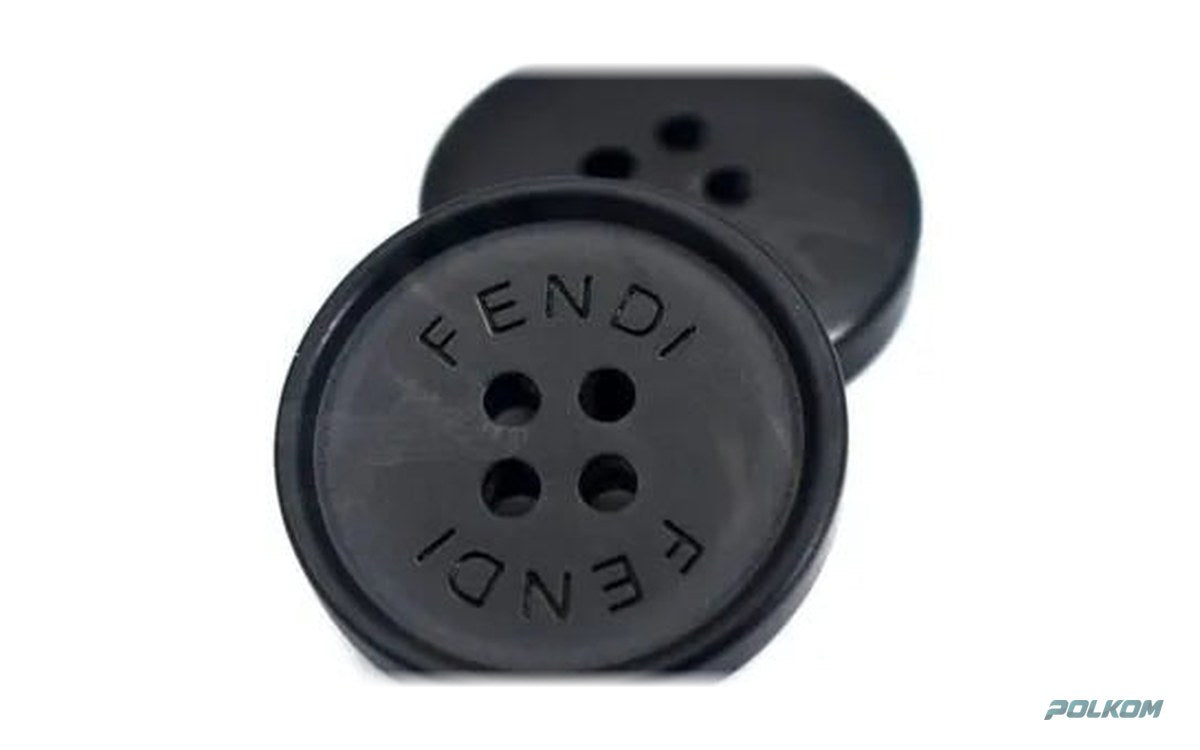
The temptation is for every button on the garment to carry the logo. This is not always a good decision. The inside buttons of a double-breasted jacket, the lining buttons and the spare buttons for trousers are not visible, and branding them only increases the cost. In addition, too many logos on one garment look obtrusive. Many brands put the logo only on the main front buttons and leave the small buttons plain or with a minimal mark. Think about which button the customer really sees and touches – that is where the logo adds the most value.
Short checklist for ordering logo buttons
| Check | Done? |
|---|---|
| Simplified logo for the small sizes | ☐ |
| Sizes in lignes or mm for each position | ☐ |
| Material suited to the washing | ☐ |
| Sample checked on the fabric | ☐ |
| Entire quantity in one order | ☐ |
| Reserve for rejects and spare buttons | ☐ |
Ordering without surprises with Polkom
Polkom is a Sofia-based manufacturer of accessories for fashion, furniture, footwear and bags with over 30 years of experience. We review your logo, suggest a suitable material and size and produce a sample of engraved buttons before series production. Send an inquiry – we will help you avoid these mistakes from the very first step.
Share this article